A $1\,kg$ block is being pushed against a wall by a force $F = 75\,N$ as shown in the Figure. The coefficient of friction is $0.25.$ The magnitude of acceleration of the block is ........ $m/s^2$

Medium
Download our app for free and get started
$\mathrm{F} \sin 37^{\circ}-\mathrm{mg}-\mu \mathrm{F} \cos 37^{\circ}=\mathrm{ma}$
$\Rightarrow \mathrm{a}=20 \mathrm{m} / \mathrm{s}^{2}$

Download our appand get started for free
Experience the future of education. Simply download our apps or reach out to us for more information. Let's shape the future of learning together!No signup needed.*
Similar Questions
- 1Starting from rest, a body slides down a $45^°$ inclined plane in twice the time it takes to slide down the same distance in the absence of friction. The coefficient of friction between the body and the inclined plane isView Solution
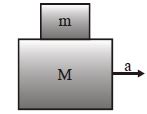
- 2A block of mass $m$ is placed on the top of another block of mass $M$ as shown in the figure. The coefficient of friction between them is $\mu $. What is the maximum acceleration with which the block $M$ may move so that m also moves along with it ?View Solution
- 3View SolutionA car is moving with uniform velocity on a rough horizontal road. Therefore, according to Newton's first law of motion
- 4A motorcycle is travelling on a curved track of radius $500\,m$. If the coefficient of friction between road and tyres is $0.5$, the speed avoiding skidding will be ....... $m/s$View Solution
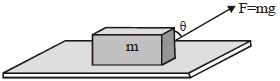
- 5A force $f$ is acting on a block of mass $m$. Coefficient of friction between block and surface is $\mu$. The block can be pulled along the surface if :-View Solution
- 6The maximum tension which an inextensible ring of mass $0.1\, kg/m$ can bear is $10\,N$. The maximum velocity in $m/s$ with which it can be rotated is ........ $m/s.$View Solution
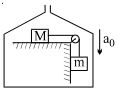
- 7In figure, two blocks $M$ and $m$ are tied together with an inextensible and light string. The mass $M$ is placed on a rough horizontal surface with coefficient of friction $\mu$ and the mass $m$ is hanging vertically against a smooth vertical wall. The pulley is frictionless. Imagine a situation in which the given arrangement is placed inside an elevator that can move only in the vertical direction and compare the situation with the case when it is placed on the ground. When the elevator accelerates downward with $a_0( < g)$, thenView Solution
- 8A motorcycle is going on an overbridge of radius $R$. The driver maintains a constant speed. As the motorcycle is ascending on the overbridge, the normal force on itView Solution
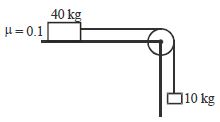
- 9For the given figure find acceleration of $40\, kg$ block ........ $m/s^2$View Solution
- 10A vehicle is moving with a velocity $v$ on a curved road of width $b$ and radius of curvature $R.$ For counteracting the centrifugal force on the vehicle, the difference in elevation required in between the outer and inner edges of the road isView Solution