A 4.5 cm needle is placed 12 cm away from a convex mirror of focal length 15 cm. Give the location of the image and the magnification. Describe what happens as the needle is moved farther from the mirror.
Exercise
Download our app for free and get started
Height of the needle, $h_1 = 4.5$ cm
Object distance, $u = – 12$ cm
Focal length of the convex mirror, $f = 15$ cm
Image distance $= v$
The value of v can be obtained using the mirror formula:
$\frac{1}{\text{f}}=\frac{1}{\text{v}}-\frac{1}{\text{u}}$
$\frac{1}{\text{u}}=\frac{1}{\text{v}}-\frac{1}{\text{f}}$
$=\frac{1}{-25}-\frac{1}{5}=\frac{-5-1}{25}=\frac{-6}{25}$
$\therefore \ \text{u}=-\frac{25}{6}=-4.167 \ \text{cm}$
$\frac{1}{\text{v}}=\frac{1}{\text{f}}-\frac{1}{\text{u}}$
$\frac{1}{\text{u}}+\frac{1}{\text{v}}=\frac{1}{\text{f}}$
$=\frac{1}{15}+\frac{1}{12}=\frac{4+5}{60}=\frac{9}{60}$
$\therefore \ \text{v}=\frac{60}{9}=6.7 \ \text{cm}$
Hence, the image of the needle is 6.7 cm away from the mirror. Also, it is on the other side of the mirror.
The image size is given by the magnification formula:
$\text{m}=\frac{\text{h}_2}{\text{h}_1}=-\frac{\text{v}}{\text{u}}$
$\therefore \ \text{h}_2=-\frac{\text{v}}{\text{u}}\times\text{h}_1$
$=\frac{-6.7}{-12}\times4.5=+2.5 \ \text{cm}$
Hence, magnification of the image, $\text{m}=\frac{\text{h}_2}{\text{h}_1}=\frac{2.5}{4.5}=0.56$
The height of the image is 2.5 cm. The positive sign indicates that the image is erect, virtual, and diminished.
If the needle is moved farther from the mirror, the image will also move away from the mirror, and the size of the image will reduce gradually.
Object distance, $u = – 12$ cm
Focal length of the convex mirror, $f = 15$ cm
Image distance $= v$
The value of v can be obtained using the mirror formula:
$\frac{1}{\text{f}}=\frac{1}{\text{v}}-\frac{1}{\text{u}}$
$\frac{1}{\text{u}}=\frac{1}{\text{v}}-\frac{1}{\text{f}}$
$=\frac{1}{-25}-\frac{1}{5}=\frac{-5-1}{25}=\frac{-6}{25}$
$\therefore \ \text{u}=-\frac{25}{6}=-4.167 \ \text{cm}$
$\frac{1}{\text{v}}=\frac{1}{\text{f}}-\frac{1}{\text{u}}$
$\frac{1}{\text{u}}+\frac{1}{\text{v}}=\frac{1}{\text{f}}$
$=\frac{1}{15}+\frac{1}{12}=\frac{4+5}{60}=\frac{9}{60}$
$\therefore \ \text{v}=\frac{60}{9}=6.7 \ \text{cm}$
Hence, the image of the needle is 6.7 cm away from the mirror. Also, it is on the other side of the mirror.
The image size is given by the magnification formula:
$\text{m}=\frac{\text{h}_2}{\text{h}_1}=-\frac{\text{v}}{\text{u}}$
$\therefore \ \text{h}_2=-\frac{\text{v}}{\text{u}}\times\text{h}_1$
$=\frac{-6.7}{-12}\times4.5=+2.5 \ \text{cm}$
Hence, magnification of the image, $\text{m}=\frac{\text{h}_2}{\text{h}_1}=\frac{2.5}{4.5}=0.56$
The height of the image is 2.5 cm. The positive sign indicates that the image is erect, virtual, and diminished.
If the needle is moved farther from the mirror, the image will also move away from the mirror, and the size of the image will reduce gradually.

Download our appand get started for free
Experience the future of education. Simply download our apps or reach out to us for more information. Let's shape the future of learning together!No signup needed.*
Similar Questions
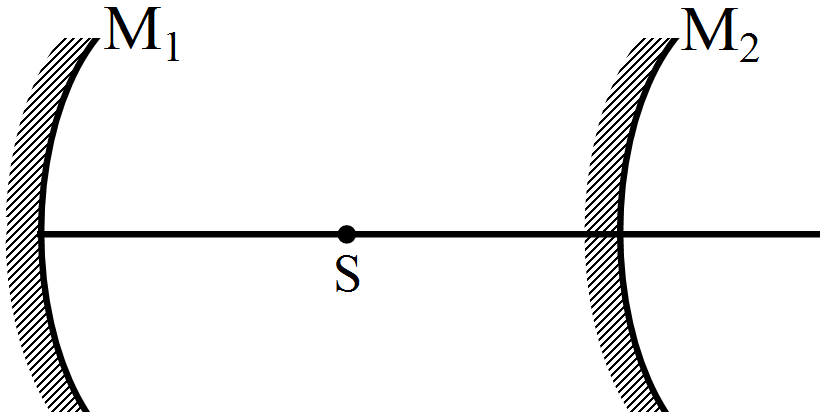
- 1A converging mirror $\mathrm{M}_1$, a point source S and a diverging mirror $\mathrm{M}_2$ are arranged as shown in figure. The source is placed at a distance of 30 cm from $\mathrm{M}_1$. The focal length of each of the mirrors is 20 cm . Consider only the images formed by a maximum of two reflections. It is found that one image is formed on the source itself.View Solution
- Find the distance between the two mirrors.
- Find the location of the image formed by the single reflection from $\mathrm{M}_2$.
- 2With the help of a ray diagram, show the formation of image of a point object due to refraction of light at a spherical surface separating two media of refractive indices $n_1$ and $n_2 (n_2 > n_1)$ respectively. Using this diagram, derive the relation.View Solution
$\frac{\text{n}_2}{\text{v}}-\frac{\text{n}_1}{\text{u}}=\frac{\text{n}_1-\text{n}_2}{\text{R}}$
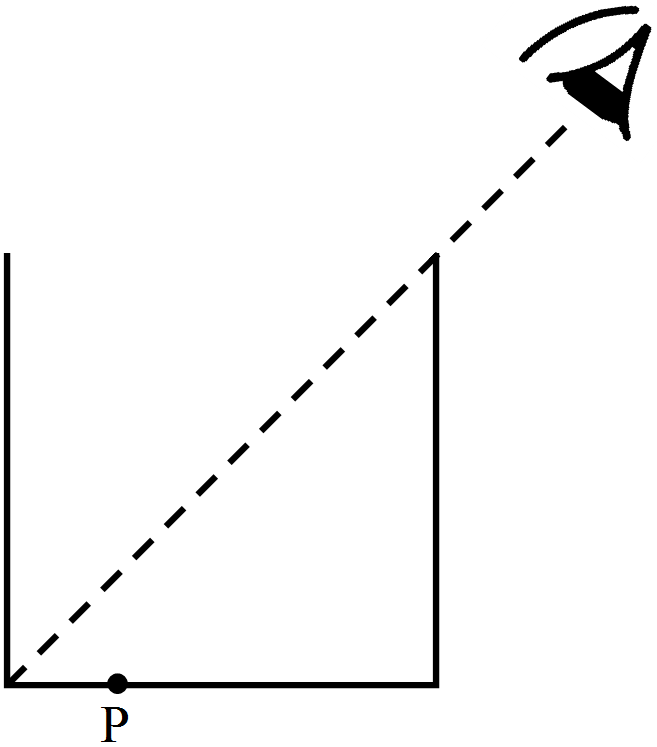
Write the sign conventions used. What happens to the focal length of convex lens when it is immersed in water? - 3View SolutionA cylindrical vessel, whose diameter and height both are equal to 30cm, is placed on a horizontal surface and a small particle P is placed in it at a distance of 5.0cm from the centre. An eye is placed at a position such that the edge of the bottom is just visible. The particle P is in the plane of drawing. Up to what minimum height should water be poured in the vessel to make the particle P visible?
- 4View Solution
- For a ray of light travelling from a denser medium of refractive index $n_1$ to a rarer medium of refractive index $n_2$ prove that $\frac{\text{n}_{2}}{\text{n}_{1}} = \sin \text{i}_{c} ,$ where $i_c$ is the critical angle of incidence for the media.
- Explain with the help of a diagram, how the above principle is used for transmission of video signals using optical fibres.
- 5A right angled prism of refractive index n has a plane of refractive index $n_1$ so that $n_1 < n$, cemented to its diagonal face. The assembly is in air. A ray is incident on AB.View Solution
- Calculate the angle of incidence at AB for which the ray strikes the diagonal face at the critical angle.
- Assuming n = 1.352, calculate the angle of incidence at AB for which the refracted ray passes through the diagonal face undeviated.
- 6A gravitational lens may be assumed to have a varying width of the formView Solution
$\text{w}(\text{b})=\text{k}_1\text{ In }\Big(\frac{\text{k}_2}{\text{b}}\Big)\ \ \text{b}_\text{min}<\text{b}<\text{b}_\text{max}$
$=\text{k}_1\text{ In }\Big(\frac{\text{k}_2}{\text{b}_\text{min}}\Big)\ \ \text{b}<\text{b}_\text{min}$
Show that an observer will see an image of a point object as a ring about the center of the lens with an angular radius
$\beta=\sqrt{\frac{(\text{n}-1)\text{k}_1\frac{\text{u}}{\text{v}}}{\text{u}+\text{v}}}$ - 7Show that for a material with refractive index $\mu\geq\sqrt{2}$, light incident at any angle shall be guided along a length perpendicular to the incident face.View Solution
- 8View SolutionWill the focal length of a lens for red light be more, same or less than that for blue light?
- 9View SolutionOne day Chetan’s mother developed a severe stomach ache all of a sudden. She was rushed to the doctor who suggested for an immediate endoscopy test and gave an estimate of expenditure for the same. Chetan immediately contacted his class teacher and shared the information with her. The class teacher arranged for the money and rushed to the hospital. On realising that Chetan belonged to a below average income group family, even the doctor offered concession for the test fee. The test was conducted successfully.
Answer the following questions based on the above information:- Which principle in optics is made use of in endoscopy?
- Briefly explain the values reflected in the action taken by the teacher.
- In what way do you appreciate the response of the doctor on the given situation?
- 10View SolutionA compound microscope consists of an objective lens of focal length 2.0 cm and an eyepiece of focal length 6.25 cm separated by a distance of 15 cm. How far from the objective should an object be placed in order to obtain the final image at (a) the least distance of distinct vision (25 cm), and (b) at infinity? What is the magnifying power of the microscope in each case?