A right angled prism of refractive index n has a plane of refractive index $n_1$ so that $n_1 < n$, cemented to its diagonal face. The assembly is in air. A ray is incident on AB.
- Calculate the angle of incidence at AB for which the ray strikes the diagonal face at the critical angle.
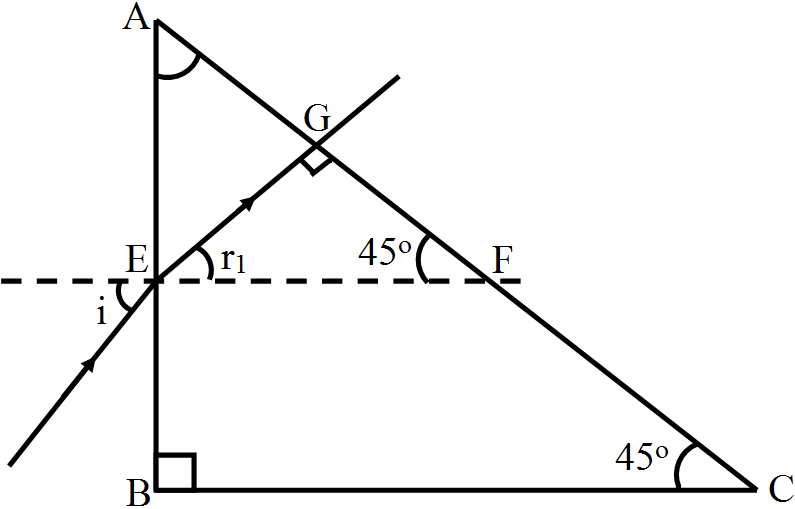
- Assuming n = 1.352, calculate the angle of incidence at AB for which the refracted ray passes through the diagonal face undeviated.
Download our app for free and get started
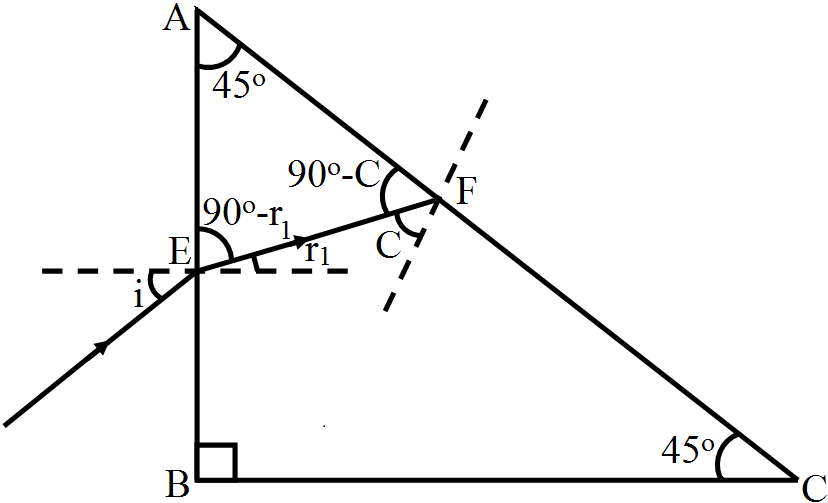
- $\sin \text{C}=\frac{\text{n}_1}{\text{n}_2}$
$(90-\text{r}_1)+45+(9-\text{C})=180$
$\Rightarrow\text{r}_1=45-\text{C}$
$\frac{\sin\text{i}}{\sin\text{r}_1}=\text{n}\sin\text{i}=\text{n}\sin\text{r}_1$
$=\text{n}\sin(45-\text{C})$
$=\text{n}(\sin45\cos\text{C}-\cos45\sin\text{C})$
$=\frac{\text{n}}{\sqrt{2}}(\cos\text{C}-\sin\text{C})$
$=\frac{\text{n}}{\sqrt{2}}\Big(\sqrt{[1-\sin^2\text{C}}]\Big)-\sin\text{C}$
$=\frac{1}{\sqrt{2}}\Big(\text{n}^2-\text{n}^2_1\Big)-\text{n}-1$
$\text{i}=\sin^{-1}\Big(\frac{1}{\sqrt{2}}\sqrt{\text{n}^2-\text{n}^2_1-\text{n}_2}\Big)$
- From $\triangle\text{ ABC}$
$\Rightarrow\text{r}_1=45^\circ\frac{\sin\text{r}}{\sin\text{r}_1}$
$\sin\text{i}=\text{n}\sin\text{r}_1$
$=1.352\sin45=0.956$
$\text{i}=\sin^-1(0.956)=72.58$

Download our appand get started for free
Experience the future of education. Simply download our apps or reach out to us for more information. Let's shape the future of learning together!No signup needed.*
Similar Questions
- 1View SolutionDefine magnifying power of a telescope. Write its expression.
A small telescope has an objective lens of focal length 150 cm and an eye piece of focal length 5 cm. If this telescope is used to view a 100m high tower 3 km away, find the height of the final image when it is formed 25 cm away from the eye piece. - 2View SolutionThe separation between the objective and the eyepiece of a compound microscope can be adjusted between 9.8cm to 11.8cm. If the focal lengths of the objective and the eyepiece are 1.0cm and 6cm respectively, find the range of the magnifying power if the image is always needed at 24cm from the eye.
- 3A hemispherical portion of the surface of a solid glass sphere $(\mu=1.5)$ of radius r is silvered to make the inner side reflecting. An object is placed on the axis of the hemisphere at a distance 3r from the centre of the sphere. The light from the object is refracted at the unsilvered part, then reflected from the silvered part and again refracted at the unsilvered part. Locate the final image formed.View Solution
- 4View SolutionA particle is moving at a constant speed V from a large distance towards a concave mirror of radius R along its principal axis. Find the speed of the image formed by the mirror as a function of the distance x of the particle from the mirror.
- 5View SolutionFigure shows a plane mirror M placed at a distance of 10cm from a concave lens L. A point object is placed at a distance of 60cm from the lens. The image formed due to refraction by the lens and reflection by the mirror is 30cm behind the mirror. What is the focal length of this lens?
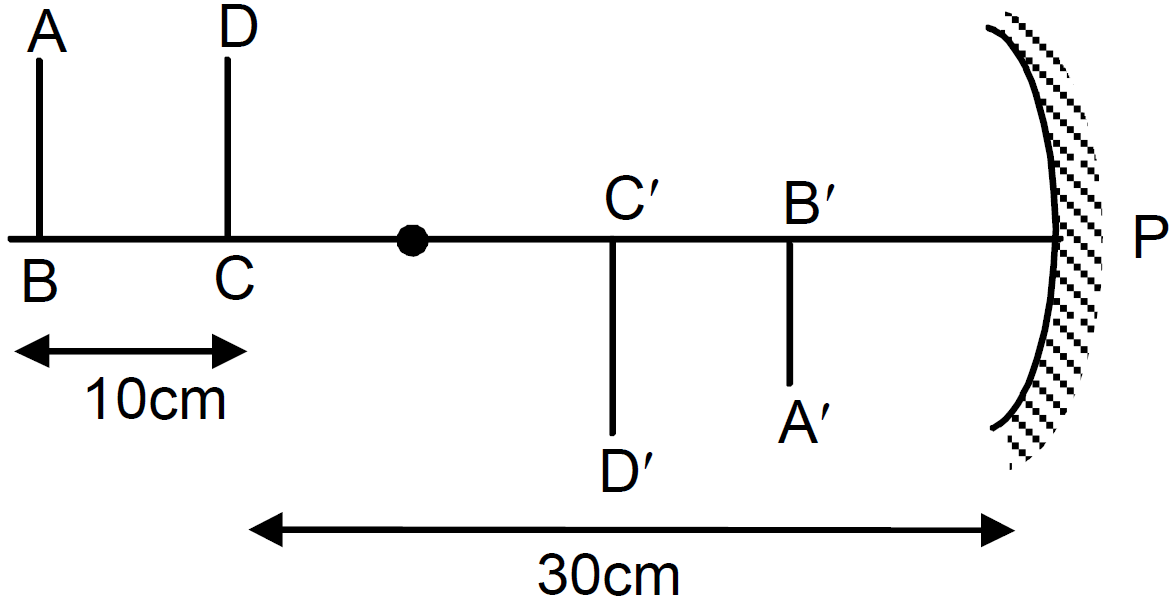
- 6View SolutionA U-shaped wire is placed before a concave mirror having radius of curvature 20cm. Find the total length of the image.
- 7View Solution
- Draw a labelled ray diagram to obtain the real image formed by an astronomical telescope in normal adjustment position. Defineits magnifying power.
- You are given three lenses of power 0.5 D, 4 D and 10 D to design a telescope.
- Which lenses should he used as objective and eyepiece? Justify your answer.
- Why is the aperture of the objective preferred to be large?
- 8With the help of a ray diagram, show the formation of image of a point object due to refraction of light at a spherical surface separating two media of refractive indices $n_1$ and $n_2 (n_2 > n_1)$ respectively. Using this diagram, derive the relation.View Solution
$\frac{\text{n}_2}{\text{v}}-\frac{\text{n}_1}{\text{u}}=\frac{\text{n}_1-\text{n}_2}{\text{R}}$
Write the sign conventions used. What happens to the focal length of convex lens when it is immersed in water? - 9View Solution
- Draw a labelled ray diagram to obtain the real image formed by an astronomical telescope in normal adjustment position. Define its magnifying power.
- You are given three lenses of power 0.5 D, 4 D and 10 D to design a telescope:
- Which lenses should he used as objective and eyepiece? Justify your answer.
- Why is the aperture of the objective preferred to be large?
- 10View SolutionA concave mirror forms an image of 20cm high object on a screen placed 5.0m away from the mirror. The height of the image is 50cm. Find the focal length of the mirror and the distance between the mirror and the object.