Will the focal length of a lens for red light be more, same or less than that for blue light?
Download our app for free and get started
Key concept: The refractive index depends on colour of light of wavelength of light.
Cauchy's equation: $\mu=\text{A}+\frac{\text{B}}{\lambda_2}+\frac{\text{C}}{\lambda^4}+\ ....$
As $\lambda_\text{red}>\lambda_\text{blue}\text{ hence }\mu_\text{red}<\mu_\text{blue}$
Hence parallel beams of light incidnt on a lens will be bent more towards the axis for blue light compared to red.
By lens maker's formula,
$\frac{1}{\text{f}}=(\mu-1)\Big(\frac{1}{\text{R}_1}-\frac{1}{\text{R}_2}\Big)$
The refractive index for red light is less than that for blue light, $\mu_\text{red}<\mu_\text{blue}$
Hence $\frac{1}{\text{f}_\text{red}}<\frac{1}{\text{f}_\text{blue}}\Rightarrow\ \text{f}_\text{red}>\text{f}_\text{blue}$
Thus, the focal length for red light will ne greater than that for blue light.
Cauchy's equation: $\mu=\text{A}+\frac{\text{B}}{\lambda_2}+\frac{\text{C}}{\lambda^4}+\ ....$
As $\lambda_\text{red}>\lambda_\text{blue}\text{ hence }\mu_\text{red}<\mu_\text{blue}$
Hence parallel beams of light incidnt on a lens will be bent more towards the axis for blue light compared to red.
By lens maker's formula,
$\frac{1}{\text{f}}=(\mu-1)\Big(\frac{1}{\text{R}_1}-\frac{1}{\text{R}_2}\Big)$
The refractive index for red light is less than that for blue light, $\mu_\text{red}<\mu_\text{blue}$
Hence $\frac{1}{\text{f}_\text{red}}<\frac{1}{\text{f}_\text{blue}}\Rightarrow\ \text{f}_\text{red}>\text{f}_\text{blue}$
Thus, the focal length for red light will ne greater than that for blue light.

Download our appand get started for free
Experience the future of education. Simply download our apps or reach out to us for more information. Let's shape the future of learning together!No signup needed.*
Similar Questions
- 1View Solution
- Draw a ray diagram to show refraction of a ray of monochromatic light passing through a glass prism.
- Explain briefly how the phenomenon of total internal reflection is used in fibre optics.
- 2View SolutionOne day Chetan’s mother developed a severe stomach ache all of a sudden. She was rushed to the doctor who suggested for an immediate endoscopy test and gave an estimate of expenditure for the same. Chetan immediately contacted his class teacher and shared the information with her. The class teacher arranged for the money and rushed to the hospital. On realising that Chetan belonged to a below average income group family, even the doctor offered concession for the test fee. The test was conducted successfully.
Answer the following questions based on the above information:- Which principle in optics is made use of in endoscopy?
- Briefly explain the values reflected in the action taken by the teacher.
- In what way do you appreciate the response of the doctor on the given situation?
- 3Derive the lens formula, $\frac{1}{\text{f}} = \frac{1}{\text{v}} - \frac{1}{\text{u}}$ for a concave lens, using the necessary ray diagram.View Solution
Two lenses of powers 10 D and – 5 D are placed in contact.- Calculate the power of the new lens.
- Where should an object be held from the lens, so as to obtain a virtual image of magnification 2?
- 4View SolutionA small object is placed at the centre of the bottom of a cylindrical vessel of radius 3cm and height 4cm filled completely with water. Consider the ray leaving the vessel through a corner. Suppose this ray and the ray along the axis of the vessel are used to trace the image. Find the apparent depth of the image and the ratio of real depth to the apparent depth under the assumptions taken. Refractive index of water = 1.33
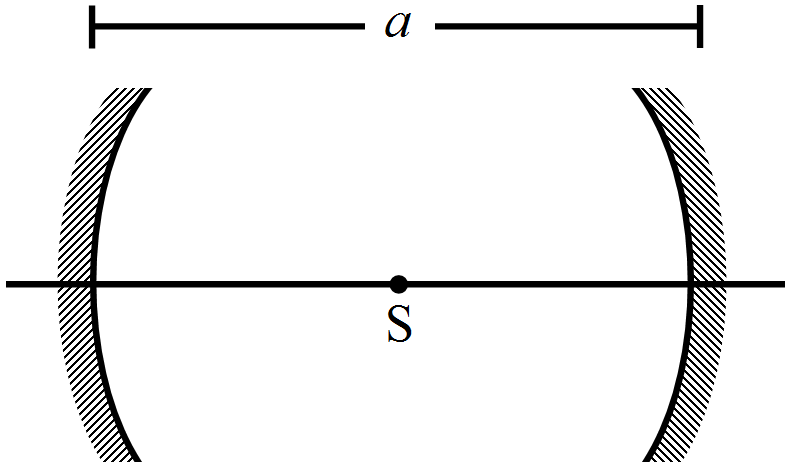
- 5View SolutionA point source S is placed midway between two converging mirrors having equal focal length f. Find the values of d for which only one image is formed.
- 6View SolutionA lady uses +1.5D glasses to have normal vision from 25cm onwards. She uses a 20D lens as a simple microscope to see an object. Find the maximum magnifying power if she uses then microscope
- Together with her glass
- Without the glass. Do the answers suggest that an object can be more clearly seen through a microscope without using the correcting glasses?
- 7A card sheet divided into squares each of size $1\ mm^2$ is being viewed at a distance of 9 cm through a magnifying glass (a converging lens of focal length 9 cm) held close to the eye.View Solution
- What is the magnification produced by the lens? How much is the area of each square in the virtual image?
- What is the angular magnification (magnifying power) of the lens?
- Is the magnification in (a) equal to the magnifying power in (b)? Explain.
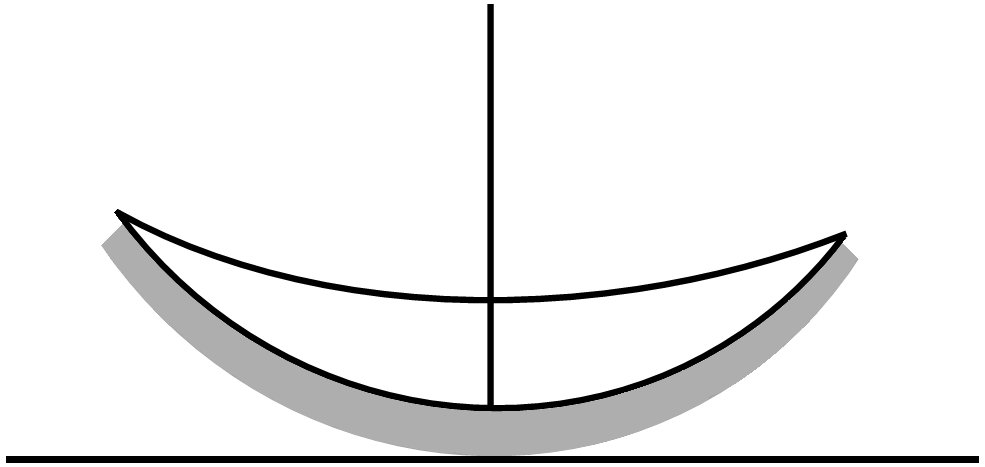
- 8The convex surface of a thin concavo-convex lens of glass of refractive index 1.5 has a radius of curvature 20cm. The concave surface has a radius of curvature 60cm. The convex side is silvered and placed on a horizontal surface as shown in figure.View Solution
- Where should a pin be placed on the axis so that its image is formed at the same place?
- If the concave part is filled with water $\Big(\mu=\frac{4}{3}\Big),$ find the distance through which the pin should be moved so that the image of the pin again coincides with the pin.
- 9View SolutionLenses are constructed by a material of refractive index 1.50. The magnitude of the radii of curvature are 20cm and 30cm. Find the focal lengths of the possible lenses with the above specifications.
- 10A point object 'O' is kept in a medium of refractive index $n_1$ in front of a convex spherical surface of radius of curvature R which separates the second medium of refractive index $n_2$ from the first one, as shown in the figure. Draw the ray diagram showing the image formation and deduce the relationship between the object distance and the image distance in terms of $n_1, n_2$ and R.View Solution
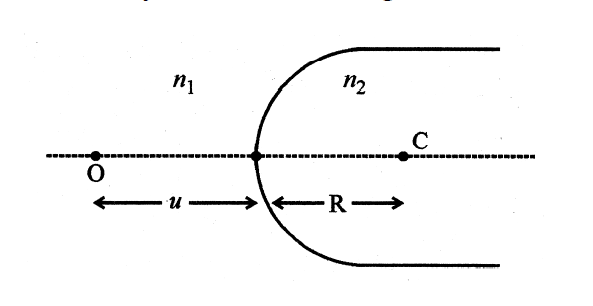
- hen the image formed above acts as a virtual object for concave spherical, surface separating the medium $n_2$ from $n_1 (n_2> n_1),$ draw this ray diagram and write the similar (similar to (a) relation. Hence obtain the expression for the lens maker's formula.