A ball is kept at a height h above the surface of a heavy transparent sphere made of a material of refractive index $\mu.$ The radius of the sphere is R. At t = 0, the ball is dropped to fall normally on the sphere. Find the speed of the image formed as a function of time for $\text{t}<\sqrt{\frac{2\text{h}}{\text{g}}}.$ Consider only the image by a single refraction.
Download our app for free and get started
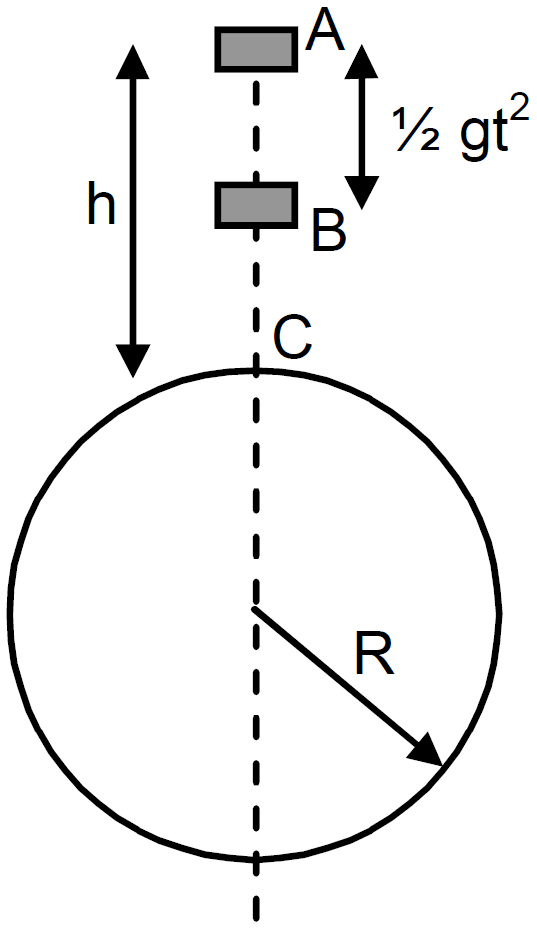
Let us assume that it has taken time ‘t’ from A to B.
$\therefore \ \text{AB}=\frac{1}{2}\text{gt}^2$
$\therefore \ \text{BC}= \text{h}-\frac{1}{2}\text{gt}^2$
This is the distance of the object from the lens at any time ‘t’.
Here, $\text{u}=-\Big(\text{h}-\frac{1}{2}\text{gt}^2\Big)$
$\mu_2=\mu$ (given) and $\mu_1=\text{i}$ (air)
So, $\Rightarrow\frac{\mu}{\text{v}}=\frac{1}{-\Big(\text{h}-\frac{1}{2}\text{gt}^2\Big)}=\frac{\mu-1}{\text{R}}$
$\Rightarrow\frac{\mu}{\text{v}}=\frac{\mu-1}{\text{R}}=\frac{1}{\Big(\text{h}-\frac{1}{2}\text{gt}^2\Big)}=\frac{(\mu-1)\Big(\text{h}-\frac{1}{2}\text{gt}^2\Big)-\text{R}}{\text{R}\Big(\text{h}-\frac{1}{2}\text{gt}^2\Big)}$
So, v = image distance at any time ‘t $=\frac{\mu\text{R}\Big(\text{h}-\frac{1}{2}\text{gt}^2\Big)}{(\mu-1)\Big(\text{h}-\frac{1}{2}\text{gt}^2\Big)-\text{R}}$
So, velocity of the image $=\text{V}=\frac{\text{dv}}{\text{dt}}=\frac{\text{d}}{\text{dt}}\begin{bmatrix}\frac{\mu\text{R}\Big(\text{h}-\frac{1}{2}\text{gt}^2\Big)}{(\mu-1)\Big(\text{h}-\frac{1}{2}\text{gt}^2\Big)-\text{R}} \end{bmatrix}=\frac{\mu\text{R}^2\text{gt}}{(\mu-1)\Big(\text{h}-\frac{1}{2}\text{gt}^2\Big)-\text{R}}$ (can be found out).

Download our appand get started for free
Experience the future of education. Simply download our apps or reach out to us for more information. Let's shape the future of learning together!No signup needed.*
Similar Questions
- 1View Solution
- Draw a ray diagram to show the image formation by a combination of two thin convex lenses in contact. Obtain the expression for the power of this combination in terms of the focal lengths of the lenses.
- A ray of light passing from air through an equilateral glass prism undergoes minimum deviation when the angle of incidence is $\frac{3}{4}^{th}$ of the angle of prism. Calculate the speed of light in the prism.
- 2View SolutionA point object is placed at a distance of 15cm from a convex lens. The image is formed on the other side at a distance of 30cm from the lens. When a concave lens is placed in contact with the convex lens, the image shifts away further by 30cm. Calculate the focal lengths of the two lenses.
- 3View SolutionA Cassegrain telescope uses two mirrors. Such a telescope is built with the mirrors 20 mm apart. If the radius of curvature of the large mirror is 220 mm and the small mirror is 140 mm, where will the final image of an object at infinity be?
- 4The refractive index of a material $M_1$ changes by 0.014 and that of another material $M_2$ changes by 0.024 as the colour of the light is changed from red to violet. Two thin prisms one made of $M_1(A = 5.3^\circ)$ and other made of $M_2(A = 3.7^\circ)$ are combined with their refracting angles oppositely directed.View Solution
- Find the angular dispersion produced by the combination.
- The prisms are now combined with their refracting angles similarly directed. Find the angular dispersion produced by the combination.
- 5View Solution
- An object is placed in front of a concave mirror. It is observed that a virtual image is formed. Draw the ray diagram to show the image formation and hence derive the mirror equation $\frac{1}{\text{f}}=\frac{1}{\text{u}}+\frac{1}{\text{v}}.$
- An object is placed 30cm in front of a plano-convex lens with its spherical surface of radius of curvature 20cm. If the refractive index of the material of the lens is 1.5, find the position and nature of the image formed.
- 6Two concave mirrors of equal radii of curvature R are fixed on a stand facing opposite directions. The whole system has a mass m and is kept on a frictionless horizontal table.View Solution
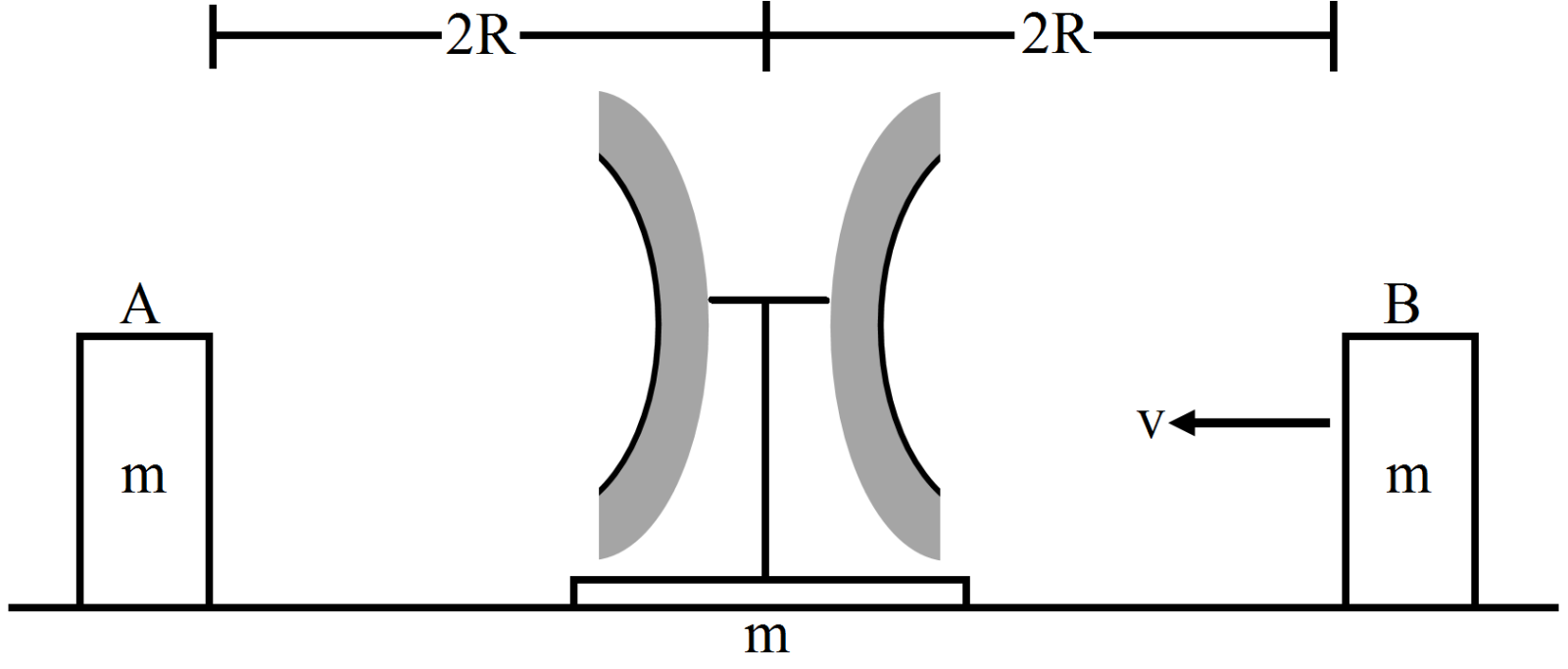
Two blocks A and B, each of mass m, are placed on the two sides of the stand. At t = 0, the separation between A and the mirrors is 2 R and also the separation between B and the mirrors is 2 R. The block B moves towards the mirror at a speed v. All collisions which take place are elastic. Taking the original position of the mirrors-stand system to be x = 0 and X-axis along AB, find the position of the images of A and B at t =- $\frac{\text{R}}{\text{v}}$
- $\frac{3\text{R}}{\text{v}}$
- $\frac{5\text{R}}{\text{v}}$
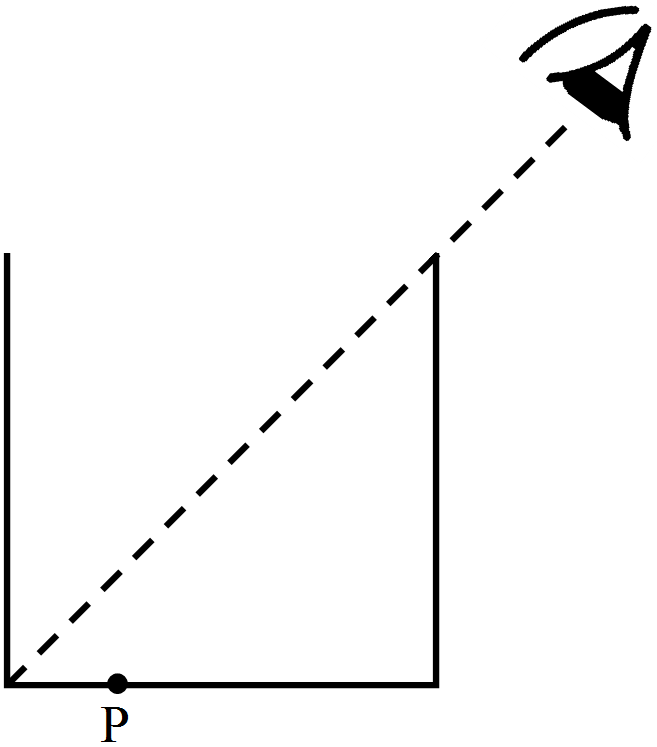
- 7View SolutionA cylindrical vessel, whose diameter and height both are equal to 30cm, is placed on a horizontal surface and a small particle P is placed in it at a distance of 5.0cm from the centre. An eye is placed at a position such that the edge of the bottom is just visible. The particle P is in the plane of drawing. Up to what minimum height should water be poured in the vessel to make the particle P visible?
- 8View SolutionDefine magnifying power of a telescope. Write its expression.
A small telescope has an objective lens of focal length 150 cm and an eye piece of focal length 5 cm. If this telescope is used to view a 100m high tower 3 km away, find the height of the final image when it is formed 25 cm away from the eye piece. - 9A card sheet divided into squares each of size $1\ mm^2$ is being viewed at a distance of 9 cm through a magnifying glass (a converging lens of focal length 9 cm) held close to the eye.View Solution
- What is the magnification produced by the lens? How much is the area of each square in the virtual image?
- What is the angular magnification (magnifying power) of the lens?
- Is the magnification in (a) equal to the magnifying power in (b)? Explain.
- 10View SolutionA compound microscope consists of an objective of focal length 1cm and an eyepiece of focal length 5cm. An object is placed at a distance of 0.5cm from the objective. What should be the separation between the lenses so that the microscope projects an inverted real image of the object on a screen 30cm behind the eyepiece?