A battery of emf 10 V and internal resistance $3\ \Omega$ is connected to a resistor. If the current in the circuit is 0.5 A, what is the resistance of the resistor? What is the terminal voltage of the battery when the circuit is closed?
Exercise
Download our app for free and get started
Given,
EMF of battery, $\varepsilon=10\ \text{V}$
Internal resistance of battery, $\text{r}=3\ \Omega$
Current flowing in the circuit, $\text{I}=0.5\text{A}$
Using the forlmula $\text{I}=\frac{\varepsilon}{\text{R}+\text{r}}$
$\text{or}\ \ \text{R}=\frac{\varepsilon}{\text{I}}-\text{r}$
where, R is the external resistance.
$\therefore\ \ \text{R}=\frac{10}{0.5}-3=17\ \Omega$ is the required resistance.
Terminal voltage,
$\text{V}=\text{IR}$
$=0.5\times17$
$=8.5\ \text{V}$
EMF of battery, $\varepsilon=10\ \text{V}$
Internal resistance of battery, $\text{r}=3\ \Omega$
Current flowing in the circuit, $\text{I}=0.5\text{A}$
Using the forlmula $\text{I}=\frac{\varepsilon}{\text{R}+\text{r}}$
$\text{or}\ \ \text{R}=\frac{\varepsilon}{\text{I}}-\text{r}$
where, R is the external resistance.
$\therefore\ \ \text{R}=\frac{10}{0.5}-3=17\ \Omega$ is the required resistance.
Terminal voltage,
$\text{V}=\text{IR}$
$=0.5\times17$
$=8.5\ \text{V}$

Download our appand get started for free
Experience the future of education. Simply download our apps or reach out to us for more information. Let's shape the future of learning together!No signup needed.*
Similar Questions
- 1View SolutionAnswer the following:
- Why are the connections between the resistors in a meter bridge made of thick copper strips?
- Why is it generally preferred to obtain the balance point in the middle of the meter bridge wire?
- Which material is used for the meter bridge wire and why?
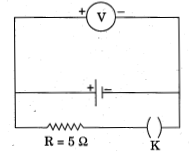
- 2View SolutionWrite any two factors on which internal resistance of a cell depends. The reading on a high resistance voltmeter, when a cell is connected across it, is 2.2 V. When the terminals of the cell are also connected to a resistance of 5 Ω as shown in the circuit, the voltmeter reading drops to 1.8 V. Find the internal resistance of the cell.
- 3View SolutionIs the motion of a charge across junction momentum conserving? Why or why not?
- 4A wire of length 1m and radius 0.1mm has a resistance of $100\Omega.$ Find the resistivity of the material.View Solution
- 5View SolutionA cell of emf E and internal resistance r is connected across an external resistance R. Plot a graph showing the variation of P.D. across R, verses R.
- 6View SolutionHow many time constants will elapse before the power delivered by a battery drops to half of its maximum value in an RC circuit?
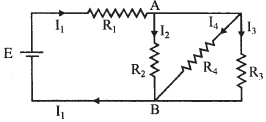
- 7In the circuit shown, $R_1 = 4\Omega , R_2 = R_3 = 15\Omega , R_4 = 30\Omega$ and $E = 10V.$ Calculate. The equivalent resistance of the circuit and the current in each resistor.View Solution
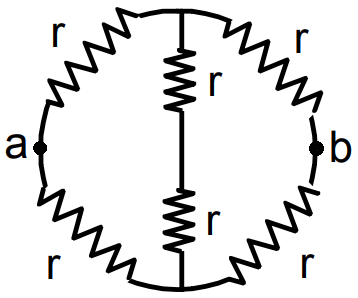
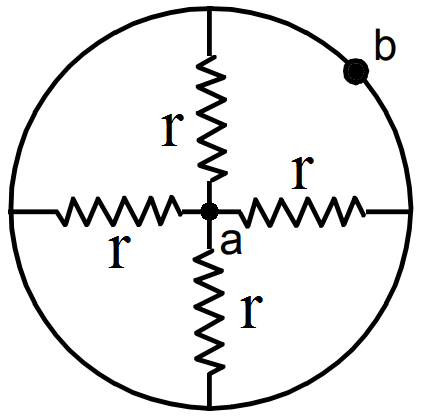
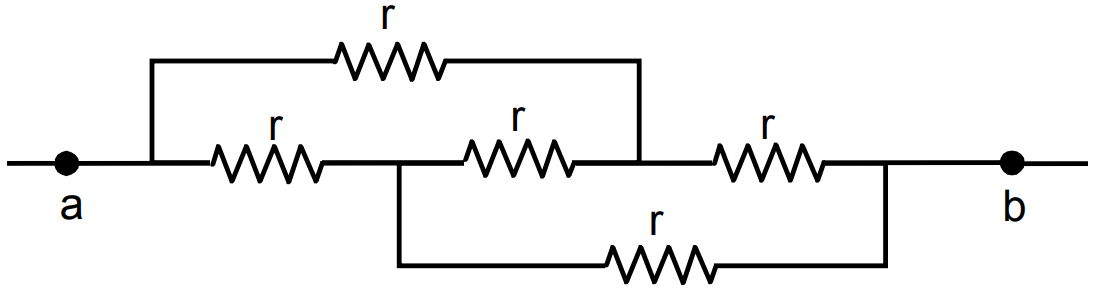
- 8View SolutionFind the equivalent resistances of the networks shown in the figure. between the points a and b.
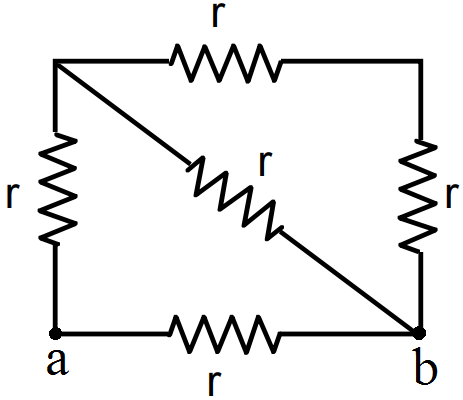
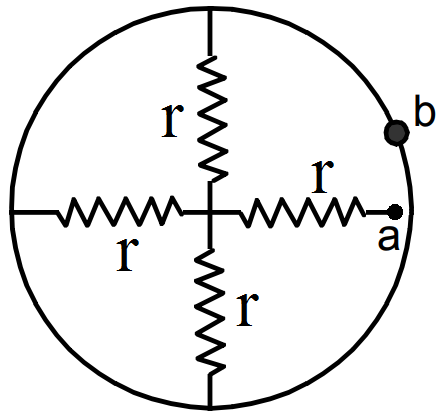
- 9A storage battery of emf $8.0 V$ and internal resistance $0.5\ \Omega$ is being charged by a $120 V\ dc$ supply using a series resistor of $15.5\ \Omega.$ What is the terminal voltage of the battery during charging? What is the purpose of having a series resistor in the charging circuit?View Solution
- 10View SolutionDefine relaxation time of the free electrons drifting in a conductor. How is it related to the drift velocity of free electrons? Use this relation to deduce the expression for the electrical resistivity of the material.