In the circuit shown, $R_1 = 4\Omega , R_2 = R_3 = 15\Omega , R_4 = 30\Omega$ and $E = 10V.$ Calculate. The equivalent resistance of the circuit and the current in each resistor.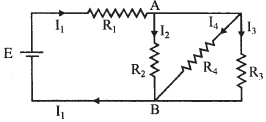
CBSE DELHI - SET 1 2011
Download our app for free and get started
$R_2, R_3$ and $R_4$ are in parallel.
$\frac{1}{\text{R}_{234}} = \frac{1}{15} + \frac{1}{30} + \frac{1}{15} = \frac{2+1+2}{30} = \frac{5}{30}$
$\Rightarrow\text{R}_{234} = 6 \Omega$
Now $R_{234}$ is in series with $R_1,$ so $R_{eq} = 4 \Omega+ 6 \Omega= 10 \Omega$
$\therefore\text{I} = \frac{\text{E}}{\text{R}_{eq}} = \frac{10}{10}\text{A} = 1\text{A}$
$\therefore\text{I}_{1} = 1 \text{A}$
$\therefore$ Current through $\text{R}_{1} = 1 \text{A}$
$P.D.$ across $\text{R}_{1} = 4 \text{V}$
So, $P.D.$ across $R_{234} = 6 V$
$\therefore\text{I}_{2}\text{R}_{2} = \text{I}_{4}\text{R}_{4} = \text{I}_{3}\text{R}_{3} = 6 \text{V}$
$\text{I}_{2} = \frac{6}{15}\text{A} = 0.4 \text{A}$
$\text{I}_{3} = \frac{6}{15}\text{A} = 0.4\text{A}$
$\text{I}_{4} = \frac{6}{30}\text{A} = 0.2\text{A}.$
$\frac{1}{\text{R}_{234}} = \frac{1}{15} + \frac{1}{30} + \frac{1}{15} = \frac{2+1+2}{30} = \frac{5}{30}$
$\Rightarrow\text{R}_{234} = 6 \Omega$
Now $R_{234}$ is in series with $R_1,$ so $R_{eq} = 4 \Omega+ 6 \Omega= 10 \Omega$
$\therefore\text{I} = \frac{\text{E}}{\text{R}_{eq}} = \frac{10}{10}\text{A} = 1\text{A}$
$\therefore\text{I}_{1} = 1 \text{A}$
$\therefore$ Current through $\text{R}_{1} = 1 \text{A}$
$P.D.$ across $\text{R}_{1} = 4 \text{V}$
So, $P.D.$ across $R_{234} = 6 V$
$\therefore\text{I}_{2}\text{R}_{2} = \text{I}_{4}\text{R}_{4} = \text{I}_{3}\text{R}_{3} = 6 \text{V}$
$\text{I}_{2} = \frac{6}{15}\text{A} = 0.4 \text{A}$
$\text{I}_{3} = \frac{6}{15}\text{A} = 0.4\text{A}$
$\text{I}_{4} = \frac{6}{30}\text{A} = 0.2\text{A}.$

Download our appand get started for free
Experience the future of education. Simply download our apps or reach out to us for more information. Let's shape the future of learning together!No signup needed.*
Similar Questions
- 1A potentiometer wire of length 1 m has a resistance of 10$\Omega$. It is connected to a 6 V battery in series with a resistance of 5$\Omega$. Determine the emf of the primary cell which gives a balance point at 40 cm.View Solution
- 2View SolutionYou are given n resistors each of resistance r. They are first connected to get the minimum possible resistance. In the second case, these are again connected differently to get the maximum possible resistance. Calculate the ratio between minimum and maximum values of resistance so obtained.
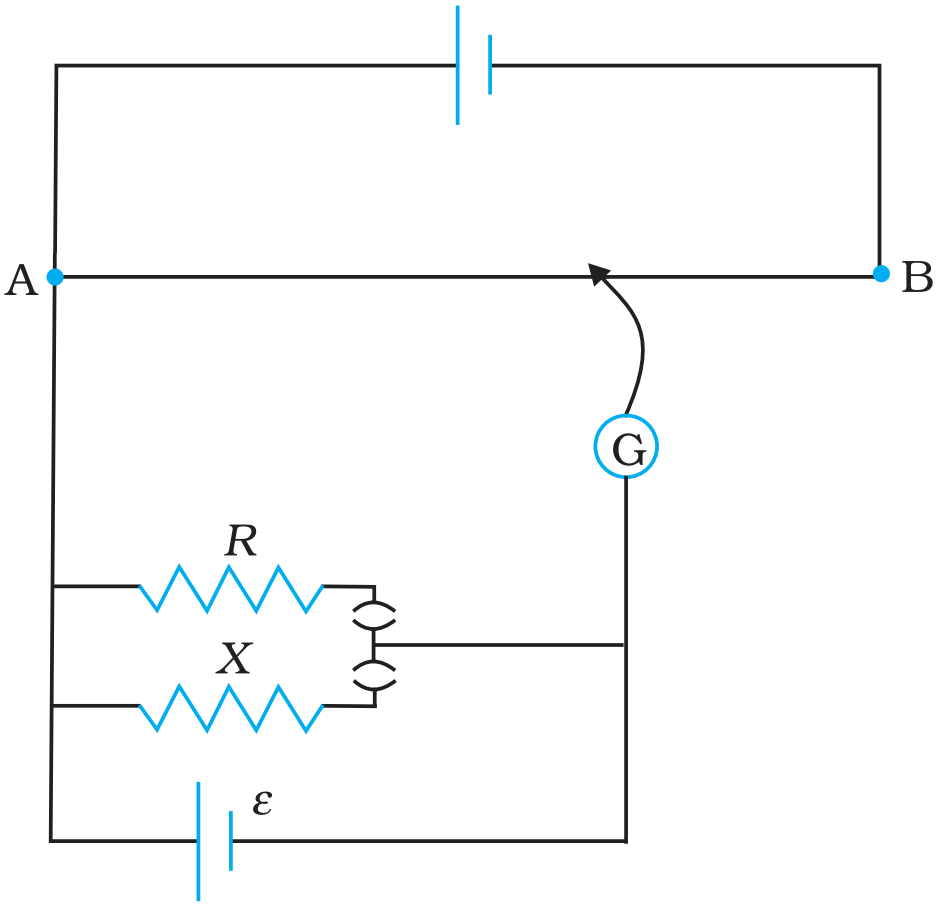
- 3Figure shows a potentiometer circuit for comparison of two resistances. The balance point with a standard resistor $\text{R}=10.0\ \Omega$ is found to be $58.3 \ cm,$ while that with the unknown resistance $X$ is $68.5 \ cm$. Determine the value of $X$. What might you do if you failed to find a balance point with the given cell of emf $\varepsilon?$View Solution
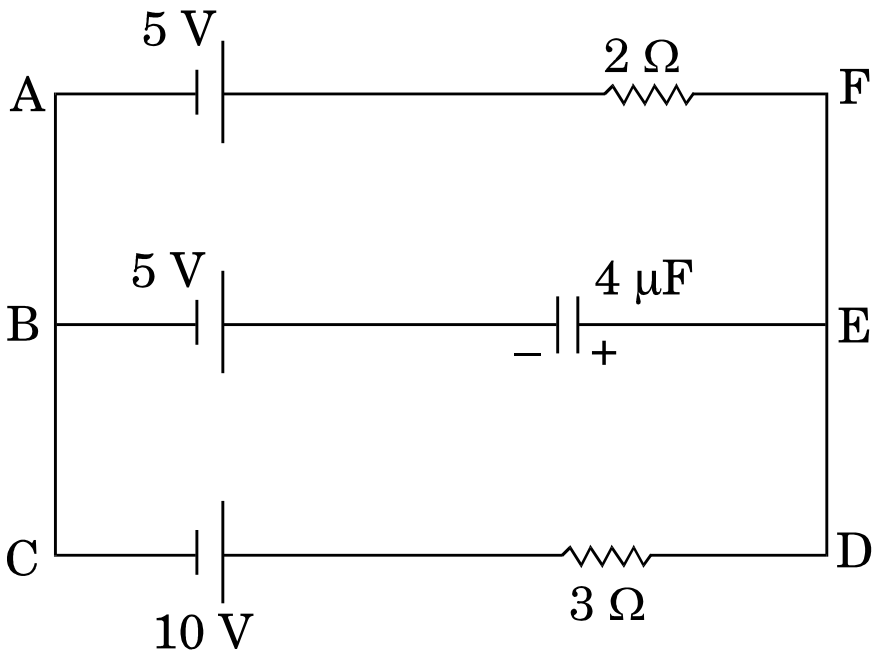
- 4View SolutionIn the given circuit, with steady current, calculate the potential drop across the capacitor in terms of V.
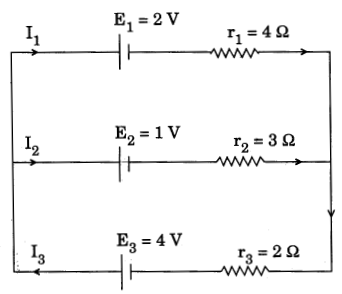
- 5State Kirchhoff’s rules. Use these rules to write the expressions for the currents $I_1, I_2$ and $I_3$ in the circuit diagram shown.View Solution
- 6A capacitance C charged to a potential difference V is discharged by connecting its plates through a resistance R. Find the heat dissipated in one time constant after the connections are made. Do this by calculating $\int\text{i}^2\text{R}$ dt and also by finding the decrease in the energy stored in the capacitor.View Solution
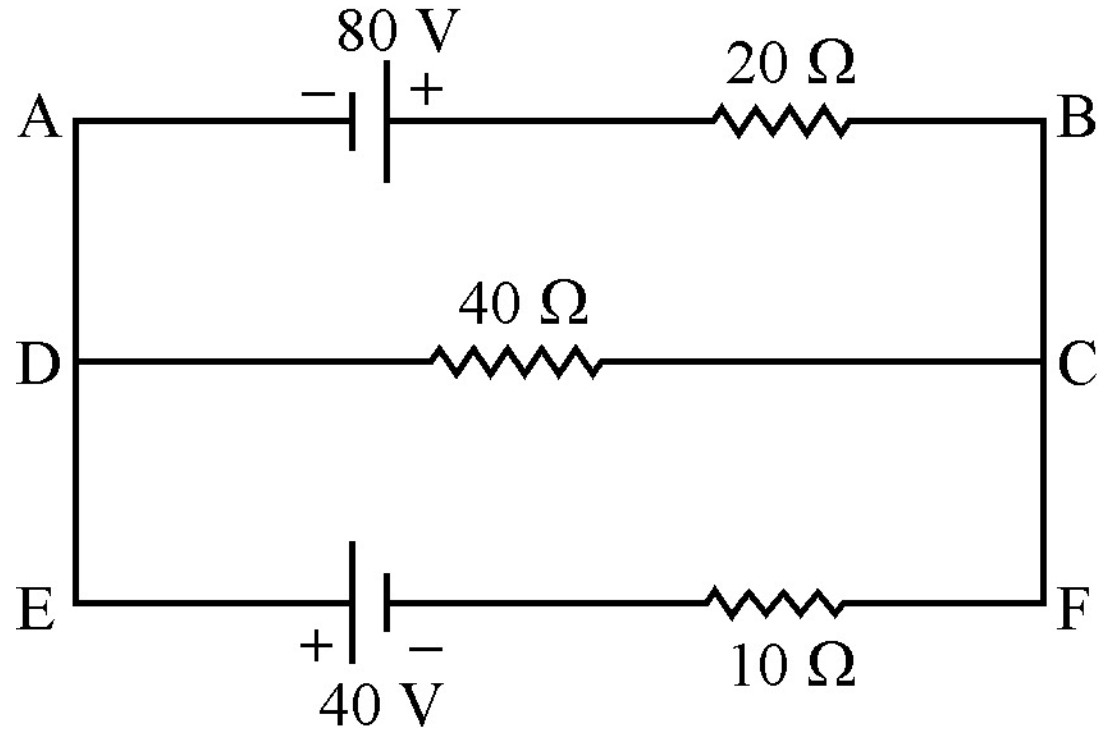
- 7Using Kirchhoff’s rules, calculate the current through the $40\Omega$ and $20\Omega$ resistors in the following circuit:View Solution
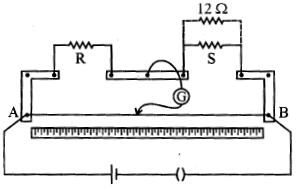
- 8View SolutionIn a meter bridge, the null point is found at a distance of 40 cm from A. If a resistance of 12 Ω is connected in parallel with S, the null point occurs at 50.0 cm from. Determine the values of R and S.
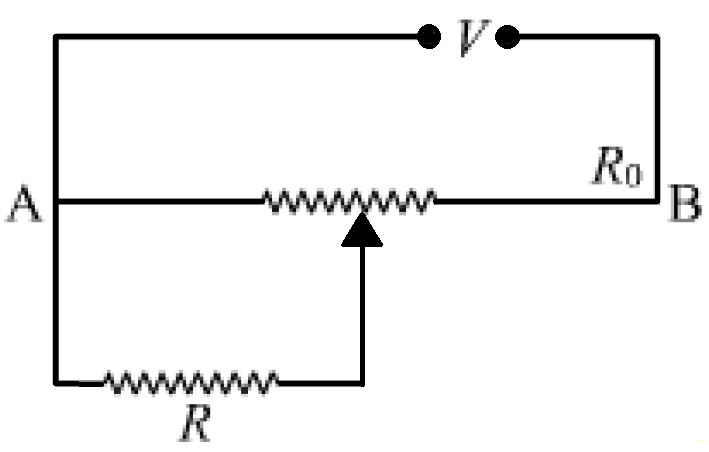
- 9A resistance of R draws current from a potentiometer. The potentiometer wire $, AB, $ has a total resistance of $R_o. A$ voltage $V$ is supplied to the potentiometer. Derive an expression for the voltage across $R$ when the sliding contact is in the middle of potentiometer wire.View Solution
- 10In the figure a long uniform potentiometer wire $AB$ is having a constant potential gradient along its length. The null points for the two primary cells of emfs $\varepsilon_{1}$ and $\varepsilon_{2}$View Solution
connected in the manner shown are obtained at a distance of $120 \ cm $ and $300 \ cm$ from the end $A$.
Find $(i) \varepsilon_{1} / \varepsilon_{2}$ and $(ii)$ position of null point for the cell $\varepsilon_{1}$. How is the sensitivity of a potentiometer increased?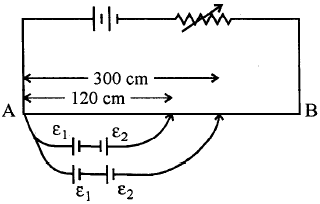
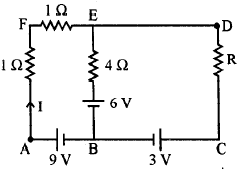
Using Kirchoffs rules determine the value of unknown resistance $R$ in the circuit so that no current flows through 4 $\Omega$ resistance. Also find the potential difference between $A$ and $D.$