A block is at rest on an inclined plane making an angle $\alpha $ with the horizontal. As the angle $\alpha $ of the incline is increased, the block starts slipping when the angle of inclination becomes $\theta $. The coefficient of static friction between the block and the surface of the inclined plane is
AIPMT 1993, Easy


Download our appand get started for free
Experience the future of education. Simply download our apps or reach out to us for more information. Let's shape the future of learning together!No signup needed.*
Similar Questions
- 1A piece of ice slides down a rough inclined plane at $\theta=45^{\circ}$ inclination in twice the time that it takes to slide down an identical but frictionless inclined plane. What is the coefficient of friction between ice and incline ?View Solution
- 2If ${\mu _s},\,{\mu _k}$ and ${\mu _r}$ are coefficients of static friction, sliding friction and rolling friction, thenView Solution
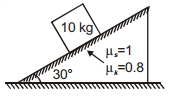
- 3A block of $10 \,kg$ mass is placed on a rough inclined surface as shown in figure. The acceleration of the block will beView Solution
- 4A block of mass $5 kg$ is at rest on a rough inclined surface. If angle of inclination of plane is $60^{\circ}$, then force applied by it on block is .......... $N$View Solution
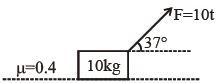
- 5View SolutionA force acts on a block as shown in figure. Find time when block loses contact with surface.
- 6A block is moving on an inclined plane making an angle $45^{\circ}$ with the horizontal and the coefficient of friction is $\mu$. The force required to just push it up the inclined plane is $3$ times the force required to just prevent it from sliding down. If we define $N=10 \ \mu$, then $N$ isView Solution
- 7A block weighs $W$ is held against a vertical wall by applying a horizontal force $F$. The minimum value of $F$ needed to hold the block isView Solution
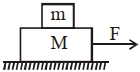
- 8Two blocks $( m =0.5\, kg$ and $M =4.5\, kg$ ) are arranged on a horizontal frictionless table as shown in figure. The coefficient of static friction between the two blocks is $\frac{3}{7} .$ Then the maximum horizontal force that can be applied on the larger block so that the blocks move together is ......... $N.$ (Round off to the Nearest Integer) [Take g as $9.8\, ms ^{-2}$ ]View Solution
- 9A particle of mass $m$ is at rest at the origin at time $t = 0$. It is subjected to a force $F(t) = F_0e^{-bt}$ in the $x$ -direction. Its speed $v(t)$ is depicted by which of the following curves ?View Solution
- 10The coefficient of friction $\mu $ and the angle of friction $\lambda $ are related asView Solution