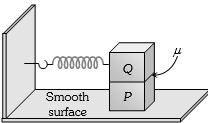
$A$ block $P$ of mass m is placed on a frictionless horizontal surface. Another block Q of same mass is kept on $P$ and connected to the wall with the help of a spring of spring constant k as shown in the figure. ${\mu _s}$ is the coefficient of friction between$ P$ and $ Q$. The blocks move together performing SHM of amplitude $A$. The maximum value of the friction force between $P$ and $Q$ is
IIT 2004, Diffcult


Download our appand get started for free
Experience the future of education. Simply download our apps or reach out to us for more information. Let's shape the future of learning together!No signup needed.*
Similar Questions
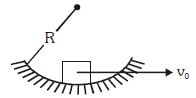
- 1A particle is projected with a speed ${v_0} = \sqrt {gR} $ . The coefficient of friction between the particle and the hemispherical plane is $\mu = 0.5$ . Then, the initial acceleration of the particle isView Solution
- 2In figure, two blocks $M$ and $m$ are tied together with an inextensible and light string. The mass $M$ is placed on a rough horizontal surface with coefficient of friction $\mu$ and the mass $m$ is hanging vertically against a smooth vertical wall. The pulley is frictionless. Choose the correct statement $(s)$View Solution

- 3A block $A$ of mass $m_1$ rests on a horizontal table. A light string connected to it passes over a frictionless pully at the edge of table and from its other end another block $B$ of mass $m_2$ is suspended. The coefficient of kinetic friction between the block and the table is $\mu _k.$ When the block $A$ is sliding on the table, the tension in the string isView Solution
- 4A block of mass $5\, kg$ is on a rough horizontal surface and is at rest. Now a force of $24\, N $is imparted to it with negligible impulse. If the coefficient of kinetic friction is $0.4$ and $g = 9.8\,m/{s^2}$, then the acceleration of the block is ........ $m/s^2$View Solution
- 5A body of mass $\mathrm{m}$ is kept on a rough horizontal surface (coefficient of friction $=\mu$ ) A horizontal force is applied on the body, but it does not move. The resultant of normal reaction and the frictional force acting on the object is given by $\mathrm{F},$ where $\mathrm{F}$ isView Solution
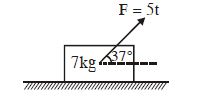
- 6A block of $7\,kg$ is placed on a rough horizontal surface and is pulled through a variable force $F$ (in $N$ ) $= 5\,t$ , where $'t'$ is time in second, at an angle of $37^o$ with the horizontal as shown in figure. The coefficient of static friction of the block with the surface is one. If the force starts acting at $t = 0\,s$ . Find the time at which the block starts to slide ......... $\sec$ (Take $g = 10\,m/s^2$ )View Solution
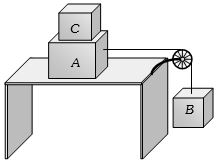
- 7Two masses $A$ and $B$ of $10\, kg$ and $5 \,kg$ respectively are connected with a string passing over a frictionless pulley fixed at the corner of a table as shown. The coefficient of static friction of $A$ with table is $0.2$. The minimum mass of $C$ that may be placed on $A$ to prevent it from moving is ........ $kg$View Solution
- 8A block $A$ of mass $4\, kg$ is placed on another block $B$ of mass $5\, kg$, and the block $B$ rests on a smooth horizontal table. If the minimum force that can be applied on $A$ so that both the blocks move together is $12\, N$, the maximum force that can be applied to $B$ for the blocks to move together will be ....... $N$View Solution
- 9Given below are two statements:View Solution
$Statement$ $(I)$ : The limiting force of static friction depends on the area of contact and independent of materials.
$Statement$ $(II)$ : The limiting force of kinetic friction is independent of the area of contact and depends on materials.
In the light of the above statements, choose the most appropriate answer from the options given below:
- 10A plank with a box on it at one end is gradually raised about the other end. As the angle of inclination with the horizontal reaches $30^o $, the box starts to slip and slides $4.0\, m $ down the plank in $4.0\, s.$ The coefficients of static and kinetic friction between the box and the plank will be, respectivelyView Solution