Which of the following law states that “good absorbers of heat are good emitters”
Easy
Download our app for free and get started
(b) Kirchhoff's law states that, the ratio of emissive power to the absorptive power corresponding to a particular wavelength and at a given temperature is constant for all bodies$:$
$e_{\lambda} / a_{\lambda}=$ constant $=E_{\lambda}$
where $E_{\lambda}=$ emissive power of a perfect black body corresponding to same wavelength and temperature, it is clear from above relation that if $a_{\lambda}$ (absorptive power) is large for a body, $e_{\lambda}$ (emissivetive power) will also be large to keep the ratio constant i.e. good absorbers are good emitters.

Download our appand get started for free
Experience the future of education. Simply download our apps or reach out to us for more information. Let's shape the future of learning together!No signup needed.*
Similar Questions
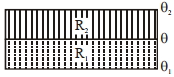
- 1The temperature $\theta$ at the junction of two insulating sheets, having thermal resistances $R _{1}$ and $R _{2}$ as well as top and bottom temperatures $\theta_{1}$ and $\theta_{2}$ (as shown in figure) is given byView Solution
- 2A black body at a temperature of $1640 K$ has the wavelength corresponding to maximum emission equal to $1.75$ $\mu $. Assuming the moon to be a perfectly black body, the temperature of the moon, if the wavelength corresponding to maximum emission is $ 14.35$ $\mu $ is ...... $K$View Solution
- 3A body cools in $7$ minutes from ${60^o}C$ to ${40^o}C$ What time (in minutes) does it take to cool from ${40^o}C$ to ${28^o}C$ if the surrounding temperature is ${10^o}C$? Assume Newton’s Law of cooling holdsView Solution
- 4According to Newton’s law of cooling, the rate of cooling of a body is proportional to ${(\Delta \theta )^n}$, where $\Delta \theta $ is the difference of the temperature of the body and the surroundings, and n is equal toView Solution
- 5A body takes $5$ minutes to cool from $90^oC$ to $60^oC$. If the temperature of the surroundings is $20^oC$, the time taken by it to cool from $60^oC$ to $30^oC$ will be ...... $\min.$View Solution
- 6Consider two rods of same length and different specific heats $\left(S_{1}, S_{2}\right)$, conductivities $\left(K_{1}, K_{2}\right)$ and area of cross-sections $\left(A_{1}, A_{2}\right)$ and both having temperatures $T_{1}$ and $T_{2}$ at their ends. If rate of loss of heat due to conduction is equal, thenView Solution
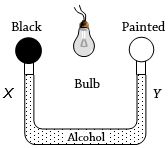
- 7The following figure shows two air-filled bulbs connected by a $ U-$ tube partly filled with alcohol. What happens to the levels of alcohol in the limbs $X$ and $Y$ when an electric bulb placed midway between the bulbs is lightedView Solution
- 8View SolutionThe dimensional formula for thermal resistance is
- 9An object is at a temperature of ${400^o}C$. At what temperature would it radiate energy twice as fast? The temperature of the surroundings may be assumed to be negligibleView Solution
- 10Which of the following circular rods. (given radius $ r$ and length $l$ ) each made of the same material as whose ends are maintained at the same temperature will conduct most heatView Solution