A boy on a cycle pedals around a circle of $20\, metres$ radius at a speed of $20\,metres/\sec .$ The combined mass of the boy and the cycle is $90\, kg$. The angle that the cycle makes with the vertical so that it may not fall is ......... $^o$ $(g = 9.8\,m/{\sec ^2})$
Easy


Download our appand get started for free
Experience the future of education. Simply download our apps or reach out to us for more information. Let's shape the future of learning together!No signup needed.*
Similar Questions
- 1A vehicle of mass $200\,kg$ is moving along a levelled curved road of radius $70\,m$ with angular velocity of $0.2\,rad / s$. The centripetal force acting on the vehicle is $.........\,N$View Solution
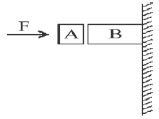
- 2Given in the figure are two blocks $A$ and $B$ of weight $20\ N$ and $100\ N,$ respectively. These are being pressed against a wall by a force $F$ as shown. If the coefficient of friction between the blocks is $0.1$ and between block $B$ and the wall is $0.15$, the frictional force applied by the wall on block $B$ is $......... N$View Solution
- 3A body of mass M is kept on a rough horizontal surface (friction coefficient $\mu $). A person is trying to pull the body by applying a horizontal force but the body is not moving. The force by the surface on the body is $F$, whereView Solution
- 4View SolutionA box is placed on an inclined plane and has to be pushed down. The angle of inclination is
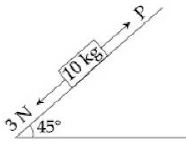
- 5A block of mass $10\, kg$ is kept on a rough inclined plane as shown in the figure. A force of $3\, N$ is applied on the block. The coefficient of static friction between the plane and the block is $0.6$. What should be the minimum value of force $P$, such that the block does not move downward? (take $g = 10\, ms^{-2}$) ........ $N$View Solution
- 6Consider a car moving along a straight horizontal road with a speed of $72\, km/h$. If the coefficient of kinetic friction between the tyres and the road is $0.5,$ the shortest distance in which the car can be stopped is ........ $m$ .$[g = 10\,m{s^{ - 2}}]$View Solution
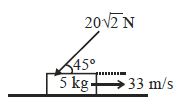
- 7A block of mass $5\, kg$ is kept on a rough horizontal floor. It is given a velocity $33\, m/s$ towards right. A force of $20\sqrt {2\,} \,N$ continuously acts on the block as shown in the figure. If the coefficient of friction between block and floor is $0.5$ the velocity of block after $3\, seconds$ is ........ $m/s$ ($g = 10\, m/s^2$)View Solution
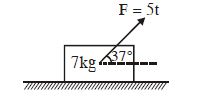
- 8A block of $7\,kg$ is placed on a rough horizontal surface and is pulled through a variable force $F$ (in $N$ ) $= 5\,t$ , where $'t'$ is time in second, at an angle of $37^o$ with the horizontal as shown in figure. The coefficient of static friction of the block with the surface is one. If the force starts acting at $t = 0\,s$ . Find the time at which the block starts to slide ......... $\sec$ (Take $g = 10\,m/s^2$ )View Solution
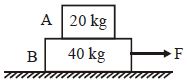
- 9In figure, the coefficient of friction between the floor and the block $B$ is $0.2$ and between blocks $A$ and $B$ is $0.3$. ........ $N$ is the maximum horizontal force $F$ can be applied to the block $B$ so that both blocks move together .View Solution
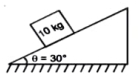
- 10A block of mass $10 \,kg$ is kept on a fixed rough $(\mu=0.8)$ inclined plane of angle of inclination $30^{\circ}$. The frictional force acting on the block is ........... $N$View Solution