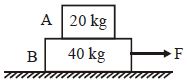
In figure, the coefficient of friction between the floor and the block $B$ is $0.2$ and between blocks $A$ and $B$ is $0.3$. ........ $N$ is the maximum horizontal force $F$ can be applied to the block $B$ so that both blocks move together .
Medium
Download our app for free and get started
Common acceleration is
$a=\frac{\mu_{A} m_{A} g}{m_{B}}=0.3 \times 10$
$a=3 \mathrm{m} / \mathrm{s}^{2}$
and
$\mathrm{F}-0.2(20+40) \mathrm{g}=(20+40) \mathrm{a}$
$\Rightarrow \mathrm{F}-120=60 \times 3$
$\Rightarrow \mathrm{F}=300 \mathrm{N}$

Download our appand get started for free
Experience the future of education. Simply download our apps or reach out to us for more information. Let's shape the future of learning together!No signup needed.*
Similar Questions
- 1The coefficient of friction between the tyres and the road is $0.25$. The maximum speed with which a car can be driven round a curve of radius $40 \,m$ without skidding is ........ $ms^{-1}$ (assume $g = 10 \,ms^{-2}$)View Solution
- 2A $500 \,kg$ car takes a round turn of radius $50 \,m$ with a velocity of $36 \,km/hr$. The centripetal force is .......... $N$View Solution
- 3A car is moving on a circular level road of curvature $300\,metres.$ If the coefficient of friction is $0.3$ and acceleration due to gravity is $10\,m/s^2,$ the maximum speed the car can have is ........ $km/hr$View Solution
- 4A car is moving on a horizontal curved road with radius $50\,m$. The approximate maximum speed of car will be $............\,ms^{-1}$, if friction between tyres and road is $0.34.\left[\right.$ Take $\left.g =10 ms ^{-2}\right]$View Solution
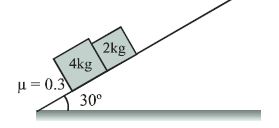
- 5Two blocks, $4\, kg$ and $2\, kg$ are sliding down an inclined plane as shown in figure. The acceleration of $2\, kg$ block is ........ $m/s^2$View Solution
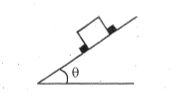
- 6A railway line is taken round a circular arc of radius $1000\ m$ , and is banked by raising the outer rail $h$ $m$ above the inner rail. If the lateral force on the inner rail when a train travels round the curve at $10\ ms^{-1}$ is equal to the lateral force on the outer rail when the train's speed is $20\ ms^{-1}$ . The value of $4g\ tan\theta $ is equal to : (The distance between the rails is $1.5\ m$ )View Solution
- 7A gramophone record is revolving with an angular velocity $\omega$. A coin is placed at a distance $r$ from the centre of the record. The static coefficient of friction is $\mu .$ The coin will revolve with the record ifView Solution
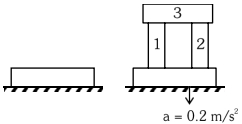
- 8A steel block of $10\, {kg}$ rests on a horizontal floor as shown. When three iron cylinders are placed on it as shown, the block and cylinders go down with an acceleration $0.2\, {m} / {s}^{2}$. The normal reaction ${R}$ by the floor if mass of the iron cylinders are equal and of $20\, {kg}$ each, is .....$N.$ [Take ${g}=10\, {m} / {s}^{2}$ and $\mu_{{s}}=0.2$ ]View Solution
- 9Determine the maximum acceleration in $m/s^2$ of the train in which a box lying on its floor will remain stationary, given that the co-efficient of static friction between the box and the train’s floor is $0.15.$View Solution
- 10View SolutionWhich is a suitable method to decrease friction