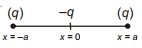
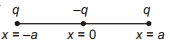
Three charges are placed along $x$-axis at $x=-a, x=0$ and $x=a$ as shown in the figure. The potential energy of the system is
Easy


Download our appand get started for free
Experience the future of education. Simply download our apps or reach out to us for more information. Let's shape the future of learning together!No signup needed.*
Similar Questions
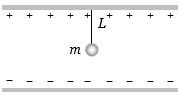
- 1A small sphere carrying a charge ‘$q$’ is hanging in between two parallel plates by a string of length $L$. Time period of pendulum is ${T_0}$. When parallel plates are charged, the time period changes to $T$. The ratio $T/{T_0}$ is equal toView Solution
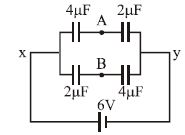
- 2What is the potential difference between $A$ and $B$ in the circuit shown.......$V$View Solution
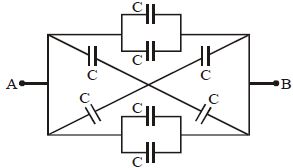
- 3Eight capacitors each of capacitance of $C$ are connected as shown in the figure. The effective capacitance between $A$ and $B$ isView Solution
- 4A parallel plate condenser with a dielectric of dielectric constant $K$ between the plates has a capacity $C$ and is charged to a potential $V\ volt$. The dielectric slab is slowly removed from between the plates and then reinserted. The net work done by the system in this process isView Solution
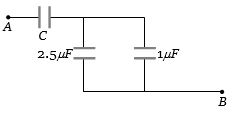
- 5The equivalent capacitance between $A$ and $B$ in the figure is $1\,\mu F$. Then the value of capacitance $C$ is.....$\mu F$View Solution
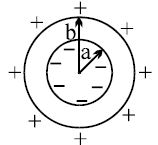
- 6An empty thick conducting shell of inner radius $a$ and outer radius $b$ is shown in figure.If it is observed that the inner face of the shell carries a uniform charge density $-\sigma$ and the surface carries a uniform charge density $ '\sigma '$View Solution
If the outer surface of the shell is earthed, then identify the correct statement(s)
- 7The two metallic plates of radius $r$ are placed at a distance $d$ apart and its capacity is $C$. If a plate of radius $r/2$ and thickness $d$ of dielectric constant $6$ is placed between the plates of the condenser, then its capacity will beView Solution
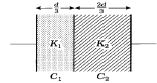
- 8A parallel plate capacitor with air between the plates has capacitance of $9\ pF$. The separation between its plates is '$d$'. The space between the plates is now filled with two dielectrics. One of the dielectrics has dielectric constant $k_1 = 3$ and thickness $\frac{d}{3}$ while the other one has dielectric constant $k_2 = 6$ and thickness $\frac{2d}{3}$ . Capacitance of the capacitor is now.......$pF$View Solution
- 9A dipole consisting of two charge $\pm q$ separated by a distance $2 a$ is placed with its centre $D$ away from the center of a grounded sphere of radius $R ( D > > a )$. When the dipole moment vector is perpendicular to the line joining the two centres (those of the dipole and sphere) the charge induced on the sphere isView Solution
- 10The two thin coaxial rings, each of radius $'a'$ and having charges $+{Q}$ and $-{Q}$ respectively are separated by a distance of $'s'.$ The potential difference between the centres of the two rings is :View Solution