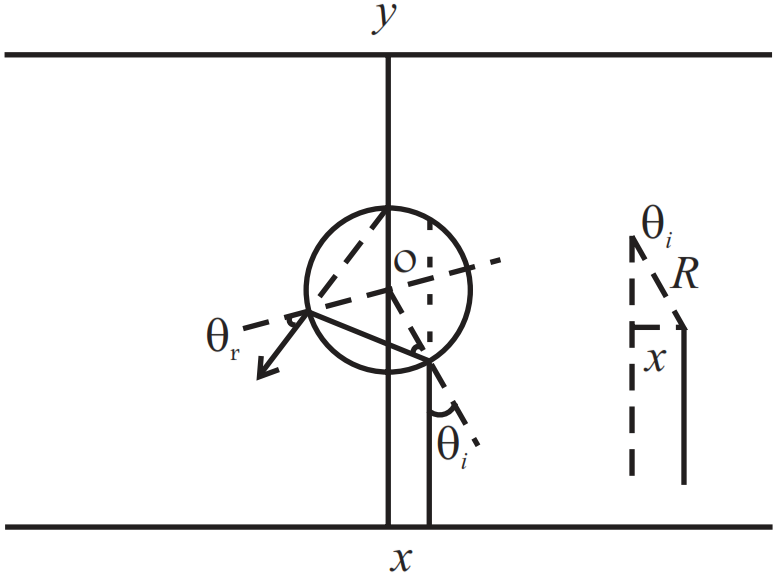
An infinitely long cylinder of radius R is made of an unusual exotic material with refractive index -1 (Fig). The cylinder is placed between two planes whose normals are along the y direction. The center of the cylinder O lies along the y-axis. A narrow laser beam is directed along the y direction from the lower plate. The laser source is at a horizontal distance x from the diameter in the y direction. Find the range of x such that light emitted from the lower plane does not reach the upper plane.
Download our app for free and get started
We are given that, the refractive index of the material is -1, $\theta_\text{r}$, is negative and $\theta_\text{r}'$ is positive.
Now, $|\theta_\text{i}|=|\theta_\text{r}|=|\theta_\text{r}'|$
The total deviation of the out coming ray from the incoming ray is $4\theta_\text{i}$.
Rays shall not reach the receiving plate if $\frac{\pi}{2}\leq4\theta,\leq\frac{3\pi}{2}$ [angles measured clockwise from the y-axis]
Dividing all the terms by 4, we get
$\frac{\pi}{8}\leq\theta,\leq\frac{3\pi}{8}\ .....(1)$
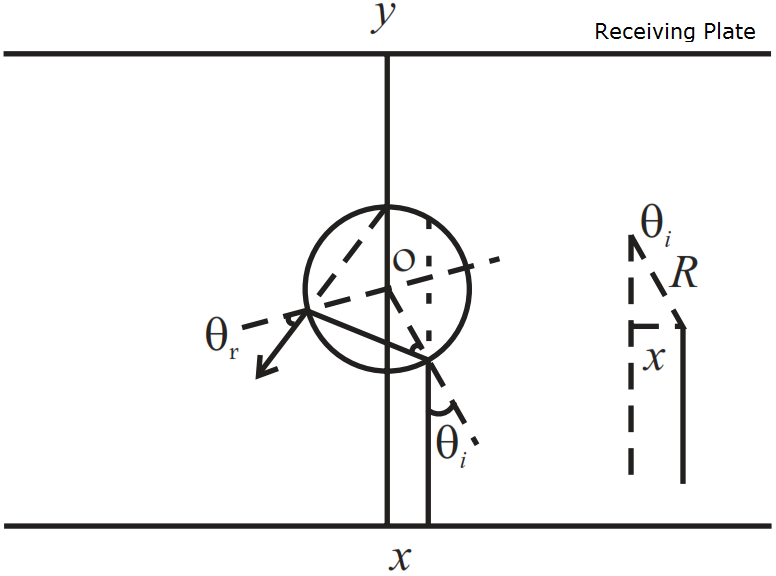
Now, $\sin\theta_\text{i}=\frac{\text{x}}{\text{R}}$
$\Rightarrow\ \theta_\text{i}=\sin^{-1}\Big(\frac{\text{x}}{\text{R}}\Big)$
Substituting $\theta_\text{i}=\sin^{-1}\Big(\frac{\text{x}}{\text{R}}\Big)$ in (1), we get
$\frac{\pi}{8}\leq\sin^{-1}\frac{\text{x}}{\text{R}}\leq\frac{3\pi}{8}$
$\frac{\pi}{8}\leq\frac{\text{x}}{\text{R}}\leq\frac{3\pi}{8}$
$\Rightarrow\ \frac{\pi\text{R}}{8}\leq\text{x}\leq\frac{3\pi\text{R}}{8}$
Thus, the range of x such that light emitted from the lower plane does not reach the upper plane is
$\frac{\text{R}\pi}{8}\leq\text{x}\leq\frac{\text{R}3\pi}{8}.$
Now, $|\theta_\text{i}|=|\theta_\text{r}|=|\theta_\text{r}'|$
The total deviation of the out coming ray from the incoming ray is $4\theta_\text{i}$.
Rays shall not reach the receiving plate if $\frac{\pi}{2}\leq4\theta,\leq\frac{3\pi}{2}$ [angles measured clockwise from the y-axis]
Dividing all the terms by 4, we get
$\frac{\pi}{8}\leq\theta,\leq\frac{3\pi}{8}\ .....(1)$
Now, $\sin\theta_\text{i}=\frac{\text{x}}{\text{R}}$
$\Rightarrow\ \theta_\text{i}=\sin^{-1}\Big(\frac{\text{x}}{\text{R}}\Big)$
Substituting $\theta_\text{i}=\sin^{-1}\Big(\frac{\text{x}}{\text{R}}\Big)$ in (1), we get
$\frac{\pi}{8}\leq\sin^{-1}\frac{\text{x}}{\text{R}}\leq\frac{3\pi}{8}$
$\frac{\pi}{8}\leq\frac{\text{x}}{\text{R}}\leq\frac{3\pi}{8}$
$\Rightarrow\ \frac{\pi\text{R}}{8}\leq\text{x}\leq\frac{3\pi\text{R}}{8}$
Thus, the range of x such that light emitted from the lower plane does not reach the upper plane is
$\frac{\text{R}\pi}{8}\leq\text{x}\leq\frac{\text{R}3\pi}{8}.$

Download our appand get started for free
Experience the future of education. Simply download our apps or reach out to us for more information. Let's shape the future of learning together!No signup needed.*
Similar Questions
- 1A biconvex thick lens is constructed with glass $(\mu=1.50)$ Each of the surfaces has a radius of 10cm and the thickness at the middle is 5cm. Locate the image of an object placed far away from the lens.View Solution
- 2View Solution
- Draw a labelled ray diagram to obtain the real image formed by an astronomical telescope in normal adjustment position. Defineits magnifying power.
- You are given three lenses of power 0.5 D, 4 D and 10 D to design a telescope.
- Which lenses should he used as objective and eyepiece? Justify your answer.
- Why is the aperture of the objective preferred to be large?
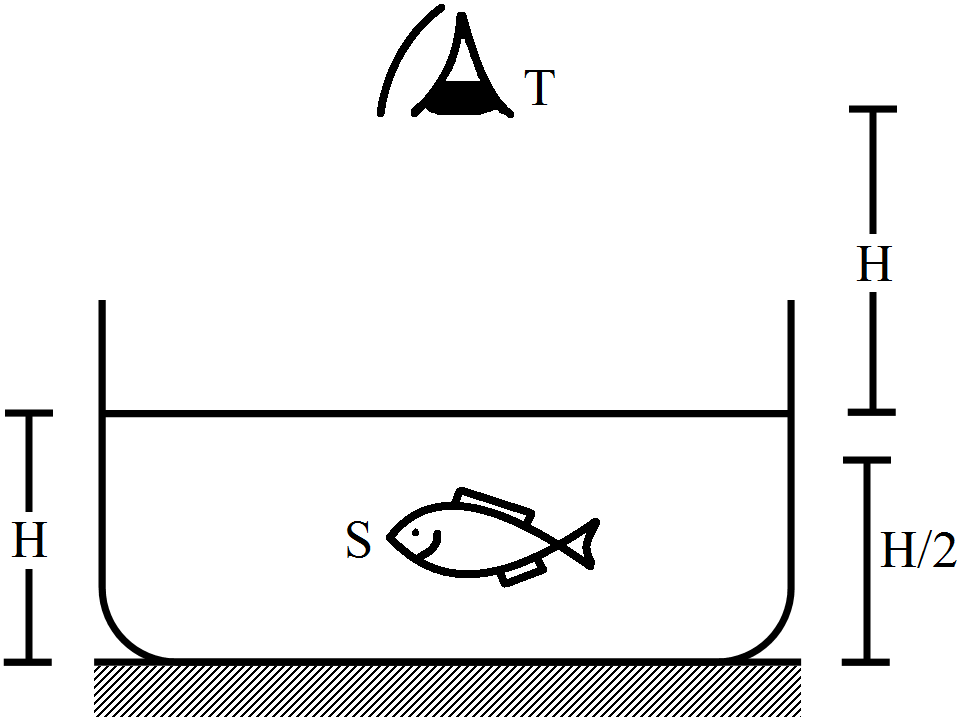
- 3View SolutionConsider the situation in figure. The bottom of the pot is a reflecting plane mirror, S is a small fish and T is a human eye. Refractive index of water is.
- At what distance(s) from itself will the fish see the image(s) of the eye?
- At what distance(s) from itself will the eye see the image(s) of the fish.
- 4View SolutionA convex lens has a focal length of 10cm. Find the location and nature of the image if a point object is placed on the principal axis at a distance of:
- 9.8cm
- 10.2cm from the lens.
- 5View SolutionOne day Chetan’s mother developed a severe stomach ache all of a sudden. She was rushed to the doctor who suggested for an immediate endoscopy test and gave an estimate of expenditure for the same. Chetan immediately contacted his class teacher and shared the information with her. The class teacher arranged for the money and rushed to the hospital. On realising that Chetan belonged to a below average income group family, even the doctor offered concession for the test fee. The test was conducted successfully.
Answer the following questions based on the above information:- Which principle in optics is made use of in endoscopy?
- Briefly explain the values reflected in the action taken by the teacher.
- In what way do you appreciate the response of the doctor on the given situation?
- 6View SolutionAn eye can distinguish between two points of an object if they are separated by more than 0.22mm when the object is placed at 25cm from the eye. The object is now seen by a compound microscope having a 20D objective and 10D eyepiece separated by a distance of 20cm. The final image is formed at 25cm from the eye. What is the minimum separation between two points of the object which can now be distinguished?
- 7View Solution
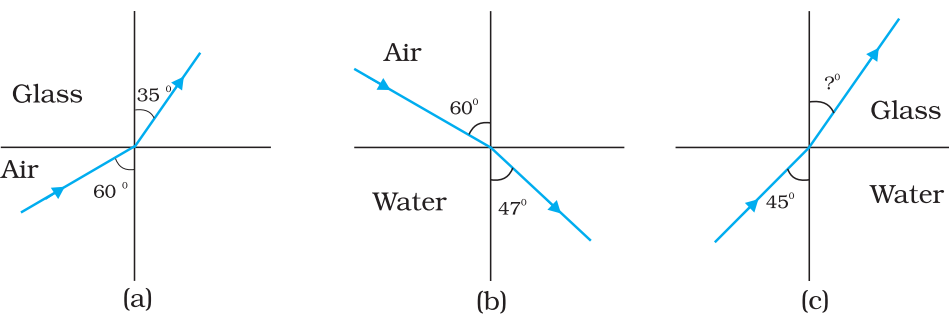
(a) and (b) show refraction of a ray in air incident at 60° with the normal to a glass-air and water-air interface, respectively. Predict the angle of refraction in glass when the angle of incidence in water is 45º with the normal to a water - glass interface.
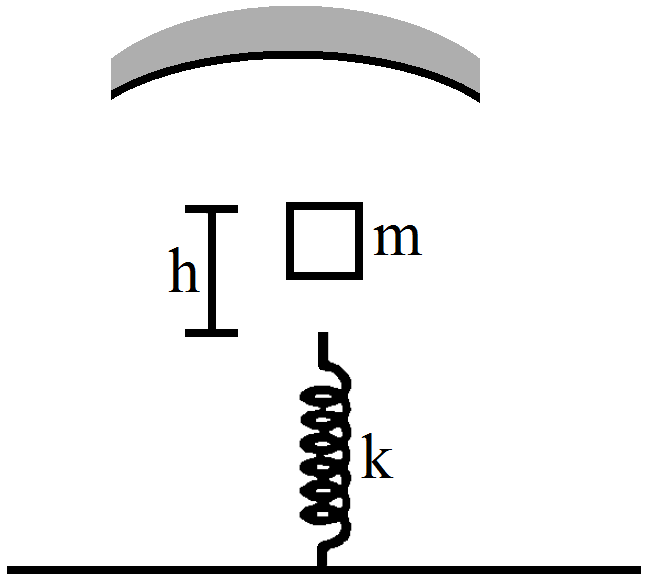
- 8View SolutionA mass m = 50g is dropped on a vertical spring of spring constant 500N/m from a height h = 10cm as shown in figure. The mass sticks to the spring and executes simple harmonic oscillations after that. A concave mirror of focal length 12cm facing the mass is fixed with its principal axis coinciding with the line of motion of the mass, its pole being at a distance of 30cm from the free end of the spring. Find the length in which the image of the mass oscillates.
- 9View SolutionA point object is placed at a distance of 15cm from a convex lens. The image is formed on the other side at a distance of 30cm from the lens. When a concave lens is placed in contact with the convex lens, the image shifts away further by 30cm. Calculate the focal lengths of the two lenses.
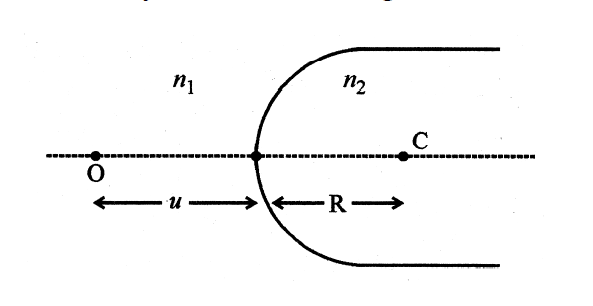
- 10A point object 'O' is kept in a medium of refractive index $n_1$ in front of a convex spherical surface of radius of curvature R which separates the second medium of refractive index $n_2$ from the first one, as shown in the figure. Draw the ray diagram showing the image formation and deduce the relationship between the object distance and the image distance in terms of $n_1, n_2$ and R.View Solution
- hen the image formed above acts as a virtual object for concave spherical, surface separating the medium $n_2$ from $n_1 (n_2> n_1),$ draw this ray diagram and write the similar (similar to (a) relation. Hence obtain the expression for the lens maker's formula.