A combination of lenses for a camera contains two converging lenses of focal lengths 20cm and 40cm and a diverging lens of focal length 50cm. Find the power and focal length of the combination.
Download our app for free and get started
$\text{f}_1=20\text{cm}=0.2\text{m}$$\text{P}_1=\frac{1}{\text{f}_1}=\frac{1}{0.2}=+5\text{D}$
$\text{f}_2=40\text{cm}=0.4\text{m}$
$\text{P}_2=\frac{1}{\text{f}_2}=\frac{1}{0.4}=+2.5\text{D}$
$\text{f}_3=-50\text{cm}=-0.5\text{m}$
$\text{P}_3=\frac{1}{\text{f}_3}=\frac{1}{-0.5}=-2\text{D}$
Power of the combination,
$\text{P}=\text{P}_1+\text{P}_2+\text{P}_3$
$=+5\text{D}+2.5\text{D}+(-2\text{D})$
$=+5.5\text{D}$
Focal length of the combination,
$\text{f}=\frac{1}{\text{P}}=\frac{1}{+5.5}=+0.1818\text{m}=+18.18\text{cm}$
$\text{f}_2=40\text{cm}=0.4\text{m}$
$\text{P}_2=\frac{1}{\text{f}_2}=\frac{1}{0.4}=+2.5\text{D}$
$\text{f}_3=-50\text{cm}=-0.5\text{m}$
$\text{P}_3=\frac{1}{\text{f}_3}=\frac{1}{-0.5}=-2\text{D}$
Power of the combination,
$\text{P}=\text{P}_1+\text{P}_2+\text{P}_3$
$=+5\text{D}+2.5\text{D}+(-2\text{D})$
$=+5.5\text{D}$
Focal length of the combination,
$\text{f}=\frac{1}{\text{P}}=\frac{1}{+5.5}=+0.1818\text{m}=+18.18\text{cm}$

Download our appand get started for free
Experience the future of education. Simply download our apps or reach out to us for more information. Let's shape the future of learning together!No signup needed.*
Similar Questions
- 1View SolutionName the type of mirror used:
- By dentists.
- In solar furnaces. Give two reasons why such mirrors are used in each case.
- 2View SolutionThe image of a candle flame placed at a distance of 45cm from a spherical lens is formed on a screen placed at a distance of 90cm from the lens. Identify the type of lens and calculate its focal length. If the height of the flame is 2cm, find the height of its image.
- 3View Solution
- Draw a ray diagram to show the refraction of light through a glass slab and mark angle of refraction and the lateral shift suffered by the ray of light while passing through the slab.
- If the refractive index of glass for light going from air to glass is 3/2, find the refractive index of air for light going from glass to air.
- 4View SolutionAn object of height 5 cm is placed perpendicular to the principal axis of a concave lens of focal length 10 cm. If the distance of the object from the optical centre of the lens is 20 cm, determine the position, nature and size of the image formed using the lens formula.
- 5View SolutionA convex lens produces an inverted image magnified three times of an object placed at a distance of 15cm from it. Calculate focal length of the lens.
- 6View SolutionFor which position of the object does a convex lens form a virtual and erect image? Explain with the help of a ray diagram.
- 7View SolutionFind the position and nature of the image of an object 5cm high and 10cm in front of a convex lens of focal length 6cm.
- 8View SolutionDescribe an activity to show that the colours of white light splinted by a glass prism can be recombined to get white light by another identical glass prism. AIso draw ray diagram to show the recombination of the spectrum of white light.
- 9View SolutionA small object is placed 150mm away from a diverging lens of focal length 100mm:
- Copy the figure below and draw rays to show how an image is formed by the lens.
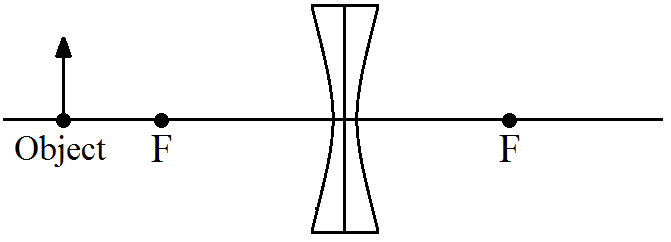
- Calculate the distance of the image from the lens by using the lens formula.
- 10View SolutionAn object is kept at a distance of 100cm from each of the above lenses. Calculate the (i) image distance and (ii) magnification in each of the two cases.