A convex lens produces an inverted image magnified three times of an object placed at a distance of 15cm from it. Calculate focal length of the lens.
Download our app for free and get started
m = -3 (Inverted image) u = -15cm$\text{m}=\frac{\text{v}}{\text{u}}$
$-3=\frac{\text{v}}{-15}$
$\text{v}=45\text{cm}$
Lens formula, $\frac{1}{\text{v}}-\frac{1}{\text{u}}=\frac{1}{\text{f}}$$\frac{1}{45}-\frac{1}{-15}=\frac{1}{\text{f}}$
$\frac{1+3}{45}=\frac{1}{\text{f}}$
$\text{f}=\frac{45}{4}\text{cm}$
$\text{f}=11.25\text{cm}$
$-3=\frac{\text{v}}{-15}$
$\text{v}=45\text{cm}$
Lens formula, $\frac{1}{\text{v}}-\frac{1}{\text{u}}=\frac{1}{\text{f}}$$\frac{1}{45}-\frac{1}{-15}=\frac{1}{\text{f}}$
$\frac{1+3}{45}=\frac{1}{\text{f}}$
$\text{f}=\frac{45}{4}\text{cm}$
$\text{f}=11.25\text{cm}$

Download our appand get started for free
Experience the future of education. Simply download our apps or reach out to us for more information. Let's shape the future of learning together!No signup needed.*
Similar Questions
- 1View SolutionThe image formed by a spherical mirror is real, inverted and is of magnification - 2. If the image is at a distance of 30 cm from the mirror, where is the object placed ? Find the focal length of the mirror. List two characteristics of the image formed if the object is moved 10 cm towards the mirror.
- 2View SolutionThe image of an object formed by a mirror is real, inverted and is of magnification - I. If the image is at a distance of 40 cm from themirror, where is the object placed? Where would the image be if the object is moved 20 cm towards the mirror? State reason and also draw ray diagram for the new position of the object to justify your answer.
- 3View SolutionTwo lenses have powers of (i) +2D and (ii) -4D. What is the nature and focal length of each lens?
- 4View SolutionMake labelled ray diagrams to illustrate the formation of:
- A real image by a converging mirror.
- A virtual image by a converging mirror.
- 5View SolutionThe filament of a lamp is 80cm from a screen and a converging lens forms an image of it on a screen, magnified three times. Find the distance of the lens from the filament and the focal length of the lens.
- 6View SolutionA small object is placed 150mm away from a diverging lens of focal length 100mm:
- Copy the figure below and draw rays to show how an image is formed by the lens.
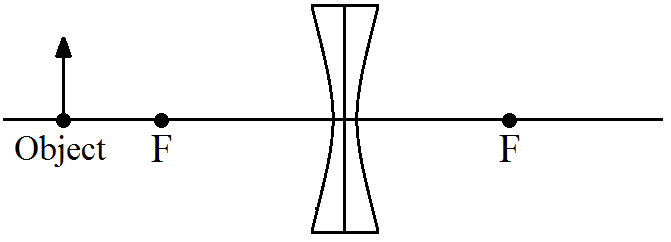
- Calculate the distance of the image from the lens by using the lens formula.
- 7View SolutionAn object is 24cm away from a concave mirror and its image is 16cm from the mirror. Find the focal length and radius of curvature of the mirror, and the magnification of the image.
- 8View SolutionWhat is the difference between regular reflection of light and diffuse reflection of light? What type of reflection of light takes place from:
- A cinema screen.
- A plane mirror.
- A cardboard.
- Still water surface of a lake
- 9View SolutionA student wants to project the image of a candle flame on a screen 90 cm in front of a mirror by keeping the flame at a distance of 15 cm from its pole.
- Suggest the type of mirror he should use.
- Determine the linear magnification in this case.
- Find the distance between the object and its image.
- Draw ray diagram to show the image formation in this case.
- 10View SolutionHow would a pencil look like if you saw it through (a) a concave lens, and (b) a convex lens? (Assume the pencil is close to the lens). Is the image real or virtual?