- State Huygen’s principle. Using this principle draw a diagram to show how a plane wave front incident at the interface of the two media gets refracted when it propagates from a rarer to a denser medium. Hence verifiy Snell’s law of refraction.
- When monochromatic light travels from a rarer to a denser medium, explain the following, giving reasons:
- Is the frequency of reflected and refracted light same as the frequency of incident light?
- Does the decrease in speed imply a reduction in the energy carried by light wave?
CBSE DELHI - SET 1 2013
Download our app for free and get started
- Law of Reflection : Let XY be a reflecting surface at which a wavefront is being incident obliquely. Let v be the speed of the wavefront and at time t = 0, the wavefront touches the surface XY at A. After time t, the point B of wavefront reaches the point B' of the surface.
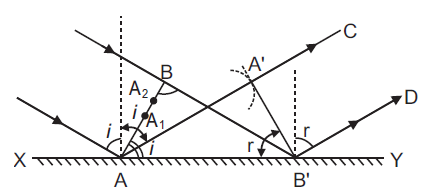
First of all the secondary wavelet starts from point A and traverses distance AA' (=vt) in first medium in time t. In the same time t, the point B of wavefront, after travelling a distance BB', reaches point B' (of the surface), from where the secondary wavelet now starts. Now taking A as centre we draw a spherical arc of radius AA' (= vt) and draw tangent A'B' on this arc from point B'. As the incident wavefront AB advances, the secondary wavelets starting from points between A and B', one after the other and will touch A'B' simultaneously. According to Huygen’s principle wavefront A'B' represents the new position of AB, i.e., A'B' is the reflected wavefront corresponding to incident wavefront AB.
Now in right-angled triangles ABB' and AA' B'
$\angle\text{ABB}' = \angle\text{AA'} B' \text{(both are equal to } 90^{o})$
side BB' = side AA' (both are equal to $v\text{t}$)
and side AB' is common
i.e., both triangles are congruent.
$\therefore\angle\text{BAB}' = \angle\text{AB}'\text{A}'$
i.e., incident wavefront AB and reflected wavefront A'B' make equal angles with the reflecting surface XY. As the rays are always normal to the wavefront, therefore the incident and the reflected rays make equal angles with the normal drawn on the surface XY, i.e.,
angle of incidence i = angle of reflection r
This is the second law of reflection.
Since AB, A'B' and XY are all in the plane of paper, therefore the perpendiculars dropped on them will also be in the same plane. Therefore we conclude that the incident ray, reflected ray and the normal at the point of incidence, all lie in the same plane. This is the first law of reflection. Thus Huygen’s principle explains both the laws of reflection.
-
- If the radiation of certain frequency interact with the atoms/molecules of the matter, they start to vibrate with the same frequency under forced oscillations. Thus, the frequency of the scattered light (Under reflection and refraction) equals to the frequency of incident radiation.
- No, energy carried by the wave depends on the amplitude of the wave, but not on the speed of the wave.

Download our appand get started for free
Experience the future of education. Simply download our apps or reach out to us for more information. Let's shape the future of learning together!No signup needed.*
Similar Questions
- 1View SolutionA converging lens of focal length 15cm and a converging mirror of focal length 10cm are placed 50cm apart with common principal axis. A point source is placed in between the lens and the mirror at a distance of 40cm from the lens. Find the locations of the two images formed.
- 2Derive the lens formula $\frac{1}{\text{f}}=\frac{1}{\text{v}}-\frac{1}{\text{u}}$ for a thin concave lens, using the necessary ray diagram.View Solution
- 3View SolutionAn angular magnification (magnifying power) of 30X is desired using an objective of focal length 1.25 cm and an eyepiece of focal length 5 cm. How will you set up the compound microscope?
- 4View SolutionA particle is moving at a constant speed V from a large distance towards a concave mirror of radius R along its principal axis. Find the speed of the image formed by the mirror as a function of the distance x of the particle from the mirror.
- 5View SolutionA circular disc of radius 'R' is placed co-axially and horizontally inside an opaque hemispherical bowl of radius 'a' (Fig). The far edge of the disc is just visible when viewed from the edge of the bowl. The bowl is filled with transparent liquid of refractive index μ and the near edge of the disc becomes just visible. How far below the top of the bowl is the disc placed?
- 6View Solution
- A point object is placed on the principal axis of a convex spherical surface of radius of curvature R, which separates the two media of refractive indices $n_1$ and $n_2(n_2 > n_1)$. Draw the ray diagram and deduce the relation between the object distance (u), image distance (v) and the radius of curvature (R) for refraction to take place at the convex spherical surface from rarer to denser medium.
- A converging lens has a focal length of 20 cm in air. It is made of a material of refractive index 1.6. If it is immersed in a liquid of refractive index 1.3, find its new focal length.
- 7k transparent slabs are arranged one over another. The refractive indices of the slabs are $\mu_1,\mu_2,\mu_3, \ ...\mu_{\text{k}}$ and the thicknesses are $t_1, t_2, t_3, ... t_k$ . An object is seen through this combination with nearly perpendicular light. Find the equivalent refractive index of the system which will allow the image to be formed at the same place.View Solution
- 8View SolutionDraw a ray diagram to show the formation of real image of the same size as that of the object placed in front of a converging lens. Using this ray diagram establish the relation between u, v and f for this lens.
- 9View SolutionA concave mirror forms an image of 20cm high object on a screen placed 5.0m away from the mirror. The height of the image is 50cm. Find the focal length of the mirror and the distance between the mirror and the object.
- 10A cylindrical vessel of diameter 12cm contains $800\pi\text{cm}^3$ of water. A cylindrical glass piece of diameter 8.0 cm and height 8.0cm is placed in the vessel. If the bottom of the vessel under the glass piece is seen by the paraxial rays, locate its image. The index of refraction of glass is 1.50 and that of water is 1.33.View Solution