Question
A cycle followed by an engine (made of one mole of perfect gas in a cylinder with a piston) is shown in Fig.
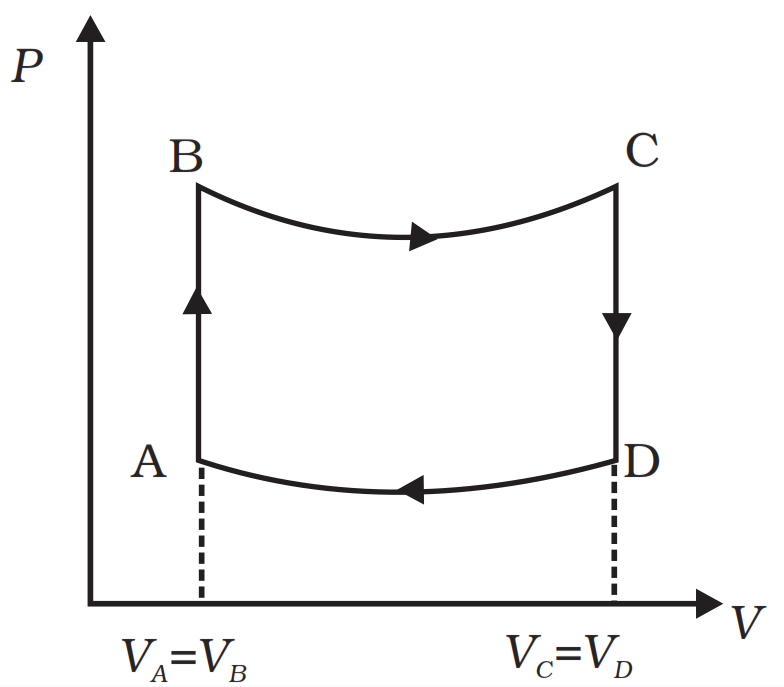
A to B : volume constant B to C : adiabatic C to D : volume constant D to A : adiabatic $V_C= V_D= 2V_A= 2V_B$
  1. In which part of the cycle heat is supplied to the engine from outside?
  2. In which part of the cycle heat is being given to the surrounding by the engine?
  3. What is the work done by the engine in one cycle? Write your answer in term of $P_A, P_B, V_A$.
  4. What is the efficiency of the engine?[$\gamma=\frac{5}{3}$ for the gas], $\big(\text{C}_\text{v}=\frac{3}{2}\text{R for one mole}\big)$

Answer

(a) A to B
(b) C to D
(c) $\text{W}_\text{AB}=\int\limits^\text{B}_\text{A}\text{pdV}=0;\text{W}_\text{CD}=0.$
Simillarly. $\text{W}_\text{BC}=\Big[\int\limits^\text{C}_\text{B}\text{pdV}=\text{k}\int\limits^\text{C}_\text{B}\frac{\text{dV}}{\text{V}^\text{r}}=\text{k}\frac{\text{V}^\text{-r+1}}{-\text{R}+1}\Big]^{\text{V}_{\text{C}}}_{\text{V}_\text{B}}$
$= \frac{1}{1-\gamma}(\text{P}_\text{c}\text{V}_\text{c}-\text{P}_\text{B}\text{V}_\text{B})$
Simillarly, $\text{W}_\text{DA}=\frac{1}{1-\gamma}(\text{P}_\text{A}\text{V}_\text{A}-\text{P}_\text{D}\text{V}_\text{D})$
Now $\text{P}_\text{C}=\text{P}_\text{B}\Big(\frac{\text{V}_\text{B}}{\text{V}_\text{C}}\Big)^\gamma=2^{-\gamma}\text{P}_\text{B}$
Simillarly, $\text{P}_\text{D}=\text{P}_\text{A}2^{-\gamma}$
Total work done $=\text{W}_\text{BC}+\text{W}_\text{DA}$
$=\frac{1}{1-\gamma}\big[\text{P}_\text{B}\text{V}_\text{B}\big(2^{-\gamma+1}-1\big)-\text{P}_\text{A}\text{V}_\text{A}\big(2^{-\gamma+1}-1\big)\big]$
$=\frac{1}{1-\gamma}\big(2^{1-\gamma}-1\big)\big(\text{P}_\text{B}-\text{P}_\text{A}\big)\text{V}_\text{A}$
$=\frac{3}{2}\big(1-\Big(\frac{1}{2}\Big)^\frac{2}{3}\big)\big(\text{P}_\text{B}-\text{P}_\text{A}\big)\text{V}_\text{A}$
  1. Heat supplied during process A, B
$\text{d}\text{Q}_\text{AB}=\text{d}\text{U}_\text{AB}$
$\text{Q}_\text{AB}=\frac{3}{2}\text{n}\text{R}\big(\text{T}_\text{B}-\text{T}_\text{A}\big)\text{V}_\text{A}$
$\text{Efficiency}=\frac{\text{Net Work done }}{\text{Heat Supplied}}=\Big[1-\Big(\frac{1}{2}\Big)^\frac{2}{3}\Big]$

Need a full question paper?

Generate a complete, print-ready paper with questions like this in minutes — across 16+ boards, with answer keys.

Start Generating Free

Similar questions

Figure. shows two vessels A and B with rigid walls containing ideal gases. The pressure, temperature and the volume are $p_A, T_A, V$ in the vessel A and $p_B, T_B$, V in the vessel B. The vessels are now connected through a small tube. Show that the pressure p and the temperature T satisfy $\frac{\text{p}}{\text{T}}=\frac{1}{2}\Big(\frac{\text{P}_\text{A}}{\text{T}_\text{A}}+\frac{\text{p}_\text{B}}{\text{T}_\text{B}}\Big)$ when equilibrium is achieved.
A mass attached to a spring is free to oscillate, with angular velocity $\omega,$ in a horizontal plane without friction or damping. It is pulled to a distance $x_0$ and pushed towards the centre with a velocity $\upsilon_0$ at time t = 0. Determine the amplitude of the resulting oscillations in terms of the parameters $\omega,x_0$ and $υ_0$. [Hint: Start with the equation $\text{x}=\text{a}\cos(\omega\text{t}+\theta)$ and note that the initial velocity is negative.]
 
Explain by giving definition of Bulk Modulus of elasticity, Modulus of Rigidity and compressibility what are their units and dimensions? What is the relation between co-efficient of elasticity $Y , K$ and $\eta$ ?
Define 1st law of thermodynamics. By using this law, derive relationship between $C_p$ and $C_v.$
Define the following international units and supplementary units : (i) Meter (ii) Kilogram (iii) Second (iv) Ampere (v) Kelvin (vi) Candela (vii) Mole (viii) Radian (ix) Steradian.
An aircraft executes a horizontal loop at a speed of $720km/h$ with its wings banked at $15°$. What is the radius of the loop?
What is scalar product? Explain by giving examples. Explain the scalar product of perpendicular and parallel vectors with an example.
Consider one mole of perfect gas in a cylinder of unit cross section with a piston attached (Fig.) A spring (spring constant k) is attached (unstretched length L) to the piston and to the bottom of the cylinder. Initially the spring is unstretched and the gas is in equilibrium. A certain amount of heat Q is supplied to the gas causing an increase of volume from $V_o$ to $V_1$.
  1. What is the initial pressure of the system.
  2. What is the final pressure of the system.
  3. Uing the first law of thermodynamics, write down a relation between $Q, P_a, V, V_o$ and $k$.
A point source emitting alpha particles is placed at a distance of $1$ m from a counter which records any alpha particle falling on its $1 cm^2$ window. If the source contains $6.0 \times 10^{16}$ active nuclei and the counter records a rate of $50000$ counts/ second, find the decay constant. Assume that the source emits alpha particles uniformly in all directions and the alpha particles fall nearly normally on the window.
Two blocks of masses $400g$ and $200g$ are connected through a light string going over a pulley which is free to rotate about its axis. The pulley has a moment of inertia $1.6 \times 10^{-4}kg-m^2$ and a radius 2.0cm. Find:
  1. The kinetic energy of the system as the $400g$ block falls through $50cm$.
  2. The speed of the blocks at this instant.