MCQ
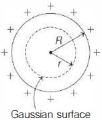
If some charge is given to a solid metallic sphere, the field inside remains zero and by Gauss's law all the charge resides on the surface. Now, suppose that Coulomb's force between two charges varies as $1 / r^{3}$. Then, for a charged solid metallic sphere
  • A
    field inside will be zero and charge density inside will be zero
  • B
    field inside will not be zero and charge density inside will not be zero
  • C
    field inside will not be zero and charge density inside will be zero
  • field inside will be zero and charge density inside will not be zero
Answer

Correct option: D.
field inside will be zero and charge density inside will not be zero
d
$(d)$ As Coulomb's force,

$\quad F \propto \frac{1}{r^{3}}$

$\Rightarrow \text { Electric field, } E \propto \frac{1}{r^{3}} \Rightarrow E=\frac{k q}{r^{3}}$

Now, for Gaussian surface $(r < R)$.

Electric flux linked with surface is

$\phi=\int \frac{k q}{r^{3}} \cdot 2 \pi r d r$

$=2 \pi k q \int \frac{d r}{r^{2}}=2 \pi k q\left(-\frac{1}{r}\right)$

As flux is non-zero, charge density is also non-zero. Also, by symmetry of charge distribution electric field is zero.

Need a full question paper?

Generate a complete, print-ready paper with questions like this in minutes — across 16+ boards, with answer keys.

Start Generating Free

Similar questions

Light described at a place by the equation $\varepsilon = (100V/m)\, [sin(5 \times 10^{15} s^{-1})t + sin (8 \times 10^{15} s^{-1})t]$ falls on a metal surface having work function $2eV$. Calculate the maximum kinetic energy of the photo electrons............... $eV$
A rectangular coil of length $0 .12\, m$ and width $0.1\, m$ having $50$ turns of wire is suspended vertically in a uniform magnetic field of strength $0.2\,\, Weber/m^2.$ The coil carries a current of $2 \,\,A.$ If the plane of the coil is inclined at an angle of $30^o $ with the direction of the field, the torque required to keep the coil in stable equilibrium will be .......$Nm$
The principle of ‘parallax’  is used in the determination of distances of very distant stars. The baseline $AB$ is the line joining the Earth’s two locations six months apart in its orbit around the Sun. That is, the baseline is about the diameter of the Earth’s orbit $\approx 3 \times 10^{11}\;m$. However, even the nearest stars are so distant that with such a long baseline, they show parallax only of the order of $1”$ (second) of arc or so. A parsec is a convenient unit of length on the astronomical scale. It is the distance of an object that will show a parallax of $1”$ (second of arc) from opposite ends of a baseline equal to the distance from the Earth to the Sun. How much is a parsec in terms of metres ?
An electric dipole is placed at an angle of $30^o $ to a nonuniform electric field. The dipole will experience
In a thin spherical fish bowl of radius $10 \,cm$ filled with water of refractive index $\left( {\mu = \frac{4}{3}} \right)$ there is a small fish at a distance of $4\, cm$ from the centre as shown in figure. Where will the image of fish appears, if seen from $F$.....$cm$
If voltage across zener diode is $6\, V$ then find out value of maximum resistance in this condition. (in $k \Omega$)
The magnifying power of an astronomical telescope for relaxed vision is $16$. On adjusting, the distance between the objective and eye lens is $34\, cm$. Then the focal length of objective and eye lens will be respectively
To remove the chromatic aberration, the combination of lenses should be such that
In Young’s double slit experiment, we get $10$ fringes in the field of view of monochromatic light of wavelength $4000{\text{ }}\mathop {\text{A}}\limits^o $. If we use monochromatic light of wavelength $5000{\text{ }}\mathop {\text{A}}\limits^o $, then the number of fringes obtained in the same field of view is
Radioactivity is