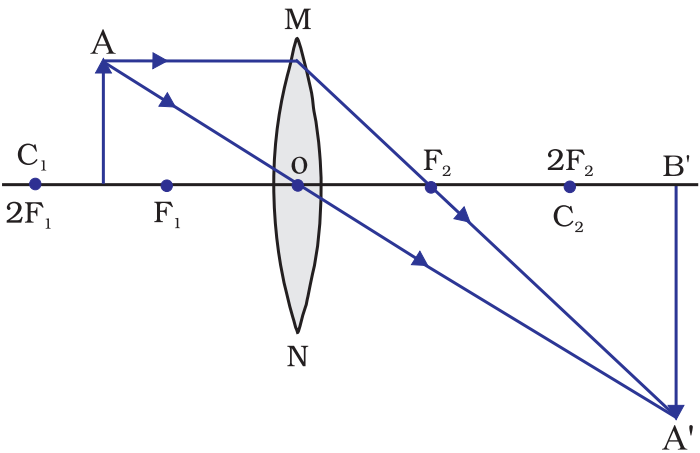
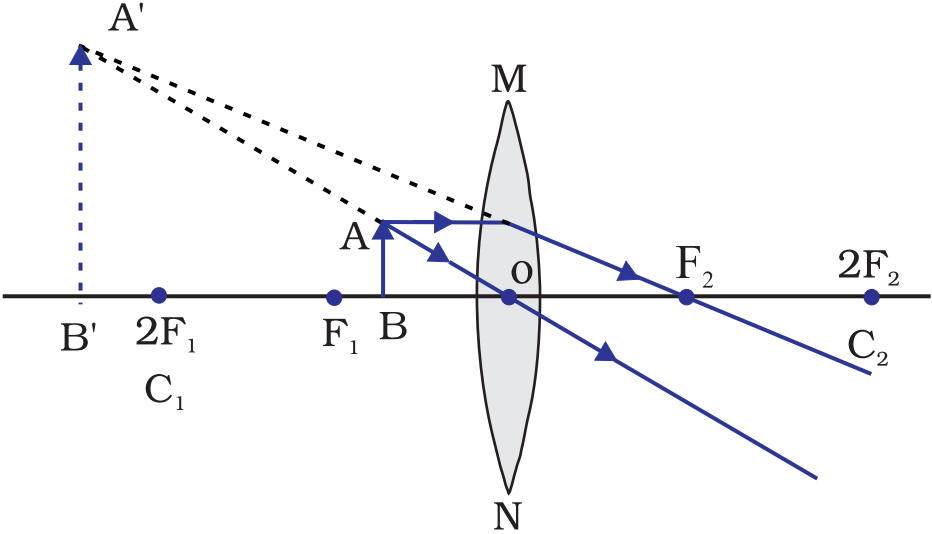
‘‘A lens can form a magnified erect image as well as magnified inverted image of an object placed in front of it.’’ State the nature of this lens and draw ray diagrams to justify the above statement. Mark the positions of O, F and 2F in the diagram.
CBSE OUTSIDE DELHI - SET 3 2017
Download our app for free and get started
- The ray diagram for three times magnified real image is shown below:
- The ray diagram for three times magnified virtual image is shown below:

Download our appand get started for free
Experience the future of education. Simply download our apps or reach out to us for more information. Let's shape the future of learning together!No signup needed.*
Similar Questions
- 1View SolutionA bright object 50mm high stands on the axis of a concave mirror of focal length 100mm and at a distance of 300mm from the concave mirror. How big will the image be?
- 2View SolutionAn object 2cm tall stands on the principal axis of a converging lens of focal length 8cm. Find the position, nature and size of the image formed if the object is:
- 12cm from the lens.
- 6 cm from the lens.
- 3View SolutionThe image of a candle flame placed at a distance of 45 cm from aspherical lens is formed on screen placed at a distance of 90 cm from the lens. Identify the type of lens and calculate its focal length If the height of the flames 2cm, find the height of its image.
- 4View SolutionAn object of size 7.0cm is placed at 27cm in front of a concave mirror of focal length 18cm. At what distance from the mirror should a screen be placed so that a sharp focussed image can be obtained? Find the size and nature of image.
[Hint. Find the value of image distance (v) first. The screen should be placed from the mirror at a distance equal to image distance.] - 5View SolutionThe magnification of an image formed by a lens is -1. If the distance of the image from the optical centre of the lens is 25 cm, where is the object placed? Find the nature and focal length of the lens. If the object is displaced 15 cm towards the optical centre of the lens, where would the image be formed? Draw a ray diagram to justify your answer.
- 6View SolutionIf the image formed by a lens for all positions of the object placed in front of it is always virtual, erect and diminished, state the type of the lens. Draw a ray diagram in support of your answer. If the numerical value of focal length of such a lens is 20 cm, find its power in new cartesian sign conventions.
- 7View SolutionA convex lens of focal length 25cm and a concave lens of focal length 10cm are placed in close contact with one another.
- What is the power of this combination?
- What is the focal length of this combination?
- Is this combination converging or diverging?
- 8View SolutionGiving reasons, state the ‘signs’ (positive or negative) which can be given to the following:
- Object distance (u) for a concave mirror or convex mirror.
- Image distances (v) for a concave mirror.
- Image distances (v) for a convex mirror.
- 9View SolutionAn object is 24cm away from a concave mirror and its image is 16cm from the mirror. Find the focal length and radius of curvature of the mirror, and the magnification of the image.
- 10View SolutionAn erect image 2.0cm high is formed 12cm from a lens, the object being 0.5cm high. Find the focal length of the lens.