A magnetic needle lying parallel to a magnetic field requires $W$ units of work to turn it through $60°$ . The torque required to maintain the needle in this position will be
AIEEE 2003, Diffcult
Download our app for free and get started
(a)$W = MB(\cos {\theta _1} - \cos {\theta _2}) = MB(\cos {0^o} - \cos {60^o})$
$ = MB\,\left( {1 - \frac{1}{2}} \right) = \frac{{MB}}{2}$
and $\tau = MB\sin \theta = MB\sin {60^o} = MB\frac{{\sqrt 3 }}{2}$
$\therefore \;\tau = \left( {\frac{{MB}}{2}} \right)\sqrt 3 \Rightarrow \tau = \sqrt 3 \,W$
$ = MB\,\left( {1 - \frac{1}{2}} \right) = \frac{{MB}}{2}$
and $\tau = MB\sin \theta = MB\sin {60^o} = MB\frac{{\sqrt 3 }}{2}$
$\therefore \;\tau = \left( {\frac{{MB}}{2}} \right)\sqrt 3 \Rightarrow \tau = \sqrt 3 \,W$

Download our appand get started for free
Experience the future of education. Simply download our apps or reach out to us for more information. Let's shape the future of learning together!No signup needed.*
Similar Questions
- 1A long straight wire of radius $a$ carries a steady current $I.$ The current is uniformly distributed over its cross-section. The ratio of the magnetic fields $B$ and $B',$ at radial distances $\frac{a}{2}$ and $2a$ respectively, from the axis of the wire isView Solution
- 2View SolutionA current carrying loop is free to turn in a uniform magnetic field. The loop will then come into equilibrium when its plane is inclined at
- 3When a resistance of $5\,\Omega$ is shunted with a moving coil galvanometer, it shows a full scale deflection for a current of $250\,mA$, however when $1050\,\Omega$ resistance is connected with it in series, it gives full scale deflection for $25$ volt. The resistance of galvanometer is $......\,\Omega$.View Solution
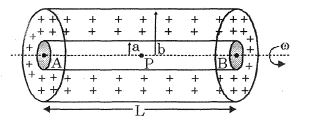
- 4A thick uniformly charged hollow cylinder of inner radius $a$ and outer radius $b$ rotates with constant angular speed $\omega $ about its axis $APB$, charge density$ = \rho $View Solution
Given that $L >>> a$ $L >>> b$ and $P$ is mid point of $AB$. Choose the incorrect option
- 5An electron moves in a circular orbit with a uniform speed $v$. It produces a magnetic field $B$ at the centre of the circle. The radius of the circle is proportional toView Solution
- 6A solenoid of $N$ turn, $'l'$ length and $'r'$ radius of cross - section. If current $i$ flow in solenoid then magnetic field at axial mid point will be (where $l\, \simeq \,\,r$ )View Solution
- 7A shunt of resistance $1\,\Omega $ is connected across a galvanometer of $120\,\Omega $ resistance. A current of $5.5\, ampere$ gives full scale deflection in the galvanometer. The current that will give full scale deflection in the absence of the shunt is nearly ............... $ampere$View Solution
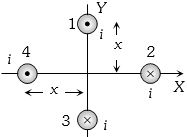
- 8What will be the resultant magnetic field at origin due to four infinite length wires. If each wire produces magnetic field '$B$' at originView Solution
- 9A moving coil galvanometer allows a full scale current of $10^{-4}\, A$. A series resistance of $2\, M\,\Omega $ is required to convert the above galvanometer into a voltmeter of range $0 -5\, V$. Therefore the value of shunt resistance required to convert the above galvanometer into a ammeter of range $0-10\, mA$ is....$\Omega $View Solution
- 10The relation between voltage sensitivity (${\sigma _V}$) and current sensitivity $({\sigma _i})$ of a moving coil galvanometer is (Resistance of Galvanometer = $G$)View Solution