MCQ
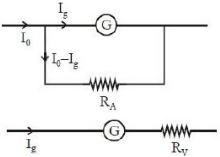
A moving coil galvanometer, having a resistance $G$, produces full scale deflection when a current $I_g$ flows through it. This galvanometer can be converted into $(i)$ an ammeter of range $0$ to $I_0 (I_0 > I_g)$ by connecting a shunt resistance $R_A$ to it and $(ii)$ into a voltmeter of range $0$ to $V(V = GI_0)$ by connecting a series resistance $R_V$ to it. Then,
  • A
    ${R_A}{R_V} = {G^2}$ and $\,\frac{{{R_A}}}{{{R_V}}} = \frac{{{I_g}}}{{\left( {{I_0} - {I_g}} \right)}}$
  • ${R_A}{R_V} = {G^2}$ and $\,\,\frac{{{R_A}}}{{{R_V}}} = {\left( {\frac{{{I_g}}}{{{I_0} - {I_g}}}} \right)^2}$
  • C
    ${R_A}{R_V} = {G^2}\left( {\frac{{{I_g}}}{{{I_0} - {I_g}}}} \right)\,$ and $\,\,\frac{{{R_A}}}{{{R_V}}} = {\left( {\frac{{{I_0} - {I_g}}}{{{I_g}}}} \right)^2}$
  • D
    ${R_A} - {R_V} = {G^2}\left( {\frac{{{I_0} - {I_g}}}{{{I_g}}}} \right)\,$ and $\,\,\frac{{{R_A}}}{{{R_V}}} = {\left( {\frac{{{I_g}}}{{{I_0} - {I_g}}}} \right)^2}$
Answer

Correct option: B.
${R_A}{R_V} = {G^2}$ and $\,\,\frac{{{R_A}}}{{{R_V}}} = {\left( {\frac{{{I_g}}}{{{I_0} - {I_g}}}} \right)^2}$
b
When galvanometer is used an ammeter shunt is used in parallel with galvanometer.

$\therefore \quad \mathrm{I}_{g} \mathrm{G}=\left(\mathrm{I}_{0}-\mathrm{I}_{g}\right) \mathrm{R}_{\mathrm{A}}$

$\therefore \quad R_{A}=\left(\frac{I_{g}}{I_{0}-I_{g}}\right) G$

When galvanometer is used as a voltmeter, resistance is used in series with galvanometer.

$\mathrm{I}_{g}\left(\mathrm{G}+\mathrm{R}_{\mathrm{v}}\right)=\mathrm{V}=\mathrm{GI}_{0}\left(\text { given } \mathrm{V}=\mathrm{GI}_{0}\right)$

$\therefore R_{v}=\frac{\left(I_{0}-I_{g}\right) G}{I_{g}}$

$\therefore \quad {{\text{R}}_{\text{A}}}{{\text{R}}_{\text{v}}} = {{\text{G}}^2}\& \frac{{{{\text{R}}_{\text{A}}}}}{{{{\text{R}}_{\text{v}}}}} = {\left( {\frac{{{{\text{I}}_g}}}{{{{\text{I}}_0} - {{\text{I}}_g}}}} \right)^2}$

Need a full question paper?

Generate a complete, print-ready paper with questions like this in minutes — across 16+ boards, with answer keys.

Start Generating Free

Similar questions

This question contains statement$-1$ and statement$-2$. Of the four choices given after the statements, choose the one that best describes the two statements.

statement$-1$ : The temperature dependence of resistance is usually given as $R=R_{0}(1+\alpha \Delta t)$. The resistance of a wire changes from $100\; \Omega$ to $150\; \Omega$ when its temperature is increased from $27^{\circ} C$ to $227^{\circ} C$. This implies that $\alpha=2.5$ $\times 10^{-3} /{ }^{\circ} C$

statement$-2\;: R=R_{0}(1+\alpha \Delta t)$ is valid only when the change in the temperature $\Delta T$ is small and $\Delta R=\left(R-R_{0}\right) < < R_{0}$

Half life period of a radioactive sample is $T$. Let $x$ fraction disintegrates in time $'t'$. How much fraction will decay in $'\frac{t}{2}'$ time
Assertion : When radius of circular loop carrying current is doubled, its magnetic moment becomes four times.
Reason : Magnetic moment depends on area of the loop.
The thermionic emission of electron is due to
A beam of light propagating in medium $A$ with index of refraction $n(A)$ passes across an interface into medium $B$ with index of refraction $n(B)$. The angle of incidence is greater than the angle of refraction; $v(A)$ and $v(B)$ denotes the speed of light in $A$ and $B.$ Then which of the following is true
An e.m.f.$E = 4\cos (1000t)$ volt is applied to an $LR$-circuit of inductance $3\, mH$ and resistance $4 \,ohms$. The amplitude of current in the circuit is.....$A$
Electric charges of $1\,\mu C,\, - 1\,\mu C$ and $2\,\mu C$ are placed in air at the corners $A$, $B$ and $C$ respectively of an equilateral triangle $ABC$ having length of each side $10 \,cm$. The resultant force on the charge at $C$ is......$N$
The current density is a solid cylindrical wire of radius $R ,$ as a function of radial distance $r$ is given by $J ( r )= J _{0}\left(1-\frac{ r }{ R }\right) .$ The total current in the radial region $r =0$ to $r =\frac{ R }{4}$ will be
During the nuclear fusion reaction
A bar magnet when placed at an angle of $30^{\circ}$ to the direction of magnetic field induction of $5 \times 10^{-2} \mathrm{~T}$, experiences a moment of couple $25 \times 10^{-6} \mathrm{~N}-\mathrm{m}$. If the length of the magnet is $5 \ cm$ its pole strength is