Lenses are constructed by a material of refractive index 1.50. The magnitude of the radii of curvature are 20cm and 30cm. Find the focal lengths of the possible lenses with the above specifications.
Download our app for free and get started
Given $\mu=1.5$
Magnitude of radii of curvatures = 20cm and 30cm
The 4types of possible lens are as below.
$\frac{1}{\text{f}}=(\mu-1)\Big(\frac{1}{\text{R}_1}-\frac{1}{\text{R}_2}\Big)$
Case (1): (Double convex) $[R_1 = +ve,\ R_2 = -ve]$
$\frac{1}{\text{f}}=(15-1)\Big(\frac{1}{20}-\frac{1}{30}\Big)\Rightarrow\text{f}=24\text{cm}$
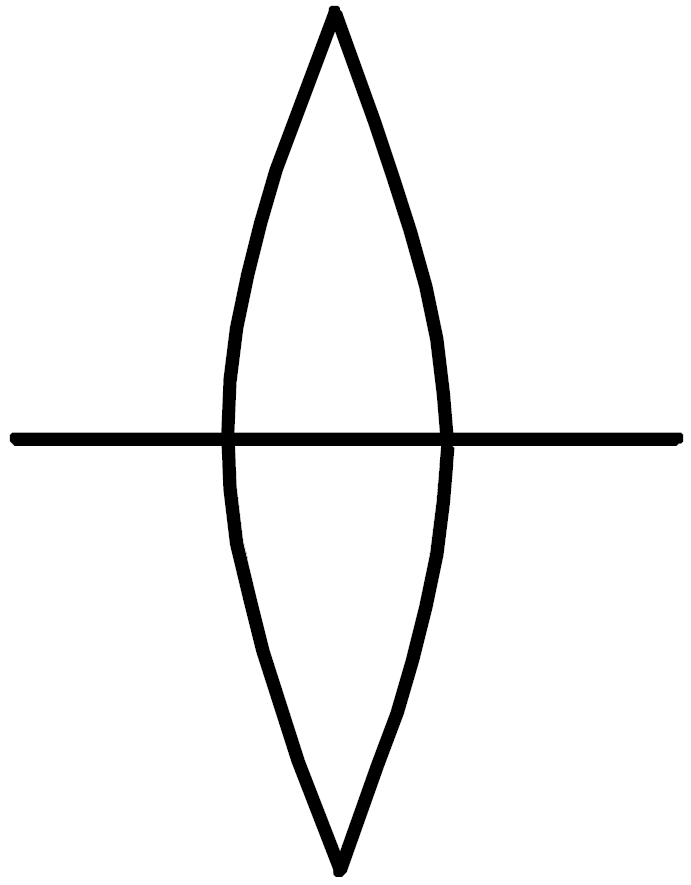
Case (2): (Double concave) $[R_1 = -ve,\ R_2 = +ve]$
$\frac{1}{\text{f}}=(15-1)\Big(\frac{-1}{20}-\frac{1}{30}\Big)\Rightarrow\text{f}=-24\text{cm}$
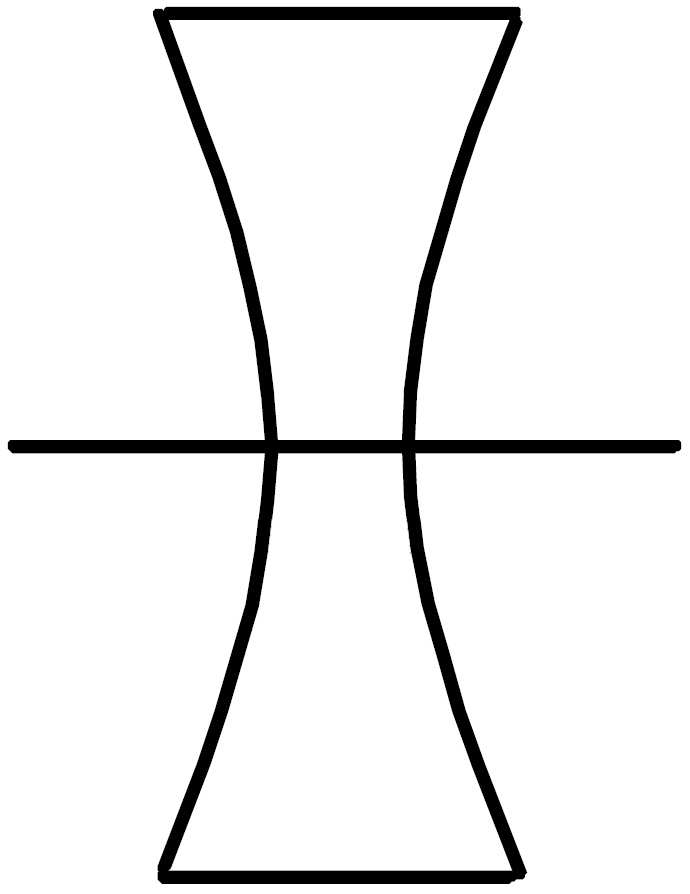
Case (3): (Concave concave) $ [R_1 = -ve,\ R_2 = -ve]$
$\frac{1}{\text{f}}=(15-1)\Big(\frac{1}{-20}-\frac{1}{-30}\Big)\Rightarrow\text{f}=-120\text{cm}$
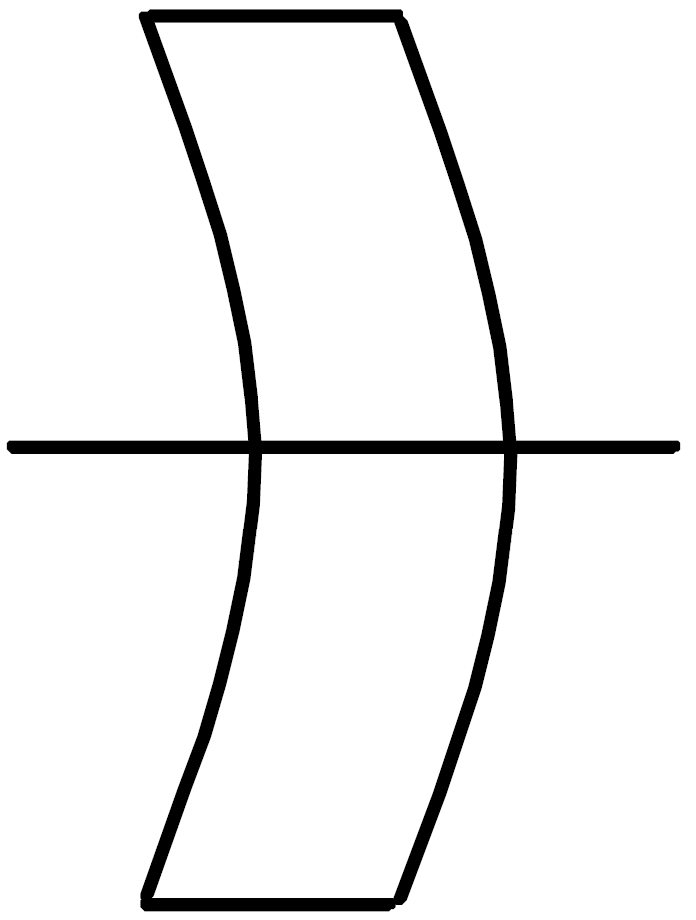
Case (4): (Concave convex) $[R_1 = +ve,\ R_2 = +ve]$
$\frac{1}{\text{f}}=(15-1)\Big(\frac{1}{20}-\frac{1}{30}\Big)\Rightarrow\text{f}=+120\text{cm}$
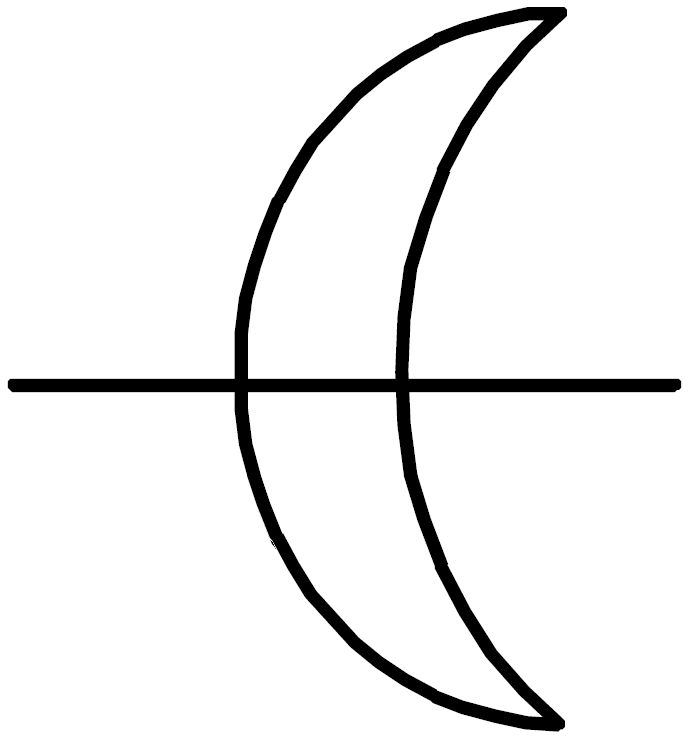
Magnitude of radii of curvatures = 20cm and 30cm
The 4types of possible lens are as below.
$\frac{1}{\text{f}}=(\mu-1)\Big(\frac{1}{\text{R}_1}-\frac{1}{\text{R}_2}\Big)$
Case (1): (Double convex) $[R_1 = +ve,\ R_2 = -ve]$
$\frac{1}{\text{f}}=(15-1)\Big(\frac{1}{20}-\frac{1}{30}\Big)\Rightarrow\text{f}=24\text{cm}$
Case (2): (Double concave) $[R_1 = -ve,\ R_2 = +ve]$
$\frac{1}{\text{f}}=(15-1)\Big(\frac{-1}{20}-\frac{1}{30}\Big)\Rightarrow\text{f}=-24\text{cm}$
Case (3): (Concave concave) $ [R_1 = -ve,\ R_2 = -ve]$
$\frac{1}{\text{f}}=(15-1)\Big(\frac{1}{-20}-\frac{1}{-30}\Big)\Rightarrow\text{f}=-120\text{cm}$
Case (4): (Concave convex) $[R_1 = +ve,\ R_2 = +ve]$
$\frac{1}{\text{f}}=(15-1)\Big(\frac{1}{20}-\frac{1}{30}\Big)\Rightarrow\text{f}=+120\text{cm}$

Download our appand get started for free
Experience the future of education. Simply download our apps or reach out to us for more information. Let's shape the future of learning together!No signup needed.*
Similar Questions
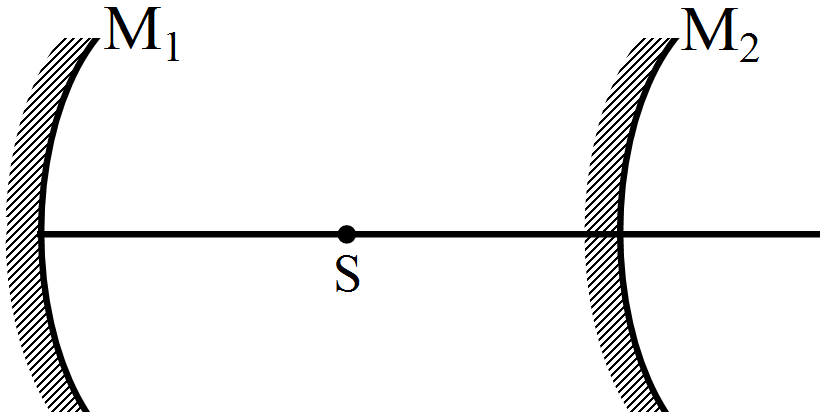
- 1A converging mirror $\mathrm{M}_1$, a point source S and a diverging mirror $\mathrm{M}_2$ are arranged as shown in figure. The source is placed at a distance of 30 cm from $\mathrm{M}_1$. The focal length of each of the mirrors is 20 cm . Consider only the images formed by a maximum of two reflections. It is found that one image is formed on the source itself.View Solution
- Find the distance between the two mirrors.
- Find the location of the image formed by the single reflection from $\mathrm{M}_2$.
- 2View SolutionThe mixture a pure liquid and a solution in a long vertical column (i.e, horizontal dimensions < < vertical dimensions) produces diffusion of solute particles and hence a refractive index gradient along the vertical dimension. A ray of light entering the column at right angles to the vertical is deviated from its original path. Find the deviation in travelling a horizontal distance d < < h, the height of the column.
- 3View Solution
- Draw the ray diagram of an astronomical telescope when the final image is formed at infinity. Write the expression for the resolving power of the telescope.
- An astronomical telescope has an objective lens of focal length 20m and eyepiece of focal length 1cm.
- Find the angular magnification of the telescope.
- If this telescope is used to view the Moon, find the diameter of the image formed by the objective lens. Given the diameter of the Moon is $3.5 \times 10^6m$ and radius of lunar orbit is $3.8 \times 10^8m.$
- 4Derive the lens formula $\frac{1}{\text{f}}=\frac{1}{\text{v}}-\frac{1}{\text{u}}$ for a thin concave lens, using the necessary ray diagram.View Solution
- 5View Solution
- Draw a ray diagram showing the image formation by a compound microscope. Hence obtain expression for total magnification when the image is formed at infinity.
- Distinguish between myopia and hypermetropia. Show diagrammatically how these defects can be corrected.
- 6Show that for a material with refractive index $\mu\geq\sqrt{2}$, light incident at any angle shall be guided along a length perpendicular to the incident face.View Solution
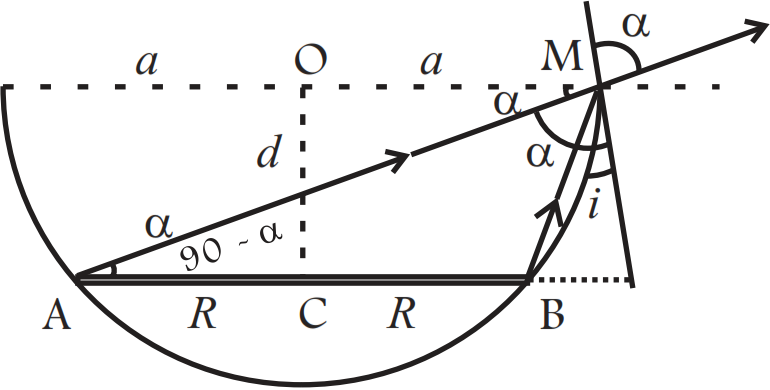
- 7View SolutionA circular disc of radius 'R' is placed co-axially and horizontally inside an opaque hemispherical bowl of radius 'a' (Fig). The far edge of the disc is just visible when viewed from the edge of the bowl. The bowl is filled with transparent liquid of refractive index μ and the near edge of the disc becomes just visible. How far below the top of the bowl is the disc placed?
- 8View Solution
- Draw a ray diagram to show the image formation by a combination of two thin convex lenses in contact. Obtain the expression for the power of this combination in terms of the focal lengths of the lenses.
- A ray of light passing from air through an equilateral glass prism undergoes minimum deviation when the angle of incidence is $\frac{3}{4}^{th}$ of the angle of prism. Calculate the speed of light in the prism.
- 9View SolutionA professor reads a greeting card received on his 50th birthday with +2.5D glasses keeping the card 25cm away. Ten years later, he reads his farewell letter with the same glasses but he has to keep the letter 50cm away. What power of lens should he now use?
- 10View SolutionAn object 1.5 cm in size is placed on the side of the convex lens in the arrangement (a) above. The distance between the object and the convex lens is 40 cm. Determine the magnification produced by the two-lens system, and the size of the image.