A parallel plate capacitor has a uniform electric field $E$ in the space between the plates. If the distance between the plates is $d$ and area of each plate is $A,$ the energy stored in the capacitor is
AIPMT 2008,AIPMT 2011,AIPMT 2012, Medium


Download our appand get started for free
Experience the future of education. Simply download our apps or reach out to us for more information. Let's shape the future of learning together!No signup needed.*
Similar Questions
- 1When a proton is accelerated through $1\,V$, then its kinetic energy will be.....$eV$View Solution
- 2View SolutionThe capacity of the conductor does not depend upon
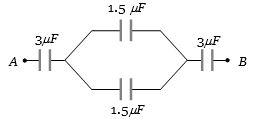
- 3The capacitance between the points $A$ and $B$ in the given circuit will be.......$\mu \,F$View Solution
- 4$64$ drops each having the capacity $C$ and potential $V$ are combined to form a big drop. If the charge on the small drop is $q$, then the charge on the big drop will beView Solution
- 5In a region, the potential is represented by $V(x, y, z) = 6x - 8xy - 8y + 6yz$, where $V$ is in volts and $x, y, z$ are in metres. The electric force experienced by a charge of $2$ coulomb situated at point $( 1, 1, 1)$ isView Solution
- 6With the rise in temperature, the dielectric constant $K$ of a liquidView Solution
- 7A parallel plate capacitor is connected to a battery. The quantities charge, voltage, electric field and energy associated with the capacitor are given by $Q_0, V_0, E_0$ and $U_0$ respectively. A dielectric slab is introduced between plates of capacitor but battery is still in connection. The corresponding quantities now given by $Q, V, E$ and $U$ related to previous ones areView Solution
- 8The work done to take an electron from rest where potential is $-60\, V$ to another point where potential is $-20\, V$ is given by.....$eV$View Solution
- 9A neutral spherical copper particle has a radius of $10 \,nm \left(1 \,nm =10^{-9} \,m \right)$. It gets charged by applying the voltage slowly adding one electron at a time. Then, the graph of the total charge on the particle versus the applied voltage would look likeView Solution
- 10If a charged spherical conductor of radius $10\,cm$ has potential $V$ at a point distant $5\,cm$ from its centre, then the potential at a point distant $15\,cm$ from the centre will beView Solution