A particle executing simple harmonic motion has an amplitude of $6\, cm$. Its acceleration at a distance of $2 \,cm$ from the mean position is $8\,cm/{s^2}$. The maximum speed of the particle is ... $ cm/s$
Easy
Download our app for free and get started
$A = {\omega ^2}y$
$\omega = \sqrt {A/y} = \sqrt {\frac{8}{2}} = 2\,rad/sec$
Now ${v_{\max }} = a\omega = 6 \times 2 = 12\,cm/sec$

Download our appand get started for free
Experience the future of education. Simply download our apps or reach out to us for more information. Let's shape the future of learning together!No signup needed.*
Similar Questions
- 1A mass $m = 8\,kg$ is attahced to a spring as shown in figure and held in position so that the spring remains unstretched. The spring constant is $200\,N/m$. The mass $m$ is then released and begins to undergo small oscillations. The maximum velocity of the mass will be ..... $m/s$ $(g = 10\,m/s^2)$View Solution
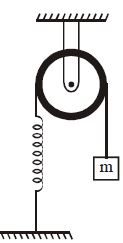
- 2A simple pendulum is suspended from the roof of a trolley which moves in a horizontal direction with an acceleration $a$, then the time period is given by $T = 2\pi \sqrt {\frac{l}{{g'}}} $, where $g'$ is equal toView Solution
- 3A linear harmonic oscillator of force constant $2 \times {10^6}N/m$ and amplitude $0.01\, m$ has a total mechanical energy of $160$ joules. ItsView Solution
- 4A simple harmonic oscillator of angular frequency $2\,rad\,s^{-1}$ is acted upon by an external force $F = sin\,t\,N .$ If the oscillator is at rest in its equilibrium position at $t = 0,$ its position at later times is proportional toView Solution
- 5The displacement of a particle along the $x-$ axis is given by $x=asin^2$$\omega t$ . The motion of the particle corresponds toView Solution
- 6Two simple harmonic motions are represented by the equationsView Solution
${x}_{1}=5 \sin \left(2 \pi {t}+\frac{\pi}{4}\right)$ and ${x}_{2}=5 \sqrt{2}(\sin 2 \pi {t}+\cos 2 \pi {t})$
The amplitude of second motion is ....... times the amplitude in first motion.
- 7For a periodic motion represented by the equation $Y=\sin \omega t+\cos \omega t$ The amplitude of the motion isView Solution
- 8A linear harmonic oscillator of force constant $2 \times 10^6\,Nm^{-1}$ and amplitude $0.01\, m$ has a total mechanical energy of $160\, J.$ ItsView Solution
- 9A body is moving in a room with a velocity of $20\, m / s$ perpendicular to the two walls separated by $5$ meters. There is no friction and the collisions with the walls are elastic. The motion of the body isView Solution
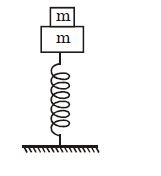
- 10A block of mass $m$ is at rest on an another block of same mass as shown in figure. Lower block is attached to the spring, then the maximum amplitude of motion so that both the block will remain in contact isView Solution