Question
A pendulum clock gives correct time. What is the error in time per day if the length increases by 0.05%?

Answer

$\text{T}=2\pi\sqrt{\frac{\text{L}}{\text{g}}}$ and $\text{T}'=2\pi\sqrt{\frac{\big(\text{L}+\frac{0.05}{100}\text{L}\big)}{\text{g}}}$

Dividing, $\frac{\text{T}'}{\text{T}}=\sqrt{\frac{\big(\text{L}+\frac{0.05}{100}\text{L}\big)}{\text{g}}}$

$=\Big[1+\frac{0.05}{100}\Big]^{\frac{1}2{}}$

Applying binomial theorem, and neglecting squares and higher powers, we get

$\frac{\text{T}'}{\text{T}}=1+\frac{1}{2}\times0.0005$

$\frac{\text{T}'}{\text{T}}-1=0.00025$

$\frac{\text{T}'-\text{T}}{\text{T}}=0.00025$

$\therefore$ Loss of time pre second $=0.00025\text{s}$

Loss of time per day

$=0.00025\times24\times60\times60\text{s}$

$=21.6\text{s}$

Need a full question paper?

Generate a complete, print-ready paper with questions like this in minutes — across 16+ boards, with answer keys.
Start Generating Free

Similar questions

Suppose the rod with the balls A and B of the previous problem is clamped at the centre in such a way that it can rotate freely about a horizontal axis through the clamp. The system is kept at rest in the horizontal position. A particle P of the same mass m is dropped from a height h on the ball B. The particle collides with B and sticks to it:
  1. Find the angular momentum and the angular speed of the system just after the collision.
  2. What should be the minimum value of h so that the system makes a full rotation after the collision.
A rocket accelerates straight up by ejecting gas downwards. In a small time interval $\Delta\text{t},$ it ejects a gas of mass $\Delta\text{m}$ at a relative speed u. Calculate KE of the entire system at $\text{t}+\Delta\text{t}$ and t and show that the device that gas does work $=\Big(\frac{1}{2}\Big)\Delta\text{mu}^2$ in this time interval (neglect gravity).
The coefficient of volume expansion of glycerine is $49 \times 10^{-5} K^{-1}$. What is the fractional change in its density for a $30^{\circ} C$ rise in temperature?
The temperatures of equal masses of three different liquids A, B and C are 12°C, 19°C and 28°C respectively. The temperature when A and B are mixed is 16°C, and when B and C are mixed, it is 23°C. What will be the temperature when A and C are mixed?
Suppose the entire system of the previous question is kept inside an elevator which is coming down with an acceleration a < g. Repeat parts (a) and (b).
One day in the morning, Ramesh filled up 1/ 3 bucket of hot water from geyser, to take bath. Remaining 2/ 3 was to be filled by cold water (at room temperature) to bring mixture to a comfortable temperature. Suddenly Ramesh had to attend to something which would take some times, say 5-10 minutes before he could take bath. Now he had two options:
  1. Fill the remaining bucket completely by cold water and then attend to the work.
  2. First attend to the work and fill the remaining bucket just before taking bath. Which option do you think would have kept water warmer? Explain.
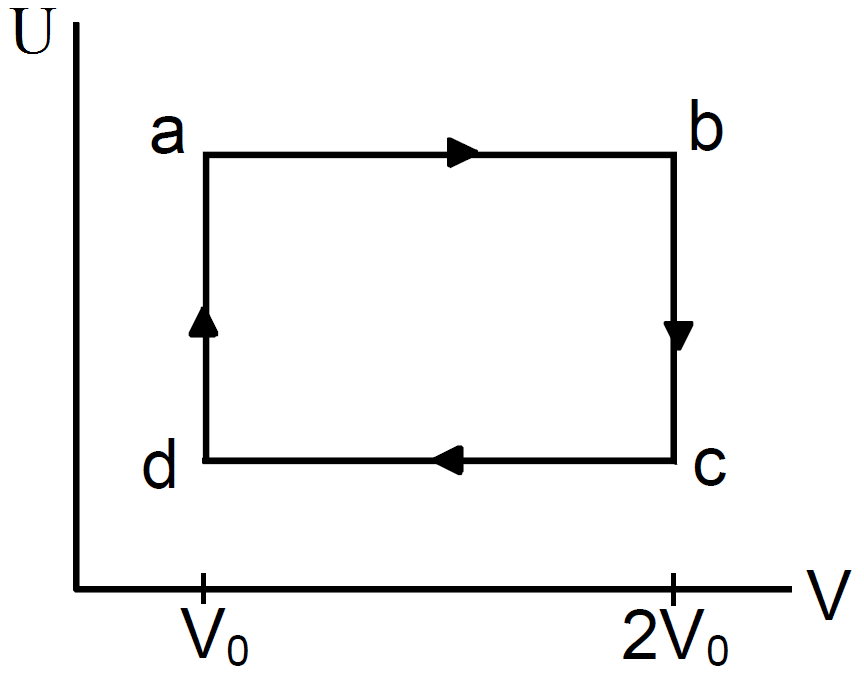
Figure. shows the variation in the internal energy U with the volume V of 2.0mol of an ideal gas in a cyclic process abcda. The temperatures of the gas at b and c are 500K and 300K respectively. Calculate the heat absorbed by the gas during the process.

A car accelerates from rest at a constant rate α for some time, after which it decelerates at a constant rate $\beta$ to come to rest. If t is the total time elapsed, then calculate.
  1. The maximum velocity attained by the car.
  2. The total distance travelled by the car.
Water leaks out from an open tank through a hole of area 2mm2 in the bottom. Suppose water is filled up to a height of 80cm and the area of cross-section of the tank is 0.4m2. The pressure at the open surface and at the hole are equal to the atmospheric pressure. Neglect the small velocity of the water near the open surface in the tank.
  1. Find the initial speed of water coming out of the hole.
  2. Find the speed of water coming out when half of water has leaked out.
  3. Find the volume of water leaked out during a time interval dt after the height remained is h. Thus find the decrease in height dh in terms of h and dt.
  4. From the result of part c find the time required for half of the water to leak out.
What amount of heat must be supplied to 2.0 × 10⁻²kg of nitrogen (at room temperature) to raise its temperature by 45°C at constant pressure? (Molecular mass of N2 = 28; R = 8.3J mol-1 K-1.)