Find the diameter of the image of the moon formed by a spherical concave mirror of focal length 7.6m. The diameter of the moon is 3450km and the distance between the earth and the moon is $3.8 \times 10^5km.$
Download our app for free and get started
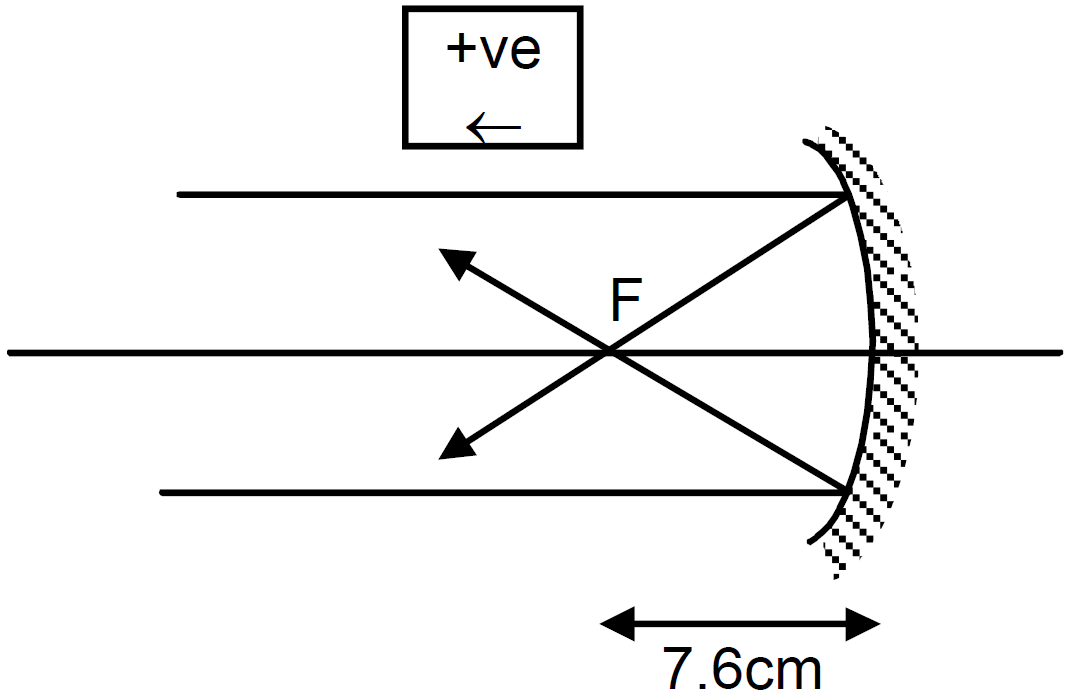
$u = -3.8 \times 10^5km$
diameter of moon $= 3450km ; f = -7.6m$
$\therefore \ \frac{1}{\text{v}}+\frac{1}{\text{u}}=\frac{1}{\text{f}}\Rightarrow\frac{1}{\text{v}}+\Big(-\frac{1}{3.8\times10^5}\Big)=\Big(-\frac{1}{7.6}\Big)$
Since, distance of moon from earth is very large as compared to focal length it can be taken as $\infty.$
⇒ Image will be formed at focus, which is inverted.
$\Rightarrow\frac{1}{\text{v}}=-\Big(\frac{1}{7.6}\Big)\Rightarrow\text{v}=-7.6\text{m}$
$\text{m}=-\frac{\text{v}}{\text{u}}=\frac{\text{d}_{\text{image}}}{\text{d}_{\text{object}}}\Rightarrow\frac{-(-7.6)}{(-3.8\times10^8)}=\frac{\text{d}_{\text{image}}}{3450\times10^3}$
$\text{d}_{\text{image}}=\frac{3450\times7.6\times10^3}{3.8\times10^8}=0.069\text{m}=6.9\text{cm}.$

Download our appand get started for free
Experience the future of education. Simply download our apps or reach out to us for more information. Let's shape the future of learning together!No signup needed.*
Similar Questions
- 1View SolutionThe mixture a pure liquid and a solution in a long vertical column (i.e, horizontal dimensions < < vertical dimensions) produces diffusion of solute particles and hence a refractive index gradient along the vertical dimension. A ray of light entering the column at right angles to the vertical is deviated from its original path. Find the deviation in travelling a horizontal distance d < < h, the height of the column.
- 2View Solution
- Draw a ray diagram to show image formation when the concave mirror produces a real, inverted and magnified image of the object.
- Obtain the mirror formula and write the expression for the linear magnification.
- Explain two advantages of a reflecting telescope over a refracting telescope.
- 3View SolutionLenses are constructed by a material of refractive index 1.50. The magnitude of the radii of curvature are 20cm and 30cm. Find the focal lengths of the possible lenses with the above specifications.
- 4A short object of length L is placed along the principal axis of a concave mirror away from focus. The object distance is u. If the mirror has a focal length f, what will be the length of the image? You may take $L < < |v - f|.$View Solution
- 5A biconvex thick lens is constructed with glass $(\mu=1.50)$ Each of the surfaces has a radius of 10cm and the thickness at the middle is 5cm. Locate the image of an object placed far away from the lens.View Solution
- 6View Solution
- Derive the mathematical relation between refractive indices $n_1$ and $n_2 $ of two radii and radius of curvature R for refraction at a convex spherical surface. Consider the object to be a point since lying on the principle axis in rarer medium of refractive index $n_1$ and a real image formed in the denser medium of refractive index $n_{2}$.Hence, derive lens maker's formula.
- Light from a point source in air falls on a convex spherical glass surface of refractive index 1.5 and radius of curvature 20 cm. The distance of light source from the glass surface is 100 cm. At what position is the image formed?
- 7View Solution
- With the help of a suitable ray diagram, derive the mirror formula for a concave mirror.
- The near point of a hypermetropic person is 50 cm from the eye. What is the power of the lens required to enable the person to read clearly a book held at 25 cm from the eye?
- 8View SolutionAt what angle should a ray of light be incident on the face of a prism of refracting angle 60° so that it just suffers total internal reflection at the other face? The refractive index of the material of the prism is 1.524.
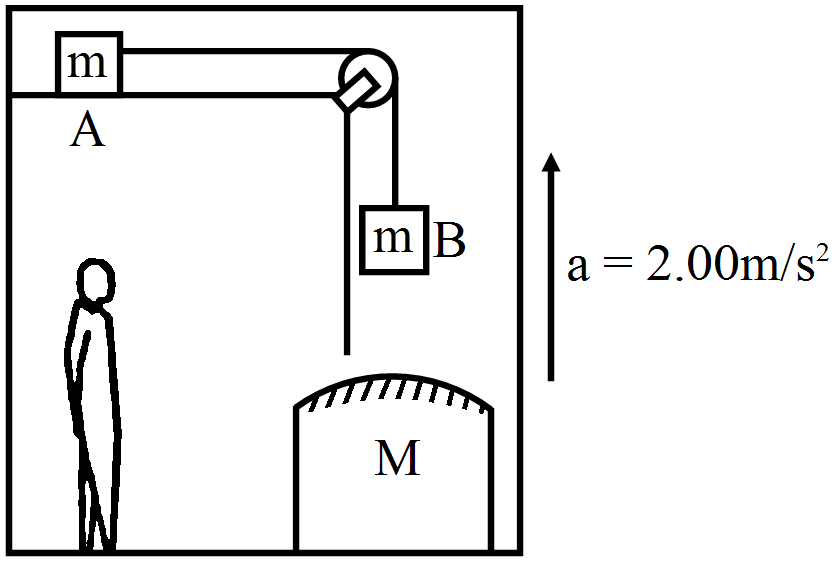
- 9Consider the situation shown in figure. The elevator is going up with an acceleration of $2.00m/s^2$ and the focal length of the mirror is 12.0cm. All the surfaces are smooth and the pulley is light. The mass-pulley system is released from rest (with respect to the elevator) at t = 0 when the distance of B from the mirror is 42.0cm. Find the distance between the image of the block B and the mirror at $t = 0.200s$. Take $g = 10m/s^2$.View Solution
- 10View SolutionAn astronomical telescope is to be designed to have a magnifying power of 50 in normal adjustment. If the length of the tube is 102cm, find the powers of the objective and the eyepiece.