Draw the labelled ray diagram for the formation of image by a compound microscope.Derive the expression for the total magnification of a compound microscope. Explain why both the objective and the eyepiece of a compound microscope must have short focal lengths.
CBSE DELHI - SET 1 2009
Download our app for free and get started
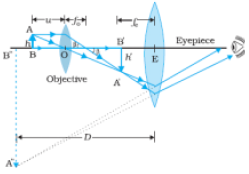
Expression for total magnification: The (linear) magnification due to the objective, namely h’/ h, equals
$\text{m}_{\circ} = \frac{\text{h}'}{\text{h}} = \frac{\text{L}}{\text{f}_{\circ}}$
where we have used the result
$\tan\beta = \bigg(\frac{\text{h}}{f}_{\circ}\bigg) = \bigg(\frac{\text{h}'}{\text{L}}\bigg)$
$\text{L}\cong$ Distance between the second focal point of the objective and the first focal point of the eye piece = tube length of the compound microscope. [When the final image is formed at infinity, the angular magnification due to the eyepiece is
$\text{m}_{e} = \big(\text{D}/f_{e}\big)]$
Alternate Answer
The (angular) magnification $m_e$ ,due to eyepiece, when the final image is formed at the near point, is
$\text{m}_{e} = \bigg(1 + \frac{\text{D}}{f}_{e}\bigg)$
The total magnification when the image is formed at infinity, is
$\text{m} = \text{m}_{\circ}\text{m}_{e} = \bigg(\frac{\text{L}}{f}_{\circ}\bigg)\bigg(\frac{\text{D}}{f}_{e}\bigg)$
Alternate Answer
The total magnification, when the final image is formed at the near point, is
$\text{m} = \text{m}_{\circ}\text{m}_{e} = \frac{\text{L}}{f}_{\circ}\bigg(1 + \frac{\text{D}}{f}_{\circ}\bigg)$
Reason: With short focal lengths of objective and eyepiece the total magnification of the compound microscope increases.

Download our appand get started for free
Experience the future of education. Simply download our apps or reach out to us for more information. Let's shape the future of learning together!No signup needed.*
Similar Questions
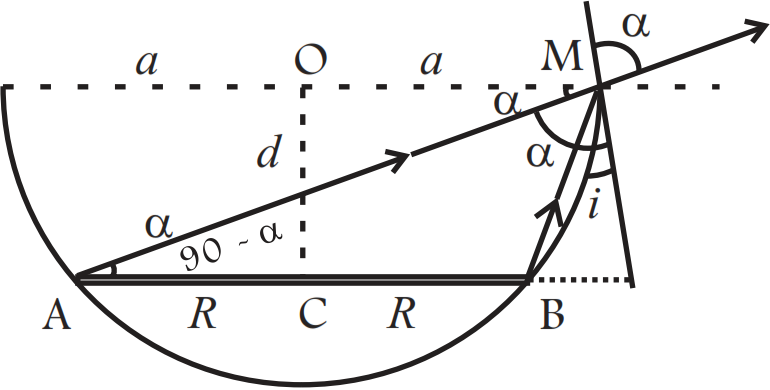
- 1View SolutionA circular disc of radius 'R' is placed co-axially and horizontally inside an opaque hemispherical bowl of radius 'a' (Fig). The far edge of the disc is just visible when viewed from the edge of the bowl. The bowl is filled with transparent liquid of refractive index μ and the near edge of the disc becomes just visible. How far below the top of the bowl is the disc placed?
- 2View SolutionA 4.5 cm needle is placed 12 cm away from a convex mirror of focal length 15 cm. Give the location of the image and the magnification. Describe what happens as the needle is moved farther from the mirror.
- 3Derive the lens formula $\frac{1}{\text{f}}=\frac{1}{\text{v}}-\frac{1}{\text{u}}$ for a thin concave lens, using the necessary ray diagram.View Solution
- 4View Solution
- State Huygen’s principle. Using this principle draw a diagram to show how a plane wave front incident at the interface of the two media gets refracted when it propagates from a rarer to a denser medium. Hence verifiy Snell’s law of refraction.
- When monochromatic light travels from a rarer to a denser medium, explain the following, giving reasons:
- Is the frequency of reflected and refracted light same as the frequency of incident light?
- Does the decrease in speed imply a reduction in the energy carried by light wave?
- 5A card sheet divided into squares each of size $1\ mm^2$ is being viewed at a distance of 9 cm through a magnifying glass (a converging lens of focal length 9 cm) held close to the eye.View Solution
- What is the magnification produced by the lens? How much is the area of each square in the virtual image?
- What is the angular magnification (magnifying power) of the lens?
- Is the magnification in (a) equal to the magnifying power in (b)? Explain.
- 6View Solution
- Draw a labelled ray diagram showing the formation of image by a compound microscope in normal adjustment. Derive the expression for its magnifying power.
- How does the resolving power of a microscope change when.
- The diameter of the objective lens is decreased,
- The wavelength of the incident light is increased.
- 7Three immiscible liquids of densities $d_1 > d_2 > d_3$ and refractive indices $\mu _1 > \mu _2 > \mu _3$ are put in a beaker. The height of each liquid column is $\frac{\text{h}}{3}$. A dot is made at the bottom of the beaker. For near normal vision, find the apparent depth of the dot.View Solution
- 8A small block of mass m and a concave mirror of radius R fitted with a stand lie on a smooth horizontal table with a separation d between them. The mirror together with its stand has a mass m. The block is pushed at t = 0 towards the mirror so that it starts moving towards the mirror at a constant speed V and collides with it. The collision is perfectly elastic. Find the velocity of the image:View Solution
- At a time $\text{t}<\frac{\text{d}}{\text{V}}$
- At a time $\text{t}>\frac{\text{d}}{\text{V}}.$
- 9A ball is kept at a height h above the surface of a heavy transparent sphere made of a material of refractive index $\mu.$ The radius of the sphere is R. At t = 0, the ball is dropped to fall normally on the sphere. Find the speed of the image formed as a function of time for $\text{t}<\sqrt{\frac{2\text{h}}{\text{g}}}.$ Consider only the image by a single refraction.View Solution
- 10View SolutionA myopic adult has a far point at 0.1m. His power of accomodation is 4 diopters.
- What power lenses are required to see distant objects?
- What is his near point without glasses?
- What is his near point with glasses? (Take the image distance from the lens of the eye to the retina to be 2cm.)