The mechanism of the heat produced in a conductor when an electric current flows through it, can be explained on the basis of
Easy


Download our appand get started for free
Experience the future of education. Simply download our apps or reach out to us for more information. Let's shape the future of learning together!No signup needed.*
Similar Questions
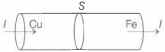
- 1Two rods of copper and iron with the same cross-sectional area are joined at $S$ and a steady current $I$ flows through the rods as shown in the figure. Choose the most appropriate representation of charges accumulated near the junction $S$.View Solution
- 2The electric intensity $E$, current density $j$ and specific resistance $k$ are related to each other by the relationView Solution
- 3Three resistors each of $2\, ohm$ are connected together in a triangular shape. The resistance between any two vertices will beView Solution
- 4A metal wire of specific resistance $64 \times {10^{ - 6}}\,ohm - cm$ and length $198\, cm$ has a resistance of $7\, ohm$, the radius of the wire will be ............. $cm$View Solution
- 5When a resistor of $11 \,\Omega$ is connected in series with an electric cell, the current flowing in it is $0.5\, A$. Instead, when a resistor of $5 \,\Omega$ is connected to the same electric cell in series, the current increases by $0.4\, A$. The internal resistance of the cell is ................ $\Omega$View Solution
- 6A solenoid is at potential difference $60\, V$ and current flows through it is $15$ ampere, then the resistance of coil will be ............ $\Omega$View Solution
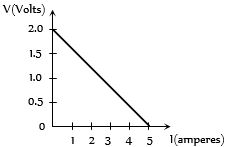
- 7For a cell, the graph between the potential difference $(V) $ across the terminals of the cell and the current $(I)$ drawn from the cell is shown in the figure. The $e.m.f.$ and the internal resistance of the cell areView Solution
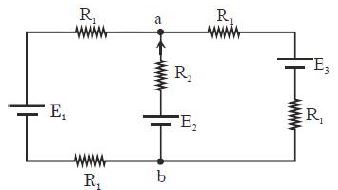
- 8For the circuit shown, with ${R_1} = 1.0\,\Omega $, ${R_2} = 2.0\,\Omega $, ${E_1} = 2\,V$ and ${E_2} = {E_3} = 4\,V$, the potential difference between the points $‘a’$ and $‘b’$ is approximately (in $V$)View Solution
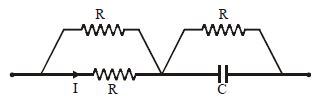
- 9View SolutionThe capacitor shown in fig. is in steady state. The energy stored in the capacitor is
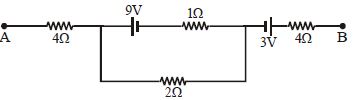
- 10In the circuit shown in figure, potential difference between points $A$ and $B$ is $16\, V$. The current passing through $2\,\Omega $ resistance will be ................. $\mathrm{A}$View Solution