In the given circuit, with steady current, calculate the potential drop across the capacitor and the charge stored in it.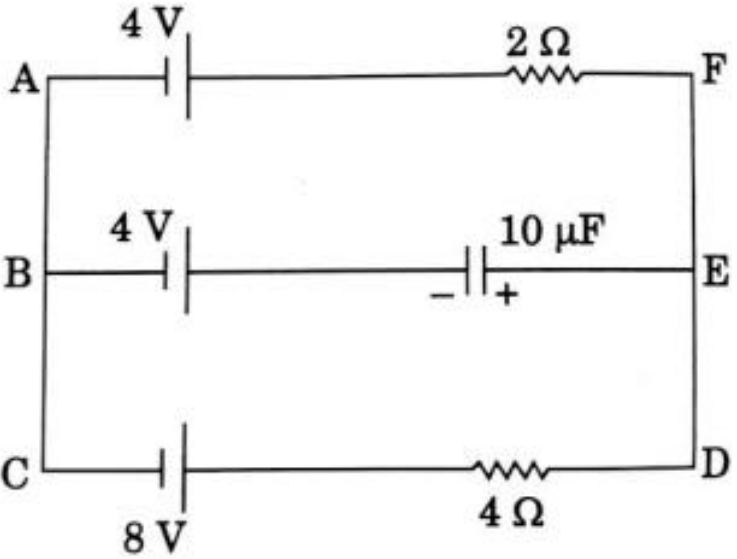
CBSE FOREIGN - SET 3 2017
Download our app for free and get started
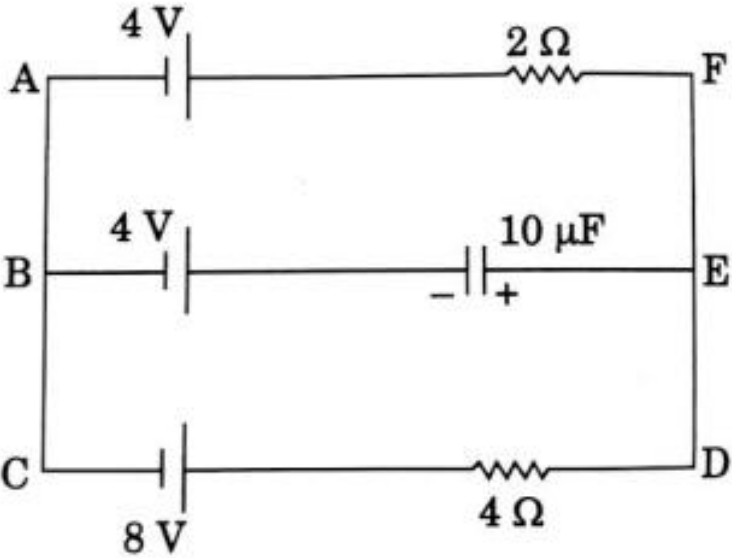 In loop ACDFA
 $I=\bigg[\frac{8-4}{4+2}\bigg]\text{A}=\frac{2}{3}\text{A}$
$V_{AF}=V_{BE}$
$\Rightarrow\text{ }4-2\times\frac{2}{3}=4-V_c$
$\Rightarrow\text{ }V_c=\frac{4}{3}\text{V}$
$\text{Charge}, \text{Q}=CV_c$
$\text{Q}=(10{\mu}\text{F}\times\frac{4}{3})$
$=13.33 \text{ }{\mu}\text{C}$

Download our appand get started for free
Experience the future of education. Simply download our apps or reach out to us for more information. Let's shape the future of learning together!No signup needed.*
Similar Questions
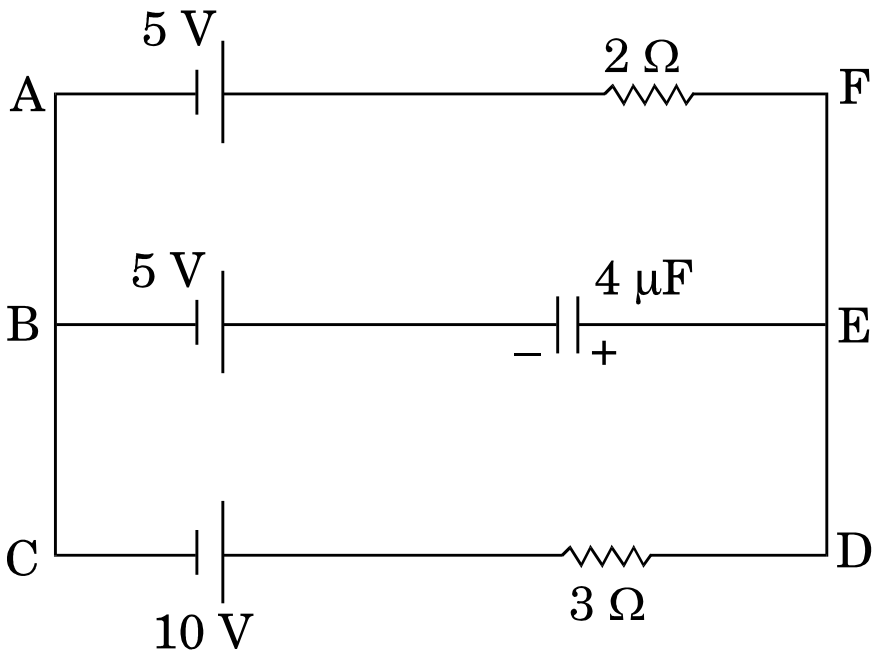
- 1View SolutionIn the given circuit, with steady current, calculate the potential drop across the capacitor in terms of V.
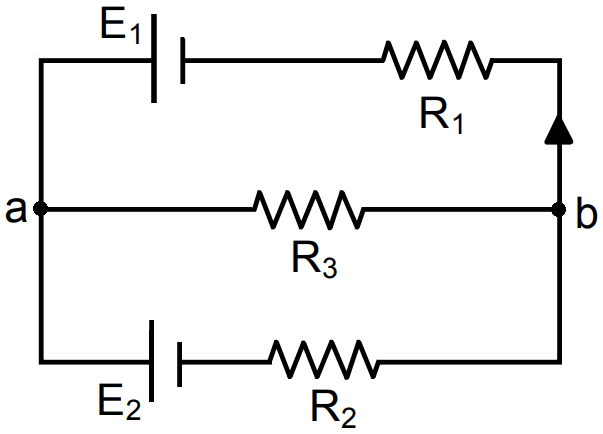
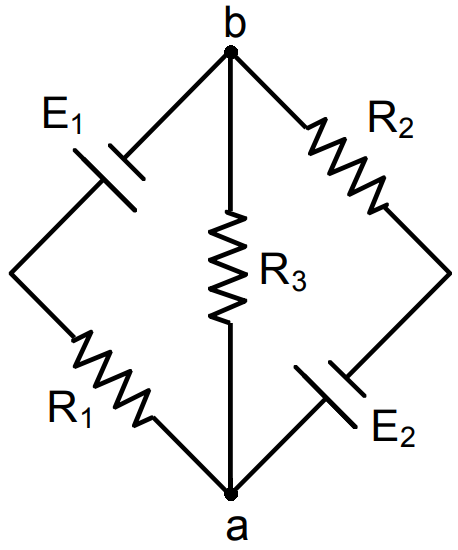
- 2Find the potential difference $V_a - V_b$ in the circuits shown in figure.View Solution
- 3A potentiometer wire of length 1.0 m has a resistance of l5 $\Omega$. It is connected to a 5 V battery in series with a resistance of 5 $\Omega$ Determine the emf of the primary cell which gives a balance point at 60 cm.View Solution
- 4Calculate the temperature at which the resistance of a conductor becomes 20% more than its resistance at 27°C. The value of the temperature coefficient of resistance of the conductor is $2.0 \times 10\frac{-4}{\text{K}}.$View Solution
- 5View Solution
- Derive an expression for drift velocity of free electrons.
- How does drift velocity of electrons in a metallic conductor vary with increase in temperature? Explain.
- 6View SolutionA cell of emf E and internal resistance r is connected across an external resistance R. Plot a graph showing the variation of P.D. across R, verses R.
- 7A capacitor of capacitance $10\mu\text{F}$ is connected across a battery of emf 6.0V through a resistance of $20\text{k}\Omega$ for 4.0s. The battery is then replaced by a thick wire. What will be the charge on the capacitor 4.0s after the battery is disconnected?View Solution
- 8View Solution
- Three resistors $2\ \Omega,\ 4\ \Omega\ \text{and}\ 5\ \Omega$ are combined in parallel. What is the total resistance of the combination?
- If the combination is connected to a battery of emf 20 V and negligible internal resistance, determine the current through each resistor, and the total current drawn from the battery.
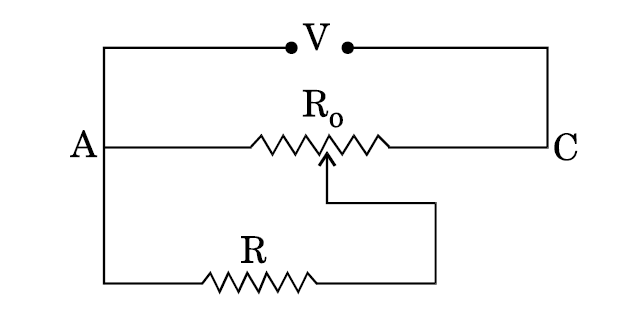
- 9A resistance of $R \Omega$ draws current from a potentiometer as shown in the figure. The potentiometer has a total resistance $R_o\Omega$ . A voltage $V$ is supplied to the potentiometer. Derive an expression for the voltage across $R$ when the sliding contact is in the middle of the potentiometer.View Solution
- 10View Solution
- Define the term ‘conductivity’ of a metallic wire. Write its SI unit.
- Using the concept of free electrons in a conductor, derive the expression for the conductivity of a wire in terms of number density and relaxation time. Hence obtain the relation between current density and the applied electric field E.