A resistance $\text{R}=4\Omega$ is connected to one of the gaps in a meter bridge, which uses a wire of length 1m. An unknown resistance $\text{x}>4\Omega$ is connected in the other gap as shown in the figure. The balance point is noticed at ‘l’ cm from the positive end of the battery. On interchanging R and X, it is found that the balance point further shifts by 20cm (away from the end A). Neglecting the end correction calculate the value of unknown resistance ‘X’ used.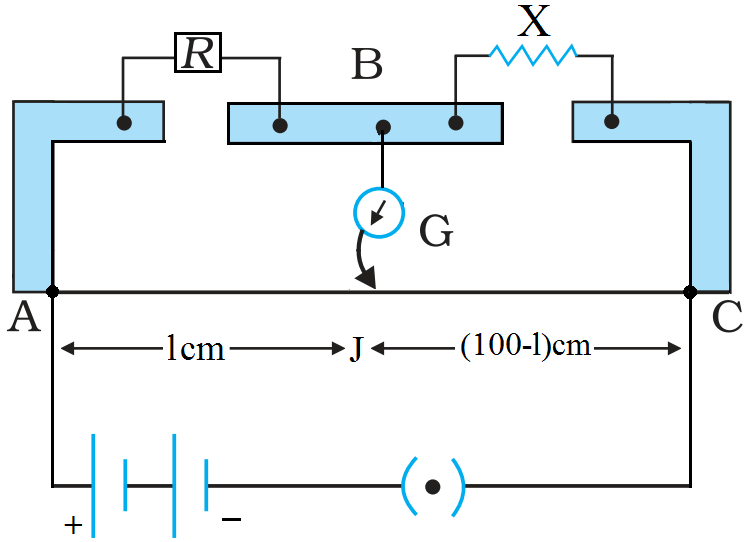
Download our app for free and get started
From 'meter bridge' formula,
$\frac{\text{R}}{\text{X}}=\frac{\text{l}}{100-\text{l}}$
$\Rightarrow\text{X}=\frac{100-\text{l}}{\text{l}}\text{R}$
Given, $\text{R}=4\Omega$
$\therefore\text{X}=\frac{(100-\text{l})}{\text{l}}\times4\Omega\ \dots\text{(i)}$
On interchanging R and X, the balance point is obtained at a distance (l + 20)cm from end A, so
$\frac{\text{X}}{\text{R}}=\frac{\text{l}+20}{100-(\text{l}+20)}$
$\Rightarrow\text{X}=\frac{\text{l}+20}{80-\text{l}}\times4\Omega\ \dots\text{(ii)}$
Equating (i) and (ii)
$\frac{(100-\text{l})}{\text{l}}\times4=\frac{\text{l}+20}{80-\text{l}}\times4$
Solving we get l = 40cm
$\therefore$ Unknown resistance, $\text{X}=\frac{100-\text{l}}{\text{l}}\times\text{4}\Omega=\frac{100-40}{40}\times4\Omega$
$\Rightarrow\text{X}=6\Omega$
$\frac{\text{R}}{\text{X}}=\frac{\text{l}}{100-\text{l}}$
$\Rightarrow\text{X}=\frac{100-\text{l}}{\text{l}}\text{R}$
Given, $\text{R}=4\Omega$
$\therefore\text{X}=\frac{(100-\text{l})}{\text{l}}\times4\Omega\ \dots\text{(i)}$
On interchanging R and X, the balance point is obtained at a distance (l + 20)cm from end A, so
$\frac{\text{X}}{\text{R}}=\frac{\text{l}+20}{100-(\text{l}+20)}$
$\Rightarrow\text{X}=\frac{\text{l}+20}{80-\text{l}}\times4\Omega\ \dots\text{(ii)}$
Equating (i) and (ii)
$\frac{(100-\text{l})}{\text{l}}\times4=\frac{\text{l}+20}{80-\text{l}}\times4$
Solving we get l = 40cm
$\therefore$ Unknown resistance, $\text{X}=\frac{100-\text{l}}{\text{l}}\times\text{4}\Omega=\frac{100-40}{40}\times4\Omega$
$\Rightarrow\text{X}=6\Omega$

Download our appand get started for free
Experience the future of education. Simply download our apps or reach out to us for more information. Let's shape the future of learning together!No signup needed.*
Similar Questions
- 1View SolutionAn electric bulb, when connected across a power supply of 220V, consumes a power of 60W. If the supply drops to 180V, what will be the power consumed? If the supply is suddenly increased to 240V, what will be the power consumed?
- 2View SolutionThe following circuit shows the use of potentiometer to measure the internal resistance of a cell:
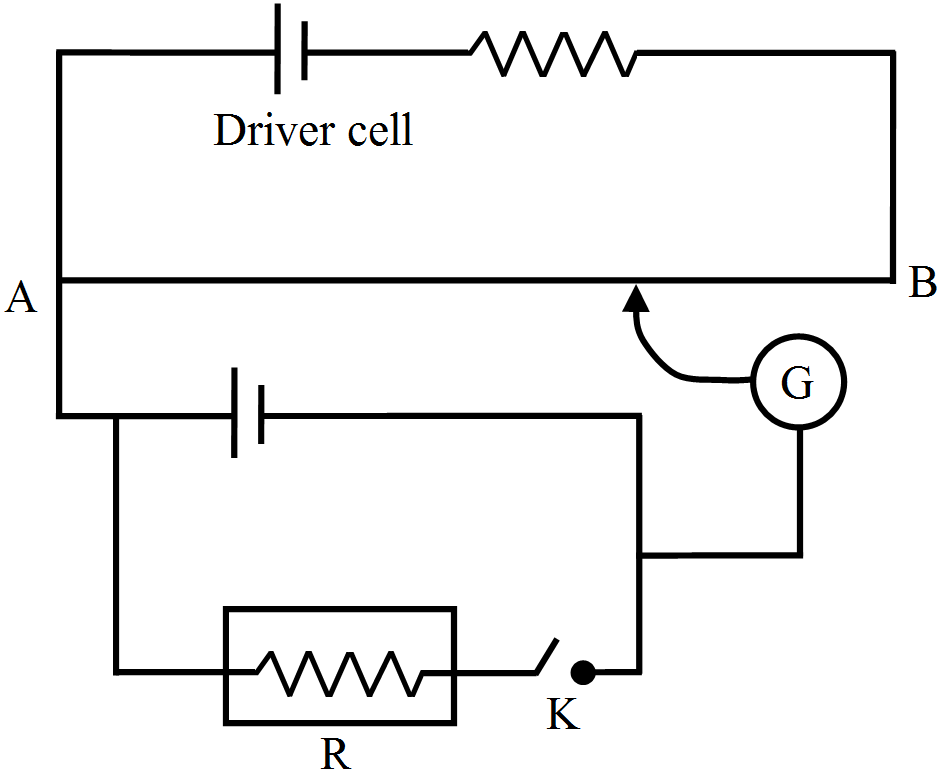
- When the key is open, how does the balance point change, if the current from the driver cell decreases?
- When the key K is closed, how does the balance point change if R is increased keeping current from the driver cell constant?
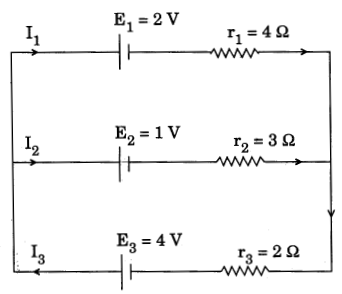
- 3State Kirchhoff’s rules. Use these rules to write the expressions for the currents $I_1, I_2$ and $I_3$ in the circuit diagram shown.View Solution
- 4A coil of resistance $100\Omega$ is connected across a battery of emf $6.0V.$ Assume that the heat developed in the coil is used to raise its temperature. If the heat capacity of the coil is $4.0J/K,$ how long will it take to raise the temperature of the coil by $15^\circ C$?View Solution
- 5View Solution
- Derive an expression for drift velocity of free electrons.
- How does drift velocity of electrons in a metallic conductor vary with increase in temperature? Explain.
- 6View SolutionTwo electric bulbs have the following specifications.
- 100W at 220V.
- 1000W at 220V.
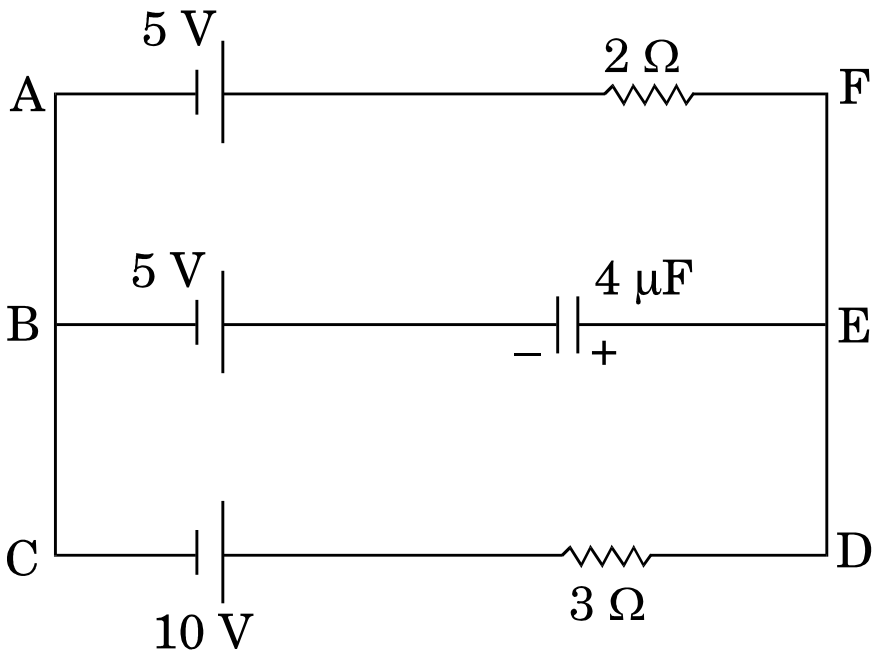
- 7View SolutionIn the given circuit, with steady current, calculate the potential drop across the capacitor in terms of V.
- 8View SolutionElectrons are continuously in motion within a conductor but there is no current in it unless some source of potential is applied across its ends. Give reason.
- 9View SolutionTwo heated wires of the same dimensions are first connected in series and then in parallel to a source of supply. What will be the ratio of heat produced in the two cases?
- 10The number density of free electrons in a copper conductor estimated in Example $3.1$ is $8.5 \times 10^{28}m^{-3}.$ How long does an electron take to drift from one end of a wire $3.0 m$ long to its other end? The area of cross$-$section of the wire is $2.0 \times 10^{-6} m^2$ and it is carrying a current of $3.0 A.$View Solution