Two electric bulbs have the following specifications.
- 100W at 220V.
- 1000W at 220V.
Download our app for free and get started
The resistance of filament,
$\text{R}=\frac{\text{V}}{\text{I}}=\frac{\text{V}^2}{\text{P}}$
At constant voltage V, the resistance,
$\text{R}\propto\frac{1}{\text{p}}$
That is the resistance of filament of 100W bulb is greater than that of 1000W bulb.
The ratio of resistances $=\frac{\text{R}_1}{\text{R}_2}=\frac{\text{P}_2}{\text{P}_1}$
$=\frac{1000}{100} $
$=\frac{10}{1}=10:1$
$\text{R}=\frac{\text{V}}{\text{I}}=\frac{\text{V}^2}{\text{P}}$
At constant voltage V, the resistance,
$\text{R}\propto\frac{1}{\text{p}}$
That is the resistance of filament of 100W bulb is greater than that of 1000W bulb.
The ratio of resistances $=\frac{\text{R}_1}{\text{R}_2}=\frac{\text{P}_2}{\text{P}_1}$
$=\frac{1000}{100} $
$=\frac{10}{1}=10:1$

Download our appand get started for free
Experience the future of education. Simply download our apps or reach out to us for more information. Let's shape the future of learning together!No signup needed.*
Similar Questions
- 1View Solution
- Define the term ‘conductivity’ of a metallic wire. Write its SI unit.
- Using the concept of free electrons in a conductor, derive the expression for the conductivity of a wire in terms of number density and relaxation time. Hence obtain the relation between current density and the applied electric field E.
- 2A storage battery of emf $8.0 V$ and internal resistance $0.5\ \Omega$ is being charged by a $120 V\ dc$ supply using a series resistor of $15.5\ \Omega.$ What is the terminal voltage of the battery during charging? What is the purpose of having a series resistor in the charging circuit?View Solution
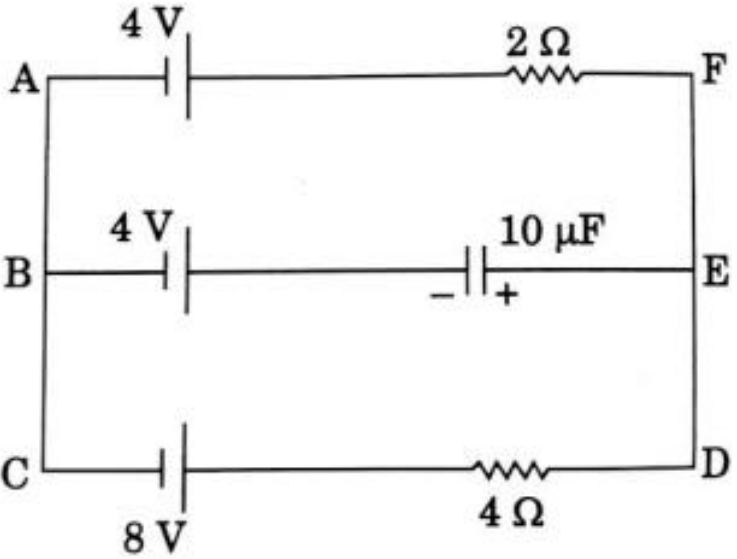
- 3View SolutionIn the given circuit, with steady current, calculate the potential drop across the capacitor and the charge stored in it.
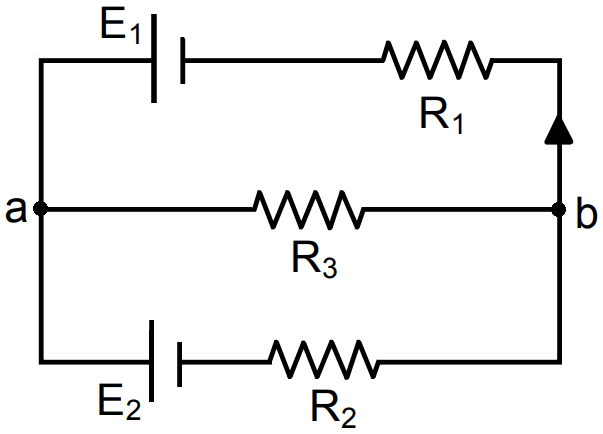
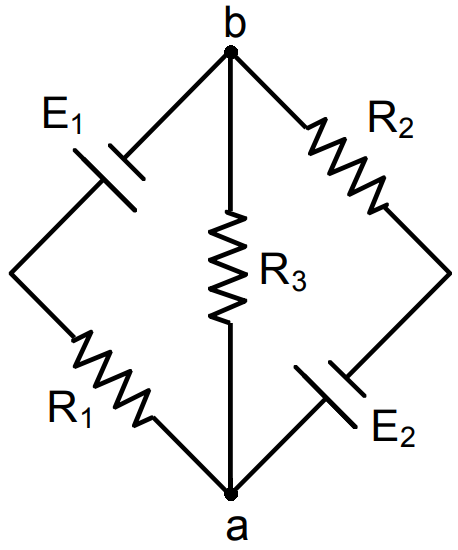
- 4Find the potential difference $V_a - V_b$ in the circuits shown in figure.View Solution
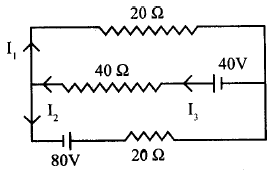
- 5View SolutionState Kirchhoff's rules of current distribution in an electrical network. Using these rules determine the value of the current I1 in the electric circuit given below.
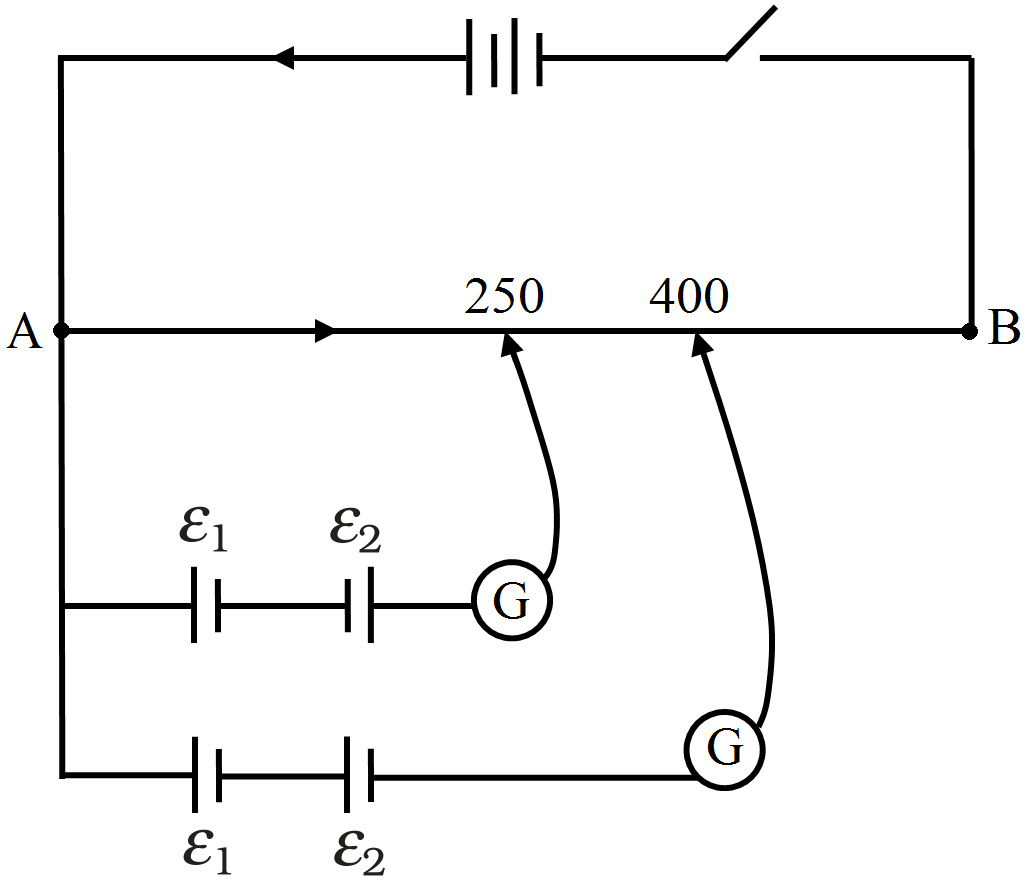
- 6Two primary cells of emfs wire $\varepsilon_1$ and $\varepsilon_2(\varepsilon_1>\varepsilon_2)$ are connected to a potentiometer wire AB as shown in fig. If the balancing lengths for the two combinations of the cells are 250cm and 400cm, find the ratio of $\varepsilon_1$ and $\varepsilon_2.$View Solution
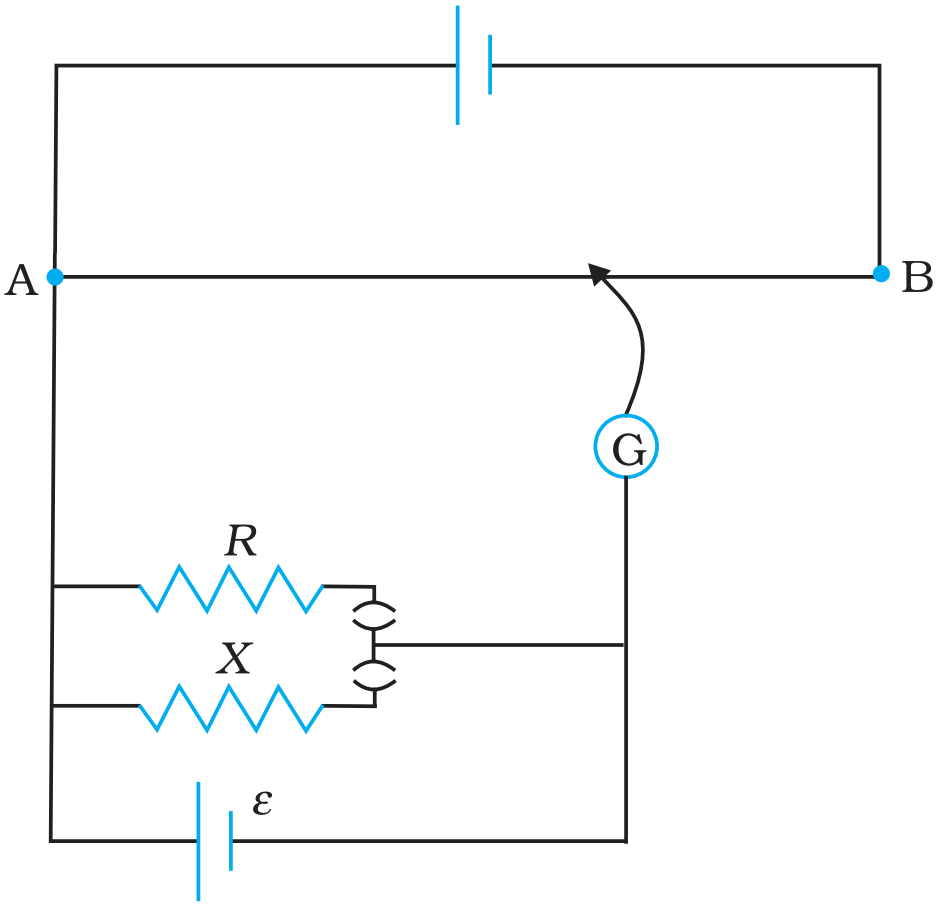
- 7Figure shows a potentiometer circuit for comparison of two resistances. The balance point with a standard resistor $\text{R}=10.0\ \Omega$ is found to be $58.3 \ cm,$ while that with the unknown resistance $X$ is $68.5 \ cm$. Determine the value of $X$. What might you do if you failed to find a balance point with the given cell of emf $\varepsilon?$View Solution
- 8View Solution
- In a metre bridge [Fig. 3.27], the balance point is found to be at 39.5 cm from the end A, when the resistor Y is of $12.5\ \Omega.$ Determine the resistance of X. Why are the connections between resistors in a Wheatstone or meter bridge made of thick copper strips?
- Determine the balance point of the bridge above if X and Y are interchanged.
- What happens if the galvanometer and cell are interchanged at the balance point of the bridge? Would the galvanometer show any current?
- 9View SolutionWhat is the advantage of using thick metallic strips to join wires in a potentiometer?
- 10A heating element using nichrome connected to a $230 V$ supply draws an initial current of $ 3.2 A$ which settles after a few seconds to a steady value of $2.8 A$. What is the steady temperature of the heating element if the room temperature is $27.0^\circ C?$ Temperature coefficient of resistance of nichrome averaged over the temperature range involved is $1.70\times10^{-4}{^\circ\text{C}}^{-1}.$View Solution