A rod is fixed between two points at $20°C$. The coefficient of linear expansion of material of rod is $1.1 \times {10^{ - 5}}/^\circ C$ and Young's modulus is $1.2 \times {10^{11}}\,N/m$. Find the stress developed in the rod if temperature of rod becomes $10°C$
Easy


Download our appand get started for free
Experience the future of education. Simply download our apps or reach out to us for more information. Let's shape the future of learning together!No signup needed.*
Similar Questions
- 1View SolutionIn suspended type moving coil galvanometer, quartz suspension is used because
- 2To break a wire of one meter length, minimum $40 \,kg \,wt$. is required. Then the wire of the same material of double radius and $6 \,m$ length will require breaking weight ....... $kg \,wt$View Solution
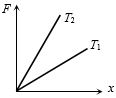
- 3The diagram shows the change $x$ in the length of a thin uniform wire caused by the application of stress $F$ at two different temperatures $T_1$ and $T_2$. The variations shown suggest thatView Solution
- 4When load of $5\,kg$ is hung on a wire then extension of $3\,m$ takes place, then work done will be ....... $joule$View Solution
- 5A sphere contracts in volume by $0.01 \%$ when taken to the bottom of sea $1 \,km$ deep. Find Bulk modulus of the material of sphere ........... $N / m ^2$View Solution
- 6A solid cube of copper of edge $10 \,cm$ subjected to a hydraulic pressure of $7 \times 10^6\, pascal$. If Bulk modulus of copper is $140 \,GPa$, then contraction in its volume will be ................ $m ^3$View Solution
- 7The bulk moduli of ethanol, mercury and water are given as $0.9, 25$ and $2 .2$ respectively in units of $10^9\, Nm^{-2}$ . For a given value of pressure, the fractional compression in volume is $\frac{{\Delta V}}{V}$. Which of the following statements about $\frac{{\Delta V}}{V}$ for these three liquids is correct ?View Solution
- 8View SolutionIf the temperature increases, the modulus of elasticity
- 9Wires $A$ and $B$ are made from the same material. $A$ has twice the diameter and three times the length of $B.$ If the elastic limits are not reached, when each is stretched by the same tension, the ratio of energy stored in $A$ to that in $B$ isView Solution
- 10View SolutionCorrect pair is ..........