MCQ
A $S.H.M.$ is represented by $x = 5\sqrt 2 (\sin 2\pi t + \cos 2\pi t).$ The amplitude of the $S.H.M.$ is .... $cm$
  • $10$
  • B
    $20$
  • C
    $5\sqrt 2 $
  • D
    $50$

Answer

Correct option: A.
$10$
a
(a) $x = 5\sqrt 2 \left( {\sin 2\pi \,t + \cos 2\pi \,t} \right)$
$ = 5\sqrt 2 \sin 2\pi \,t + 5\sqrt 2 \cos 2\pi \,t$
$x = 5\sqrt 2 \sin 2\pi t + 5\sqrt 2 \sin \,\left( {2\pi \,t + \frac{\pi }{2}} \right)$
Phase difference between constituent waves $\phi = \frac{\pi }{2}$
$\therefore $ Resultant amplitude $A = \sqrt {{{(5\sqrt 2 )}^2} + {{(5\sqrt 2 )}^2}} \,=10 \,cm.$

Need a full question paper?

Generate a complete, print-ready paper with questions like this in minutes — across 16+ boards, with answer keys.
Start Generating Free

Similar questions

The dimensions of couple are
A wire of $10^{-2} kgm^{-1}$ passes over a frictionless light pulley fixed on the top of a frictionless inclined plane which makes an angle of $30^o$ with the horizontal. Masses $m$ and $M$ are tied at two ends of wire such that m rests on the plane and $M$ hangs freely vertically downwards. The entire system is in equilibrium and a transverse wave propagates along the wire with a velocity of $100 ms^{^{-1}}$.
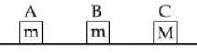
Three blocks $A, B$ and $C$ are lying on a smooth horizontal surface, as shown in the figure. $A$ and $B$ have equal masses, $m$ while $C$ has mass $M$. Block $A$ is given an initial speed $v$ towards $B$ due to which it collides with $B$ perfectly inelastically. The combined mass collides with $C$, also perfectly inelastically. The combined mass collides with $C$, also perfectly inelastically if $\frac{5}{6}^{th}$ of the initial kinetic energy is lost in whole process. What is value of $M/m$ ?
A pendulum is suspended in a lift and its period of oscillation when the lift is stationary is  $T_0$. What must be the acceleration of the lift for the period of oscillation of the  pendulum to be $T_0/2$ ?
In which of the following cases the centre of mass of a rod is certainly not at its centre?
  1. The density continuously increases from left to right.
  2. The density continuously decreases from left to right.
  3. The density decreases from left to right upto the centre and then increases.
  4. The density increases from left to right upto the centre and then decreases.
A tuning fork sends sound waves in air. If the temperature of the air increases, which of the following parameters will change?
A particle of mass $m$ is attached to a light string of length $l$, the other end of which is fixed. Initially the string is kept horizontal and the particle is given an upward velocity $v.$ The particle is just able to complete a circle.
  1. The string becomes slack when the particle reaches its highest point.
  2. The velocity of the particle become zero at the highest point.
  3. The kinetic energy of the ball in initial position was $\frac{1}{2}\text{m}\nu^2=\text{mgl}.$
  4. The particle again passes through the initial position.
A point charge q is rotated along a circle in the electric field generated by another point charge Q. The work done by the electric field on the roatating charge in one complete revolution is:
A solid sphere, a hollow sphere and a disc, all having same mass and radius, are placed at the top of an incline and released. The friction coefficients between the objects and the incline are same and not sufficient to allow pure rolling. Least time will be taken in reaching the bottom by:
A liquid does not wet the solid surface if angle of contact is