MCQ
A spring of force constant $k$ is cut into lengths of ratio $1:2:3$ . They are connected in series and the new force constant is $k'$ . Then they are connected in parallel and force constant is $k''$ . Then $k':k''$ is
  • $1:11$
  • B
    $1:14$
  • C
    $1:16$
  • D
    $1:9$

Answer

Correct option: A.
$1:11$
a
Let us assume, the length of spring be $l$. 

When we cut the spring into ratio of length $1: 2: 3,$ we

get three springs of lengths $\frac{l}{6}, \frac{2 l}{6}$ and $\frac{3 l}{6}$ with force

constant,

$\therefore k_{1}=\frac{k l}{l_{1}}=\frac{k l}{l / 6}=6 k$

${k_{2}=\frac{k l}{l_{2}}=\frac{k l}{2 l / 6}=3 k}$

${k_{3}=\frac{k l}{l_{3}}=\frac{k l}{3 l / 6}=2 k}$

When connected in series,

$\frac{1}{k^{\prime}}=\frac{1}{6 k}+\frac{1}{3 k}+\frac{1}{2 k}=\frac{1+2+3}{6 k}=\frac{1}{k}$

$\therefore \quad \overline{k^{\prime}}=k$

When connected in parallel,

${k^{\prime \prime}=6 k+3 k+2 k=11 k}$

${\frac{k^{\prime}}{k^{\prime \prime}}=\frac{k}{11 k}=\frac{1}{11}}$
Need a full question paper?

Generate a complete, print-ready paper with questions like this in minutes — across 16+ boards, with answer keys.

Start Generating Free

Similar questions

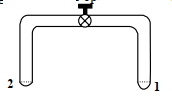
A glass tube of uniform internal radius ( $\mathrm{r}$ ) has a valve separating the two identical ends. Initially, the valve is in a tightly closed position. End $1$ has a hemispherical soap bubble of radius $\mathrm{r}$. End $2$ has sub-hemispherical soap bubble as shown in figure. Just after opening the valve,

Figure: $Image$

A solid cube and a solid sphere of the same material have equal surface area. Both are at the same temperature ${120^o}C$, then
A seconds pendulum clock has a steel wire. The clock shows correct time at $25^{\circ} C$. .......... $s$ time does the clock lose or gain, in one week, when the temperature is increased to $35^{\circ} C$ ? $\left(\alpha_{\text {toel }}=1.2 \times 10^{-5} /{ }^{\circ} C \right)$
There are two force vectors, one of $5\, N$ and other of $12\, N $ at what angle the two vectors be added to get resultant vector of $17\, N, 7\, N $ and $13 \,N$ respectively
Molar specific heat at constant volume, for a non-linear triatomic gas is (vibration mode neglected)
Match List $I$ with List $II$ :

List $I$ (Physical Quantity) List $II$ (Dimensional Formula)
$(A)$ Pressure gradient $(I)$ $\left[ M ^0 L ^2 T ^{-2}\right]$
$(B)$ Energy density $(II)$ $\left[ M ^1 L ^{-1} T ^{-2}\right]$
$(C)$ Electric Field $(III)$ $\left[ M ^1 L ^{-2} T ^{-2}\right]$
$(D)$ Latent heat $(IV)$ $\left[ M ^1 L ^1 T ^{-3} A ^{-1}\right]$

Choose the correct answer from the options given below:

If the equation for the displacement of a particle moving on a circular path is given by $(\theta ) = 2{t^3} + 0.5$, where $\theta $ is in radians and $t$ in seconds, then the angular velocity of the particle after $2 \,sec$ from its start is ......... $rad/sec$
A body falling vertically downwards under gravity breaks in two parts of unequal masses. The centre of mass of the two parts taken together
A Carnot engine take $5000 \,k\,cal$ of heat from a reservoir at $727\,^{\circ}C$ and gives heat to a $\operatorname{sink}$ at $127\,^{\circ}C$. The work done by the engine is $.......... \times 10^{6}\,J$
A black body calorimeter filled with hot water cools from $60^o C$ to $50^o C$ in $4 \,\,min$ and $40^o C$ to $30^o C$ in $8 \,\min$. The approximate temperature of surrounding is  ........ $^oC$