A thermally isolated cylindrical closed vessel of height $8 m$ is kept vertically. It is divided into two equal parts by a diathermic $($perfect thermal conductor$)$ frictionless partition of mass $8.3 kg$. Thus the partition is held initially at a distance of $4 m$ from the top, as shown in the schematic figure below. Each of the two parts of the vessel contains $0.1$ mole of an ideal gas at temperature $300 K$. The partition is now released and moves without any gas leaking from one part of the vessel to the other. When equilibrium is reached, the distance of the partition from the top $($in $m )$ will be $. . . . . ($take the acceleration due to gravity $=10 ms ^{-2}$ and the universal gas constant $=8.3 J mol ^{-1} K ^{-1} ).$
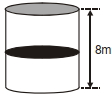
IIT 2020, Advanced
Download our app for free and get started
Assuming temperature remains constant at $300 K$From $P _1 V _1= P _2 V _2$
$\frac{ P _1\left(\frac{ V _0}{2}\right)}{ T }=\frac{ P _1^{\prime}\left(\frac{ V _0}{2}- Ax \right)}{ T }$
$\left( P _1^{\prime}- P _2^{\prime}\right) A = mg$
${\left[\frac{ P _1\left(\frac{ V _0}{2}\right)}{\frac{ V _0}{2}- Ax }-\frac{ P _2\left(\frac{ V _0}{2}\right)}{\frac{ V _0}{2}+ Ax }\right] A = mg }$
$nRT \left[\frac{1}{4- x }-\frac{1}{4+ x }\right]= mg$
$(0.1)(8.3)\left[\frac{4+ x -4+ x }{16- x ^2}\right]= mg$
$3\left(\frac{2 x }{16- x ^2}\right)=1$
$6 x =16- x ^2$
$x ^2+6 x -16=0$
$x =2$
$\text { distance }=4+2=6 m $
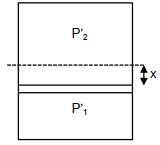
$\frac{ P _1\left(\frac{ V _0}{2}\right)}{ T }=\frac{ P _1^{\prime}\left(\frac{ V _0}{2}- Ax \right)}{ T }$
$\left( P _1^{\prime}- P _2^{\prime}\right) A = mg$
${\left[\frac{ P _1\left(\frac{ V _0}{2}\right)}{\frac{ V _0}{2}- Ax }-\frac{ P _2\left(\frac{ V _0}{2}\right)}{\frac{ V _0}{2}+ Ax }\right] A = mg }$
$nRT \left[\frac{1}{4- x }-\frac{1}{4+ x }\right]= mg$
$(0.1)(8.3)\left[\frac{4+ x -4+ x }{16- x ^2}\right]= mg$
$3\left(\frac{2 x }{16- x ^2}\right)=1$
$6 x =16- x ^2$
$x ^2+6 x -16=0$
$x =2$
$\text { distance }=4+2=6 m $

Download our appand get started for free
Experience the future of education. Simply download our apps or reach out to us for more information. Let's shape the future of learning together!No signup needed.*
Similar Questions
- 1The temperature inside and outside of refrigerator are $260\, K$ and $315\, K$ respectively. Assuming that the refrigerator cycle is reversible, calculate the heat delivered to surroundings for every joule of work done.View Solution
- 2A mono atomic gas is supplied the heat $Q$ very slowly keeping the pressure constant. The work done by the gas will beView Solution
- 3View SolutionA measure of the degree of disorder of a system is known as
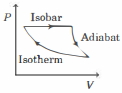
- 4The efficiency of the cycle shown below in the figure (consisting of one isobar, one adiabat and one isotherm) is $50 \%$. The ratio $x$, between the highest and lowest temperatures attained in this cycle obeys (the working substance is an ideal gas)View Solution
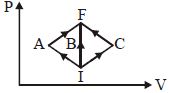
- 5In the $P-V$ diagram, $I$ is the initial state and $F$ is the final state. The gas goes from $I$ to $F$ by $(i)\,IAF,\,\,(ii)\,IBF,\,\,(iii) ICF$. The heat absorbed by the gas isView Solution
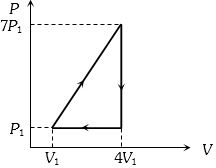
- 6View SolutionIn the cyclic process shown in the figure, the work done by the gas in one cycle is
- 7A diatomic gas initially at $18^o C$ is compressed adiabatically to one-eighth of its original volume. The temperature after compression will beView Solution
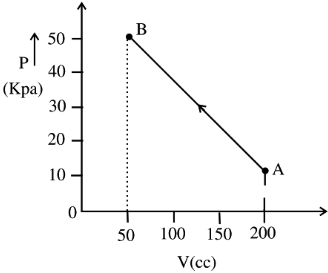
- 8The pressure of a gas changes linearly with volume from $A$ to $B$ as shown in figure. If no heat is supplied to or extracted from the gas then change in the internal energy of the gas will be $............\,J$View Solution
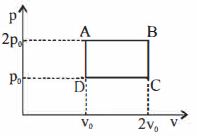
- 9The above $P-V$ diagram represents the thermodynamic cycle of an engine, operating with an ideal monatomic gas. The amount of heat, extracted from the source in a single cycle isView Solution
- 10The temperature of a hypothetical gas increases to $\sqrt 2 $ times when compressed adiabatically to half the volume. Its equation can be written asView Solution