A uniform metal chain is placed on a rough table such that one end of chain hangs down over the edge of the table. When one-third of its length hangs over the edge, the chain starts sliding. Then, the coefficient of static friction is
Medium
Download our app for free and get started
(d) ${\mu _s} = \frac{{{\rm{Lenght\, of \,the\, chain\, hanging \,from \,the \,table }}}}{{{\rm{Length \,of \,the \,chain\, lying \,on\, the \,table}}}}$
$ = \frac{{l/3}}{{l - l/3}} = \frac{{l/3}}{{2l/3}} = \frac{1}{2}$

Download our appand get started for free
Experience the future of education. Simply download our apps or reach out to us for more information. Let's shape the future of learning together!No signup needed.*
Similar Questions
- 1Two blocks $A$ and $B$ of masses $5 \,kg$ and $3 \,kg$ respectively rest on a smooth horizontal surface with $B$ over $A$. The coefficient of friction between $A$ and $B$ is $0.5$. The maximum horizontal force (in $kg$ wt.) that can be applied to $A$, so that there will be motion of $A$ and $B$ without relative slipping, isView Solution
- 2A car is moving on a circular level road of curvature $300\,metres.$ If the coefficient of friction is $0.3$ and acceleration due to gravity is $10\,m/s^2,$ the maximum speed the car can have is ........ $km/hr$View Solution
- 3A block slides down an inclined plane with an acceleration $g/2$ as shown in fig. Then coefficient of kinetic friction isView Solution
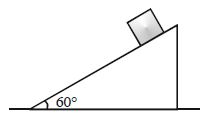
- 4A body is sliding down an inclined plane having coefficient of friction $0.5$. If the normal reaction is twice that of the resultant downward force along the incline, the angle between the inclined plane and the horizontal is ....... $^o$View Solution
- 5A body of mass $1\, kg$ rests on a horizontal floor with which it has a coefficient of static friction $\frac{1}{\sqrt{3}}$. It is desired to make the body move by applying the minimum possible force $F\, N$. The value of $F$ will be the Nearest Integer) [Take $g =10 \,ms ^{-2}$ ]View Solution
- 6A heavy box is solid across a rough floor with an initial speed of $4 \,m / s$. It stops moving after $8$ seconds. If the average resisting force of friction is $10 \,N$, the mass of the box (in $kg$ ) is .....View Solution
- 7On a rough horizontal surface, a body of mass $2 \,kg$ is given a velocity of $10 \,m/s$. If the coefficient of friction is $0.2$ and $g = 10\, m/{s^2}$, the body will stop after covering a distance of ........ $m$View Solution
- 8A block of mass $m$ is placed on a surface having vertical cross section given by $y=x^2 / 4$. If coefficient of friction is $0.5$ , the maximum height above the ground at which block can be placed without slipping is:View Solution
- 9A block is projected upwards on an inclined plane of inclination $37^o$ along the line of greatest slope of $\mu = 0.5$ with velocity of $5 m/s$. The block $1^{st}$ stops at $a$ distance of .......... $m$ from starting pointView Solution
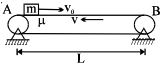
- 10With what minimum velocity should block be projected from left end $A$ towards end $B$ such that it reaches the other end $B$ of conveyer belt moving with constant velocity $v$. Friction coefficient between block and belt is $\mu$ .View Solution