Question
A wave $\text{Y} = \text{A}\sin(\omega\text{t} - \text{kx})$ allowed through a string gets reflected from a rigid support and forms stationary wave. Derive the expression for the standing wave.

Answer

Given wave: $\text{Y}_\text{i}=\text{A}\sin(\omega\text{t}-\text{Kx})$
Reflected wave:
$\text{Y}_\text{r}=\text{A}\sin (\omega\text{t}+\text{Kx}+\pi)$
$=-\text{A}\sin(\omega\text{t}+\text{Kx})$

Applying superposition principle,
$\text{y}=\text{Y}_\text{i}+\text{Y}_\text{r}$
$=\text{A}\sin(\omega\text{t}-\text{Kx})-\text{A}\sin(\omega\text{t}+\text{Kx})$
$\text{y}=2\text{A}\sin\text{Kx}\cos\omega\text{t}$
Since amplitude $2\text{A}\sin\text{Kx}$ varies with position, it represents a standing wave.

Need a full question paper?

Generate a complete, print-ready paper with questions like this in minutes — across 16+ boards, with answer keys.
Start Generating Free

Similar questions

A comet revolves around the sun in a highly elliptical orbit having a minimum distance of $7 \times 10^{10}m$ and a maximum distance of $1.4 \times 10^{13}m$. If its speed while nearest to the Sun is $60km s^{-1}$, find its linear speed when situated farthest from the Sun.
What is the gravitational potential and gravitational potential energy of a body of $0.2kg$ at a height $1600km$ above the surface of the earth? ($G= 6.67 \times 10^{-11}Nm^2kg^{-2}$, mass of the earth = $6 \times 10^{24}kg$ and radius of the earth = $6400km$).
A body of mass m falls from a height h on to the pan of a spring balance. The masses of the pan and spring are negligible. The spring constant of the spring is k. Having stuck to the pan the body starts performing harmonic oscillations in the vertical direction. Find the amplitude and energy of oscillation.
Obtain an expression for the moment of inertia of a disc relative to its geometric axis.
What is gravitational potential? Find the expression for gravitational potential energy. A $400kg$ satellite is in a circular orbit of radius $2R_E$ about the earth. Calculate the kinetic energy, potential energy and total energy of the satellite. Given that radius of Earth $R_E = 6.4 \times 10^6m$ and mass of Earth $M = 6 \times 10^{24}kg$.
The angle between the resultant contact force and the normal force exerted by a body on the other is called the angle of friction. Show that, if $\lambda$ be the angle of friction and la the coefficient of static friction, $\lambda\leq\tan^{-1}\mu.$
Show that a(b × c) is equal in magnitude to the volume of the parallelepiped formed on the three vectors a, b and c.
Answer the following:
What is the temperature of the triple-point of water on an absolute scale whose unit interval size is equal to that of the Fahrenheit scale?
A charge Q is uniformly distributed on a thin spherical shell. What is the field at the centre of the shell? If a point charge is brought close to the shell, will the field at the centre change? Does your answer depend on whether the shell is conducting or nonconducting?
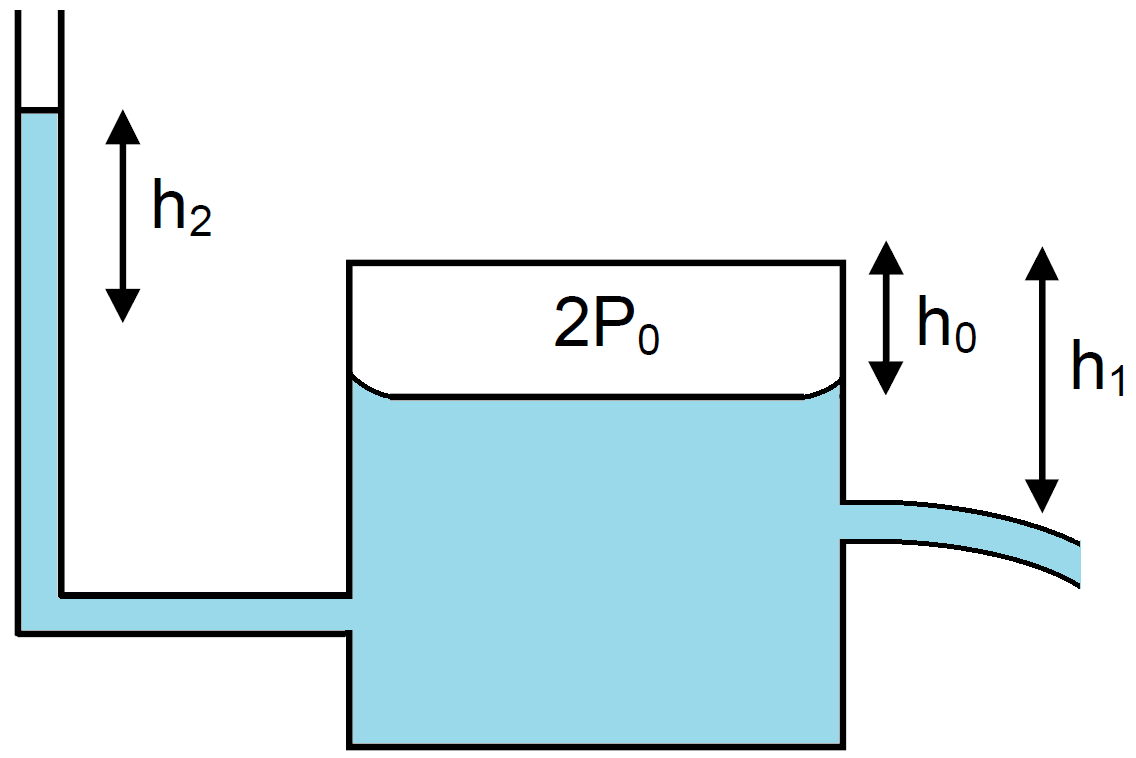
Figure. shows a large closed cylindrical tank containing water. Initially the air trapped above the water surface has a height $h_0$ and pressure $2p_0$ where $p_0$ is the atmospheric pressure. There is a hole in the wall of the tank at a depth $h_1$ below the top from which water comes out. A long vertical tube is connected as shown.
  1. Find the height $h_2$ of the water in the long tube above the top initially.
  2. Find the speed with which water comes out of the hole.
  3. Find the height of the water in the long tube above the top when the water stops coming out of the hole.