Show that a(b × c) is equal in magnitude to the volume of the parallelepiped formed on the three vectors a, b and c.
Exercise
Download our app for free and get started
A parallelepiped with origin O and sides a, b, and c is shown in the following figure: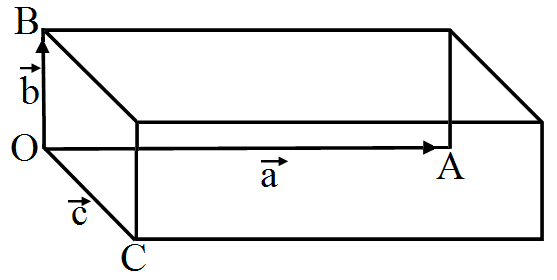
Volume of the given parallelepiped = abc $\vec{\text{O}}\text{C}=\vec{\text{a}}$ $\vec{\text{O}}\text{B}=\vec{\text{b}}$ $\vec{\text{O}}\text{C}=\vec{\text{c}}$ Let $\widehat{\text{n}}$ be a unit vector perpendicular to both b and c. Hence, $\widehat{\text{n}}$ and a have the same direction. $\therefore\ \vec{\text{b}}\times\vec{\text{c}}=\text{bc}\sin\theta\widehat{\text{n}}$ $=\text{bc}\sin90^{\circ}\widehat{\text{n}}$ $=\text{bc}\widehat{\text{n}}$ $\vec{\text{a}}\cdot\big(\vec{\text{b}}\times\vec{\text{c}}\big)$ $=\text{a}\cdot(\text{bc}\widehat{\text{n}})$ $=\text{abc}\cos\theta\widehat{\text{n}}$ $=\text{abc}\cos0^{\circ}$ $=\text{abc}$ = Volume of the parallelepiped.
Volume of the given parallelepiped = abc $\vec{\text{O}}\text{C}=\vec{\text{a}}$ $\vec{\text{O}}\text{B}=\vec{\text{b}}$ $\vec{\text{O}}\text{C}=\vec{\text{c}}$ Let $\widehat{\text{n}}$ be a unit vector perpendicular to both b and c. Hence, $\widehat{\text{n}}$ and a have the same direction. $\therefore\ \vec{\text{b}}\times\vec{\text{c}}=\text{bc}\sin\theta\widehat{\text{n}}$ $=\text{bc}\sin90^{\circ}\widehat{\text{n}}$ $=\text{bc}\widehat{\text{n}}$ $\vec{\text{a}}\cdot\big(\vec{\text{b}}\times\vec{\text{c}}\big)$ $=\text{a}\cdot(\text{bc}\widehat{\text{n}})$ $=\text{abc}\cos\theta\widehat{\text{n}}$ $=\text{abc}\cos0^{\circ}$ $=\text{abc}$ = Volume of the parallelepiped.

Download our appand get started for free
Experience the future of education. Simply download our apps or reach out to us for more information. Let's shape the future of learning together!No signup needed.*
Similar Questions
- 1The angular speed of a motor wheel is increased from $1200$ rpm to $3120$ rpm in $16$ seconds. $(i)$ What is its angular acceleration, assuming the acceleration to be uniform? $(ii)$ How many revolutions does the engine make during this time?View Solution
- 2View SolutionFind the centre of mass of a uniform:
- Half-disc.
- Quarter-disc.
- 3Two discs of moments of inertia $I_1$ and $I_2$ about their respective axes (normal to the disc and passing through the centre), and rotating with angular speeds $\omega_1$ and $\omega_2$ are brought into contact face to face with their axes of rotation coincident.View Solution
- What is the angular speed of the two-disc system?
- Show that the kinetic energy of the combined system is less than the sum of the initial kinetic energies of the two discs. How do you account for this loss in energy? Take $\omega_1\neq\omega_2$
- 4A comet revolves around the sun in a highly elliptical orbit having a minimum distance of $7 \times 10^{10}m$ and a maximum distance of $1.4 \times 10^{13}m$. If its speed while nearest to the Sun is $60km s^{-1}$, find its linear speed when situated farthest from the Sun.View Solution
- 5Prove that the velocity v of translation of a rolling body (like a ring, disc, cylinder or sphere) at the bottom of an inclined plane of height h is given by:$\text{v}^2=\frac{2\text{gh}}{\big(1+\frac{\text{K}^2}{\text{R}^2}\big)}$View Solution
Note K is the radius of gyration of the body about its symmetry axis, and R is the radius of the body. The body starts from rest at the top of the plane. - 6Prove the result that the velocity v of translation of a rolling body (like a ring, disc, cylinder or sphere) at the bottom of an inclined plane of a height h is given by $\text{v}^2=\frac{2\text{gh}}{\Big(\frac{1+\text{k}^2}{\text{R}^2}\Big)}$ using dynamical consideration (i.e. by consideration of forces and torques).View Solution
Note: k is the radius of gyration of the body about its symmetry axis, and R is the radius of the body. The body starts from rest at the top of the plane. - 7View SolutionA uniform rod of length L lies on a smooth horizontal table. A particle moving on the table strikes the rod perpendicularly at an end and stops. Find the distance travelled by the centre of the rod by the time it turns through a right angle. Show that if the mass of the rod is four times that of the particle, the collision is elastic.
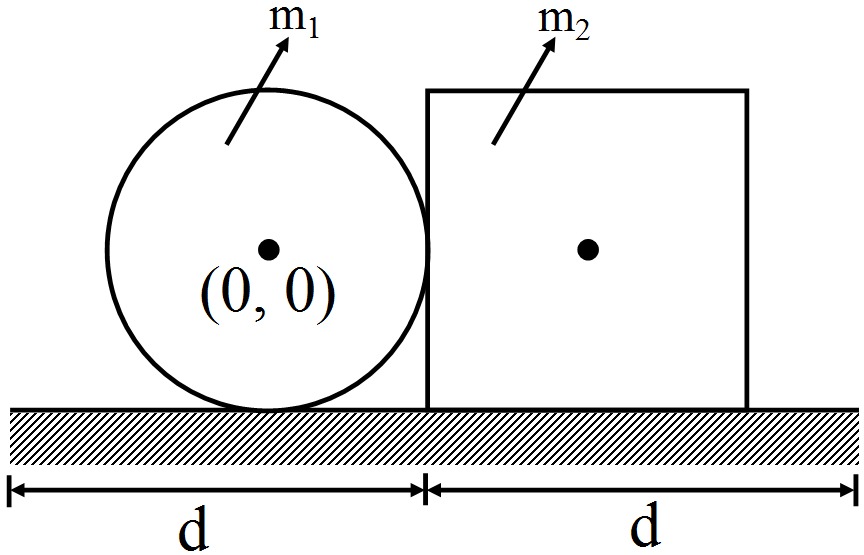
- 8View SolutionA square plate of edge d and a circular disc of diameter d are placed touching each other at the midpoint of an edge of the plate as shown in figure. Locate the centre of mass of the combination, assuming same mass per unit area for the two plates.
- 9A grindstone has a moment of inertia of $6kg m^2$. A constant torque is applied and the grindstone is found to have a speed of $150rpm, 10s$. after starting from rest. Calculate the torque.View Solution
- 10View SolutionTwo particles, each of mass m and speed v, travel in opposite directions along parallel lines separated by a distance d. Show that the angular momentum vector of the two particle system is the same whatever be the point about which the angular momentum is taken.