An electron is moving in a circular path under the influence of a transverse magnetic field of $3.57 \times 10^{-2}\, T $. If the value of $e/m$ is $1.76 \times 10^{11}\, C/kg $, the frequency of revolution of the electron is
NEET 2016, Medium


Download our appand get started for free
Experience the future of education. Simply download our apps or reach out to us for more information. Let's shape the future of learning together!No signup needed.*
Similar Questions
- 1View SolutionWhich of the following gives the value of magnetic field according to, Biot-Savart’s law’
- 2View SolutionElectrons moving with different speeds enter a uniform magnetic field in a direction perpendicular to the field. They will move along circular paths.
- 3In the following hexagons, made up of two different material $P$ and $Q,$ current enters and leaves from points $X$ and $Y$ respectively. In which case the magnetic field at its centre is not zero.View Solution
- 4${10^{ - 3}}amp$ is flowing through a resistance of $1000\,\Omega $. To measure the correct potential difference, the voltmeter is to be used of which the resistance should beView Solution
- 5A current $i$ is flowing in a straight conductor of length $L.$ The magnetic induction at a point on its axis at a distance $\frac {L}{4}$ from its centre will beView Solution
- 6View SolutionThe sensitiveness of a moving coil galvanometer can be increased by decreasing
- 7A long conducting wire having a current $I$ flowing through it, is bent into a circular coil of $N$ turns.Then it is bent into a circular coil of $n$ tums. The magnetic field is calculated at the centre of coils in both the cases. The ratio of the magnetic field in first case to that of second case is:View Solution
- 8A galvanometer has a resistance of $50\ \Omega$ and it allows maximum current of $5 \mathrm{~mA}$. It can be converted into voltmeter to measure upto $100 \mathrm{~V}$ by connecting in series a resistor of resistanceView Solution
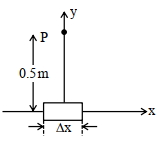
- 9An element $\Delta l=\Delta \mathrm{xi}$ is placed at the origin and carries a large current $\mathrm{I}=10 \mathrm{~A}$. The magnetic field on the $y$-axis at a distance of $0.5 \mathrm{~m}$ from the elements $\Delta \mathrm{x}$ of $1 \mathrm{~cm}$ length is:View Solution
- 10Through two parallel wires $A$ and $B$, $10$ and $2$ $ampere$ of currents are passed respectively in opposite direction. If the wire $A$ is infinitely long and the length of the wire $B$ is $ 2\, m$, the force on the conductor $B$, which is situated at $10\, cm$ distance from $A$ will beView Solution