An engineer claims to have made an engine delivering $10 kW$ power with fuel consumption of $1 g/sec$. The calorific value of the fuel is $2 kcal/g$. Is the claim of the engineer
Medium
Download our app for free and get started
(b) Input energy $ = \frac{{1g}}{{\sec }} \times \frac{{2kcal}}{g} = 2kcal/\sec .$
Output energy $ = 10\;KW = 10\;K\;J/S$$ = \frac{{10}}{{4.2}}kcal/\sec .$
==> $\eta = \frac{{{\rm{output}}\;{\rm{energy}}}}{{{\rm{input}}\;{\rm{energy}}}} = \frac{{10}}{{4.2 \times 2}} > 1,$ it is impossible.
Output energy $ = 10\;KW = 10\;K\;J/S$$ = \frac{{10}}{{4.2}}kcal/\sec .$
==> $\eta = \frac{{{\rm{output}}\;{\rm{energy}}}}{{{\rm{input}}\;{\rm{energy}}}} = \frac{{10}}{{4.2 \times 2}} > 1,$ it is impossible.

Download our appand get started for free
Experience the future of education. Simply download our apps or reach out to us for more information. Let's shape the future of learning together!No signup needed.*
Similar Questions
- 1A diatomic ideal gas is used in a Carnot engine as the working substance. If during the adiabatic expansion part of the cycle the volume of the gas increases from $V$ to $32\ V$, the efficiency of the engine isView Solution
- 2A polyatomic gas with six degrees of freedom does $25\,\,J$ of work when it is expanded at constant pressure. The heat given to the gas is ..... $J$View Solution
- 3View SolutionA gas is being compressed adiabatically. The specific heat of the gas during compression is
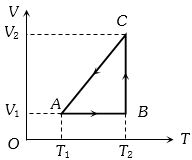
- 4A cyclic process for $1\, mole$ of an ideal gas is shown in figure in the $V-T,$ diagram. The work done in $AB, BC$ and $CA$ respectivelyView Solution
- 5One mole of a monatomic ideal gas undergoes the cyclic process $J \rightarrow K \rightarrow L \rightarrow M \rightarrow J$, as shown in the $P - T$ diagram.View Solution
Match the quantities mentioned in $List-I$ with their values in $List-II$ and choose the correct option. [ $R$ is the gas constant]
$List-I$ $List-II$ ($P$) Work done in the complete cyclic process ($1$) $R T_0-4 \ R T_0 \ln 2$ ($Q$) Change in the internal energy of the gas in the process $JK$ ($2$) $0$ ($R$) Heat given to the gas in the process $KL$ ($3$) $3 \ R T_0$ ($S$) Change in the internal energy of the gas in the process $MJ$ ($4$) $-2 \ R T_0 \ln 2$ ($5$) $-3 \ R T_0 \ln 2$ 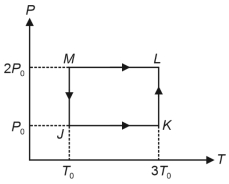
- 6View SolutionHeat is not being exchanged in a body. If its internal energy is increased, then
- 7The gas law $\frac{{PV}}{T} = $ constant is true forView Solution
- 8View SolutionThe ratio of work done by an ideal monoatomic gas to the heat supplied to it in an isobaric process is
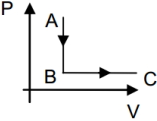
- 9If one mole of an ideal gas goes through the process $A \rightarrow B$ and $B \rightarrow C .$ Given that $T _{ A }=400\, K ,$ and $T _{ C }=400 \,K .$ If $\frac{ P _{ B }}{ P _{ A }}=\frac{1}{5},$ then find the heat supplied to the gas (in $J$)View Solution
- 10During the adiabatic expansion of $2$ moles of a gas, the internal energy of the gas is found to decrease by $2$ joules, the work done during the process on the gas will be equal to ....... $J$View Solution