A grindstone has a moment of inertia of $6kg m^2$. A constant torque is applied and the grindstone is found to have a speed of $150rpm, 10s$. after starting from rest. Calculate the torque.
Download our app for free and get started
Here, Moment of inertia of grindstone, $I = 6kgm^2$ Initial angular velocity $\omega_1=0$ Final angular velocity, $\omega_2=2\pi\text{n}=2\pi\times\frac{150}{60}$
$=5\pi\text{ rad/sec}^2$ Time for which torque acts, $\text{t}=10\text{\sec.}$
$\therefore$ Angular acceleration $(\alpha)=\frac{\omega_2-\omega_1}{\text{t}}$
$=\frac{5\pi-0}{10}=\frac{\pi}{2}\text{rad/sec}^2$ As $\tau=\text{I}\alpha$
$\therefore\tau=6\times\frac{\pi}{2}=3\pi\text{Ns}.$
$=5\pi\text{ rad/sec}^2$ Time for which torque acts, $\text{t}=10\text{\sec.}$
$\therefore$ Angular acceleration $(\alpha)=\frac{\omega_2-\omega_1}{\text{t}}$
$=\frac{5\pi-0}{10}=\frac{\pi}{2}\text{rad/sec}^2$ As $\tau=\text{I}\alpha$
$\therefore\tau=6\times\frac{\pi}{2}=3\pi\text{Ns}.$

Download our appand get started for free
Experience the future of education. Simply download our apps or reach out to us for more information. Let's shape the future of learning together!No signup needed.*
Similar Questions
- 1The distance between the centres of carbon and oxygen atoms in carbon monoxide gas molecules is $=1.13\mathring{\text{A}}.$ Locate the centre of mass of the molecules relative to carbon atom.View Solution
- 2Two discs of moments of inertia $I_1$ and $I_2$ about their respective axes (normal to the disc and passing through the centre), and rotating with angular speed $\omega_1$ and $\omega_2$ are brought into contact face to face with their axes of rotation coincident.View Solution
- Does the law of conservation of angular momentum apply to the situation? why?
- Find the angular speed of the two-disc system.
- Calculate the loss in kinetic energy of the system in the process.
- Account for this loss.
- 3Separation of Motion of a system of particles into motion of the centre of mass and motion about the centre of mass: Show $\text{K}=\text{K}'+\frac{1}{2}\text{M}\text{V}^2$ where K' is the total kinetic energy of the system of particles, K′ is the total kinetic energy of the system when the particle velocities are taken with respect to the centre of mass and $\frac{\text{MV}^2}{2}$ is the kinetic energy of the translation of the system as a whole (i.e. of the centre of mass motion of the system). The result has been used in $\sec7.14$View Solution
- 4Separation of Motion of a system of particles into motion of the centre of mass and motion about the centre of mass: Show $\text{K}=\text{K}'+\frac{1}{2}\text{M}\text{V}^2$ where K' is the total kinetic energy of the system of particles, K′ is the total kinetic energy of the system when the particle velocities are taken with respect to the centre of mass and $\frac{\text{MV}^2}{2}$ is the kinetic energy of the translation of the system as a whole (i.e. of the centre of mass motion of the system). The result has been used in $\sec7.14$View Solution
- 5View SolutionA uniform rod of mass m and length l is struck at an end by a force F perpendicular to the rod for a short time interval t. Calculate:
- The speed of the centre of mass.
- The angular speed of the rod about the centre of mass.
- The kinetic energy of the rod.
- The angular momentum of the rod about the centre of mass after the force has stopped to act. Assume that t is so small that the rod does not appreciably change its direction while the force acts.
- 6Separation of Motion of a system of particles into motion of the centre of mass and motion about the centre of mass: Show $\frac{\text{dL}}{\text{dt}}=\sum\text{r}'_\text{i}\times\frac{\text{dp}'}{\text{dt}}$ Further, show that $\frac{\text{dL}'}{\text{dt}}=\tau'_\text{ext}$ where $\tau'_\text{ext}$ is the sum of all external torques acting on the system about the centre of mass. (Hint: Use the definition of centre of mass and third law of motion. Assume the internal forces between any two particles act along the line joining the particles)View Solution
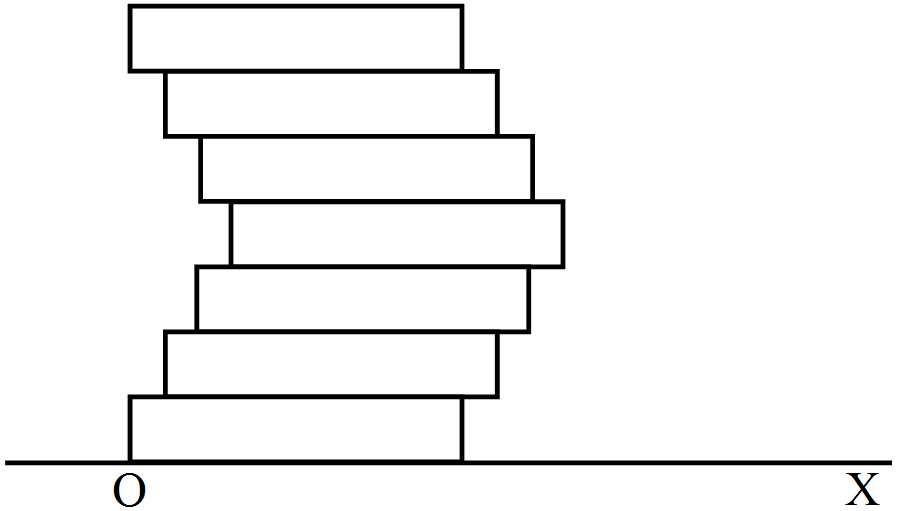
- 7Seven homogeneous bricks, each of length L, are arranged as shown in figure. Each brick is displaced with respect to the one in contact by $\frac{\text{L}}{10}.$ Find the x-coordinate of the centre of mass relative to the origin shown.View Solution
- 8View SolutionExplain why friction is necessary to make the disc in roll in the direction indicated.
- Give the direction of frictional force at B, and the sense of frictional torque, before perfect rolling begins.
- What is the force of friction after perfect rolling begins?
- 9View SolutionThree particles of masses 1.0kg, 2.0kg and 3.0kg are placed at the corners A, B and C respectively of an equilateral triangle ABC of edge 1m. Locate the centre of mass of the system.
- 10View SolutionA solid sphere rolls down two different inclined planes of the same heights but different angles of inclination.
- Will it reach the bottom with the same speed in each case?
- Will it take longer to roll down one plane than the other?
- If so, which one and why?