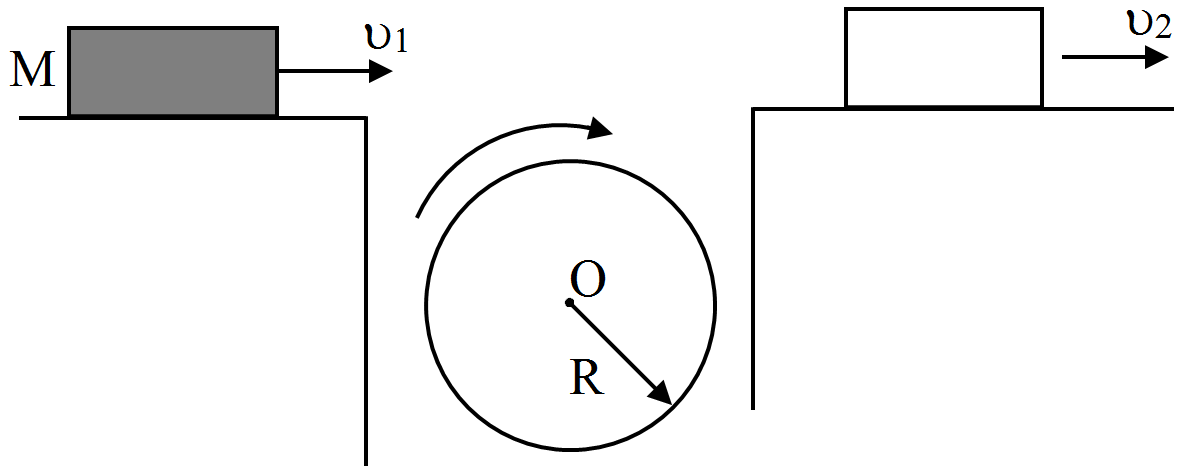
A block of mass M is moving with a velocity $v_1$ on a frictionless surface as shown in fig. It passes over to a cylinder of radius R and moment of inertia I which has fixed axis and is initially at rest. When it first makes contact with the cylinder, it slips on the cylinder, but the friction is large enough so that slipping ceases before it losses contact with the cylinder. Finally it goes to the dotted position with velocity $v_2$ compute $v_2$ in terms of $v_1, M, I$ and $R$.
Download our app for free and get started
When the mass M makes first contact with the cylinder, its angular momentum about O. $L_1$ = moment of intertia about O \times angular velocity $=\text{MR}^2\times\alpha=\text{MR}^2\Big(\frac{\text{v}_1}{\text{R}}\Big)=\text{MRv}_1$ When the mass M loses the contact with the cylinder, its final angular momentum, $\text{L}_2=\text{MRv}_2$
$\therefore$ Loss in angular momentum $\Delta\text{L}=\text{L}_1-\text{L}_2=\text{MR}(\text{v}_1-\text{v}_2)\dots(1)$ This provides an angular impulse to the cylinder about O which is given by $\tau\Delta\text{t}.$ Now, Loss in angular momentum of mass = angular impulse to the cylinder $\therefore\text{MR}(\text{v}_1-\text{v}_2)=\tau\Delta\text{t}\dots(2)$$\therefore\tau=\text{I}\alpha=\text{I}\frac{\Delta\omega}{\Delta\text{t}}$
Initially cylinder is at rest and finally it moves with a velocity $v_2$, hence, $\Delta\omega=\frac{\text{v}_2}{\text{R}}$
$\therefore\tau=\text{I}\frac{\text{v}_2}{\text{R}.\Delta}\dots(3)$Substituting the value of $\tau$ from eqn. (3) in eqn. (2), we get
$\text{MR}(\text{v}_1-\text{v}_2)=\frac{\text{I}\text{v}_2.\Delta\text{t}}{\text{R}.\Delta\text{t}}=\text{I}\frac{\text{v}_2}{\text{R}}$
$\text{or }(\text{v}_1-\text{v}_2)=\frac{\text{I}}{\text{MR}^2}\text{v}_2$
$\text{or }\text{v}_1=\text{v}_2\Bigg[1+\Big(\frac{\text{I}}{\text{MR}^2}\Big)\Bigg]$
$\text{v}_2=\frac{\text{v}_1}{\Bigg[1+\Big(\frac{\text{I}}{\text{MR}^2}\Big)\Bigg]}$
$\therefore$ Loss in angular momentum $\Delta\text{L}=\text{L}_1-\text{L}_2=\text{MR}(\text{v}_1-\text{v}_2)\dots(1)$ This provides an angular impulse to the cylinder about O which is given by $\tau\Delta\text{t}.$ Now, Loss in angular momentum of mass = angular impulse to the cylinder $\therefore\text{MR}(\text{v}_1-\text{v}_2)=\tau\Delta\text{t}\dots(2)$$\therefore\tau=\text{I}\alpha=\text{I}\frac{\Delta\omega}{\Delta\text{t}}$
Initially cylinder is at rest and finally it moves with a velocity $v_2$, hence, $\Delta\omega=\frac{\text{v}_2}{\text{R}}$
$\therefore\tau=\text{I}\frac{\text{v}_2}{\text{R}.\Delta}\dots(3)$Substituting the value of $\tau$ from eqn. (3) in eqn. (2), we get
$\text{MR}(\text{v}_1-\text{v}_2)=\frac{\text{I}\text{v}_2.\Delta\text{t}}{\text{R}.\Delta\text{t}}=\text{I}\frac{\text{v}_2}{\text{R}}$
$\text{or }(\text{v}_1-\text{v}_2)=\frac{\text{I}}{\text{MR}^2}\text{v}_2$
$\text{or }\text{v}_1=\text{v}_2\Bigg[1+\Big(\frac{\text{I}}{\text{MR}^2}\Big)\Bigg]$
$\text{v}_2=\frac{\text{v}_1}{\Bigg[1+\Big(\frac{\text{I}}{\text{MR}^2}\Big)\Bigg]}$

Download our appand get started for free
Experience the future of education. Simply download our apps or reach out to us for more information. Let's shape the future of learning together!No signup needed.*
Similar Questions
- 1Two discs of moments of inertia $I_1$ and $I_2$ about their respective axes (normal to the disc and passing through the centre), and rotating with angular speeds $\omega_1$ and $\omega_2$ are brought into contact face to face with their axes of rotation coincident.View Solution
- What is the angular speed of the two-disc system?
- Show that the kinetic energy of the combined system is less than the sum of the initial kinetic energies of the two discs. How do you account for this loss in energy? Take $\omega_1\neq\omega_2$
- 2A uniform sphere of mass m and radius R is placed on a rough horizontal surface. The sphere is struck horizontally at a height h from the floor. Match the following:View Solution
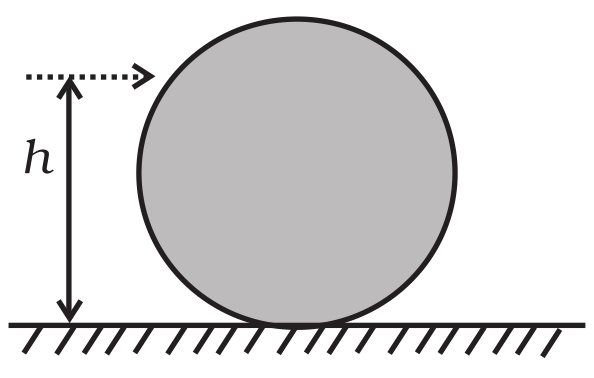
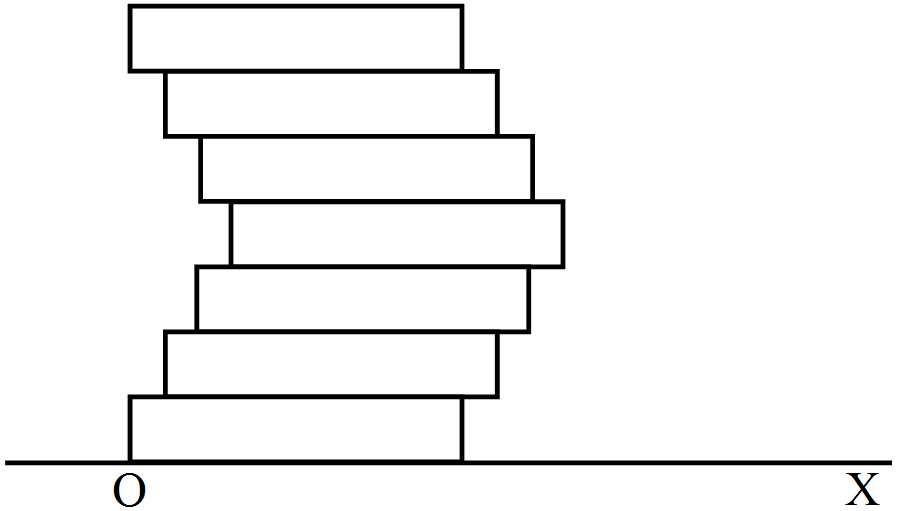
a. $\text{h}=\frac{\text{R}}{2}$ i. Sphere rolls without slipping with a constant velocity and no loss of energy. b. $\text{h}=\text{R}$ ii. Sphere spins clockwise, loses energy by friction. c. $\text{h}=\frac{3\text{R}}{2}$ iii. Sphere spins anti-clockwise, loses energy by friction. d. $\text{h}=\frac{7\text{R}}{5}$ iv. Sphere has only a translational motion, looses energy by friction. - 3Seven homogeneous bricks, each of length L, are arranged as shown in figure. Each brick is displaced with respect to the one in contact by $\frac{\text{L}}{10}.$ Find the x-coordinate of the centre of mass relative to the origin shown.View Solution
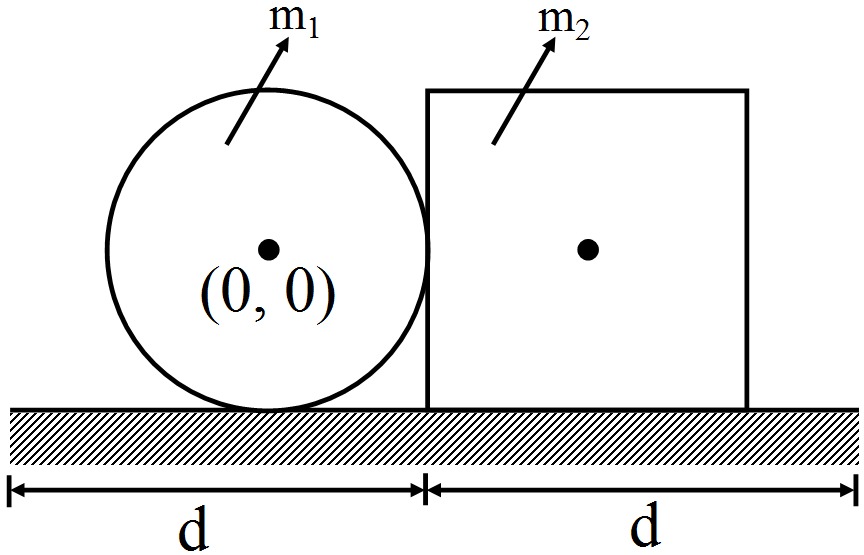
- 4View SolutionA square plate of edge d and a circular disc of diameter d are placed touching each other at the midpoint of an edge of the plate as shown in figure. Locate the centre of mass of the combination, assuming same mass per unit area for the two plates.
- 5Establish the relation $\theta=\omega_0\text{t}+\frac{1}{2}\alpha\text{t}^2$ where the letters have their usual meanings.View Solution
- 6View SolutionA ball is whirled in a circle by attaching it to a fixed point with a string. Is there an angular rotation of the ball about its centre? If yes, is this angular velocity equal to the angular velocity of the ball about the fixed point?
- 7Two particles of mass $2kg$ and $1kg$ are moving along the same line with speeds $2ms-1$ and $5ms^{-1}$ respectively. What is the speed of the centre of mass of the system if both the particles are moving (a) in same direction (b) in opposite direction?View Solution
- 8A disc of mass $5kg$ and radius $50cm$ rolls on the ground at the rate of $10ms^{-1}$. Calculate the K.E. of the disc. $\Big(\text{Given}:\text{I}=\frac{1}{2}\text{MR}^2\Big)$View Solution
- 9Locate the centre of mass of a system of particles of mass $m_1 = 1kg, m_2 = 2kg$ and $m_3 = 3kg$, situated at the corners of an equilateral triangle of side 1.0 metre.View Solution
- 10A uniform rod pivoted at its upper end hangs vertically. It is displaced through an angle of $60°$ and then released. Find the magnitude of the force acting on a particle of mass dm at the tip of the rod when the rod makes an angle of $37°$ with the vertical.View Solution