Question
Balance the following ionic equations.
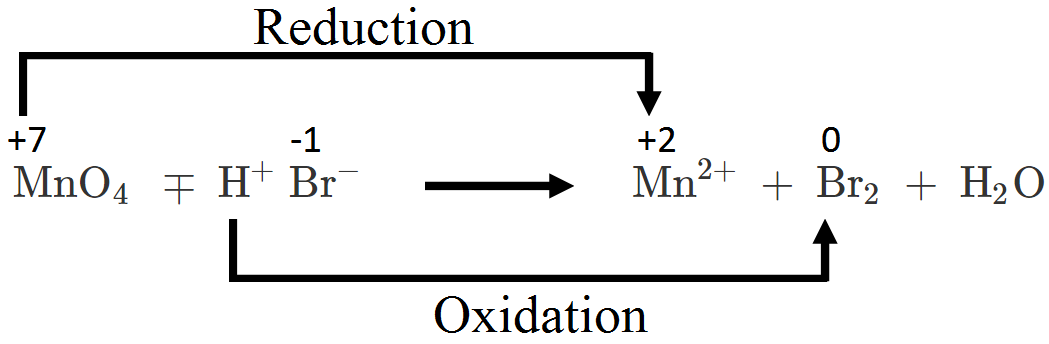
$\text{MnO}^-_4+\text{H}^++\text{Br}^-\xrightarrow{ \ \ \ \ \ \ \ \ }\text{Mn}^{2+}+\text{Br}_2+\text{H}_2\text{O}$
Answer


Dividing the equation into two half reactions:
Oxidation half reaction: $\text{Br}^-\xrightarrow{ \ \ \ \ \ \ \ \ }\text{Br}_2$
Reduction half reaction: $\text{MnO}^-_4\xrightarrow{ \ \ \ \ \ \ \ \ }\text{Mn}^{2+}$
Balancing oxidation and reduction half reactions separately as:
Oxidation half reaction
$\text{Br}^-\xrightarrow{ \ \ \ \ \ \ \ \ }\text{Br}_2$
$2\text{Br}^-\xrightarrow{ \ \ \ \ \ \ \ \ \ }\text{Br}_2$
$2\text{Br}^-\xrightarrow{ \ \ \ \ \ \ \ \ }\text{Br}_2+2\text{e}^-...(\text{i})$
Reduction half reaction
$\text{MnO}^-_4\xrightarrow{ \ \ \ \ \ \ \ }\text{Mn}^{2+}$
$\text{MnO}^-_4+5\text{e}^-\xrightarrow{ \ \ \ \ \ \ \ \ }\text{Mn}^{2+}$
$\text{MnO}^-_4+8\text{H}^++5\text{e}^-\xrightarrow{ \ \ \ \ \ \ \ }\text{Mn}^{2+}$
$\text{MnO}^-_4+8\text{H}^++5\text{e}^-\xrightarrow{ \ \ \ \ \ \ \ \ }\text{Mn}^{2+}+4\text{H}_2\text{O}...(\text{ii})$
To balance the electrons, multiply eq. (i) by 5 and eq. (ii) by 2 and add
$2\text{MnO}^-_4+10\text{Br}^-+16\text{H}^+\xrightarrow{ \ \ \ \ \ \ \ \ }2\text{Mn}^{2+}+5\text{Br}_2+8\text{H}_2\text{O}$

Need a full question paper?

Generate a complete, print-ready paper with questions like this in minutes — across 16+ boards, with answer keys.

Start Generating Free

Similar questions

Explain the shape of $BrF_5$.
Why are lithium salts commonly hydrated and those of the other alkali ions usually anhydrous?
Differentiate between the following (with examples)
  1. Open and closed system.
  2. Adiabatic and isothermal process.
  3. State function and path function.
In each of the following pairs of compounds, which one is more covalent and why?
i. $\mathrm{AgCl}, \mathrm{Agl}$
ii. $\mathrm{BeCl}_2, \mathrm{MgCl}_2$
iii. $\mathrm{SnCl}_2, \mathrm{SnCl}_4$
iv. $\mathrm{CuO}, \mathrm{CuS}$
Explain the structure of the $CO _2$ molecule.
Show that the circumference of the Bohr orbit for the hydrogen atom is an integral multiple of the de Broglie wavelength associated with the electron revolving around the orbit.
Write reactions to justify amphoteric nature of aluminium.
  1. Name an alkaline earth metal which forms insoluble sulphate.
  2. Name an alkaline earth metal which forms insoluble oxalate.
  3. Name a alkali metal which has most negative $\text{E}^\circ_\text{value}$?
  4. Among Li, Na, Ca and Ba which forms strongest mono acidic base.
The magnitude of surface tension of liquid depends on the attractive forces between the molecules. Arrange the following in increasing order of surface tension:
water, alcohol $\left(\mathrm{C}_2 \mathrm{H}_5 \mathrm{OH}\right)$ and hexane $\left.\left[\mathrm{CH}_3\left(\mathrm{CH}_2\right)_4 \mathrm{CH}_3\right)\right]$.
  1. Account for the following:
  1. Boron halides do not dimerise like $BH_3$.
  2. Carbon shows catenation remarkably.
  3. $PbCl_4$ is a good oxidising agent.
  1. Complete the following reactions:
  1. $\text{Na}_{2}\text{B}_{4}\text{O}_{7} + 2\text{HCl} + \text{5H}_{2}\text{O} \xrightarrow{\ \ \ \ \ \ \ \ }$
  2. $\text{B}_{2}\text{H}_{6} + 6\text{NH}_{3} \xrightarrow[\ \ \ \ \ \ ]{\Delta}$