Two discs of moments of inertia $I_1$ and $I_2$ about their respective axes (normal to the disc and passing through the centre), and rotating with angular speeds $\omega_1$ and $\omega_2$ are brought into contact face to face with their axes of rotation coincident.
- What is the angular speed of the two-disc system?
- Show that the kinetic energy of the combined system is less than the sum of the initial kinetic energies of the two discs. How do you account for this loss in energy? Take $\omega_1\neq\omega_2$
Exercise
Download our app for free and get started
- Moment of inertia of dise $\text{I}=\text{I}_{1}$
Angular speed of disc $\text{II}=\text{I}_2$
Angular momentum of disc $\text{II}=\omega_1$
Angular momentum of disc $\text{I},\text{L}_1=\text{I}_1\omega_1$
Angular momentum of disc $\text{II},\text{L}_2=\text{I}_2\omega_2$
Total initial angular momentum, $\text{L}_{\text{i}}=\text{I}_1\omega_1+\text{I}_2+\omega_2$
When the two discs are joined together, their moments of inertia get added up.
Moment of inertia of the system of two discs $\text{I}=\text{I}_1+\text{I}_2$
Let $\omega$ be the angular speed of the system.
Total final angular momentum, $\text{L}_{\text{f}}=(\text{I}_1+\text{I}_2)\omega$
Using the law of conservation of angular momentum, we have,
$\text{L}_{\text{i}}=\text{L}_{\text{f}}$
$\text{I}_1\omega_1+\text{I}_2\omega_2=(\text{I}_1+\text{I}_2)\omega$
$\therefore\ \omega=\frac{\text{I}_1\omega_1+\text{I}_2\omega_2}{\text{I}_1+\text{I}_2}$
- Kinetic energy of disc I, $\text{E}_1=\frac{1}{2}\text{I}_1\omega^2_1$
Total initial kinetic energy, $\text{E}_{\text{i}}=\frac{1}{2}\big(\text{I}_1\omega^2_1+\text{I}_2\omega^2_2\big)$
When the discs are joined, their moments of inertia get added up.
Moment of inertia of the system, $\text{I}=\text{I}_1+\text{I}_2$
Angular speed of the system $=\omega$
Final kinetic energy $E_f$
$=\frac{1}{2}(\text{I}_1+\text{I}_2)\omega^2$
$=\frac{1}{2}(\text{I}_1+\text{I}_2)\Big(\frac{\text{I}_1\omega_1+\text{I}_2\omega_2}{\text{I}_1+\text{I}_2}\Big)^2=\frac{1}{2}\frac{(\text{I}_1\omega_1+\text{I}_2\omega_2)^2}{\text{I}_1+\text{I}_2}$
$\therefore\ \text{E}_{\text{i}}-\text{E}_{\text{f}}$
$=\frac{1}{2}\big(\text{I}_1\omega^2_1+\text{I}_2\omega^2_2\big)-\frac{(\text{I}_1\omega_1+\text{I}_2\omega_2)^2}{2(\text{I}_1+\text{I}_2)}$
$=\frac{1}{2}\text{I}_1\omega_1^2+\frac{1}{2}\text{I}_2\omega_2^2-\frac{1}{2}\frac{\text{I}^2_1\omega^2_1}{(\text{I}_1+\text{I}_2)}-\frac{1}{2}\frac{\text{I}^2_2\omega^2_2}{(\text{I}_1+\text{I}_2)}-\frac{1}{2}\frac{2\text{I}_1\text{I}_2\omega_1\omega_2}{(\text{I}_1+\text{I}_2)}$
$=\frac{1}{(\text{I}_1+\text{I}_2)}\Big[\frac{1}{2}\text{I}^2_1\omega^2_1+\frac{1}{2}\text{I}_1\text{I}_2\omega^2_1+\frac{1}{2}\text{I}_1\text{I}_2\omega^2_2+\frac{1}{2}\text{I}^2_2\omega^2-\frac{1}{2}\text{I}^2_1\omega^2_1-\frac{1}{2}\text{I}_2^2\omega^2_2-\text{I}_1\text{I}_2\omega_1\omega_2\Big]$
$=\frac{\text{I}_1\text{I}_2}{2(\text{I}_1+\text{I}_2)}\big[\omega^2_1+\omega^2_2-2\omega_1\omega_2\big]$
$=\frac{\text{I}_1\text{I}_2(\omega_1-\omega_2)^2}{2(\text{I}_1+\text{I}_2)}$
All the qauantities on RHS are positive.
$\therefore\ \text{E}_{\text{i}}-\text{E}_{\text{f}}>0$
$\text{E}_{\text{i}}>\text{E}_{\text{f}}$
The loss of KE can be attributed to the frictional force that comes into play when the two discs come in contact with each other.

Download our appand get started for free
Experience the future of education. Simply download our apps or reach out to us for more information. Let's shape the future of learning together!No signup needed.*
Similar Questions
- 1View Solution
- Prove the theorem of perpendicular axes.
- Prove the theorem of parallel axes.
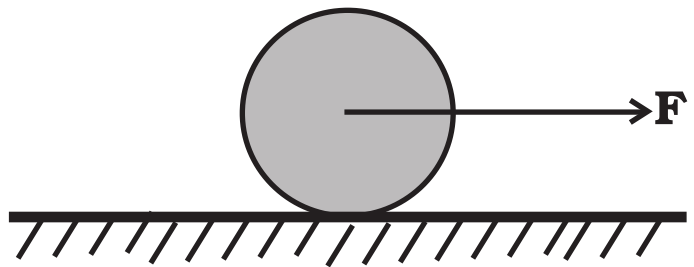
- 2A uniform disc of radius R, is resting on a table on its rim.The coefficient of friction between disc and table is $\mu.$Now the disc is pulled with a force F as shown in the figure. What is the maximum value of F for which the disc rolls without slipping?View Solution
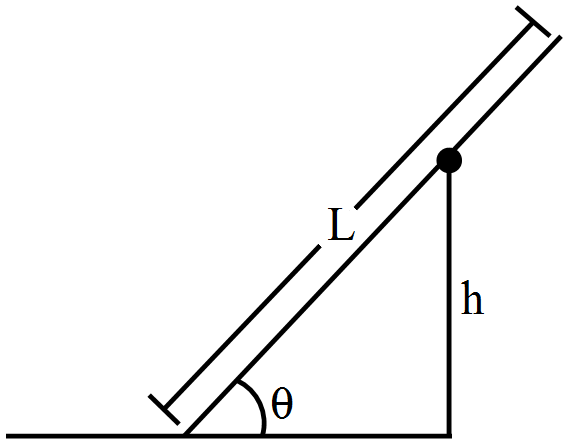
- 3A uniform rod of length L rests against a smooth roller as shown in figure. Find the friction coefficient between the ground and the lower end if the minimum angle that the rod can make with the horizontal is $\theta.$View Solution
- 4View SolutionThree particles of masses 1.0kg, 2.0kg and 3.0kg are placed at the corners A, B and C respectively of an equilateral triangle ABC of edge 1m. Locate the centre of mass of the system.
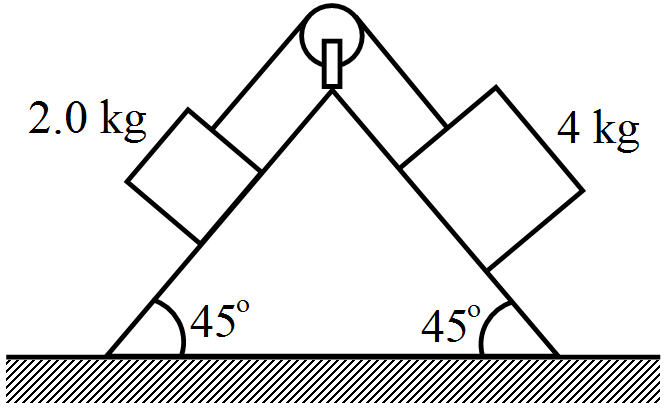
- 5The pulley shown in figure has a radius $10cm$ and moment of inertia $0.5kg-m^2$ about its axis. Assuming the inclined planes to be frictionless, calculate the acceleration of the $4.0kg$ block.View Solution
- 6An isolated particle of mass m is moving in a horizontal plane (x - y), along the x-axis at a certain height about the ground. It explodes suddenly into two fragments of masses $\frac{\text{m}}{4}$ and $3\frac{\text{m}}{4}.$ An instant later, the smaller fragment is at y = + 15 cm. What is the position of larger fragment at this instant?View Solution
- 7Two blocks of masses $400g$ and $200g$ are connected through a light string going over a pulley which is free to rotate about its axis. The pulley has a moment of inertia $1.6 \times 10^{-4}kg-m^2$ and a radius 2.0cm. Find:View Solution
- The kinetic energy of the system as the $400g$ block falls through $50cm$.
- The speed of the blocks at this instant.
- 8In the HCl molecule, the separation between the nuclei of the two atoms is about $1.27\mathring{\text{A}}\big(1\mathring{\text{A}}= 10^{-10} \text{m}\big).$ Find the approximate location of the CM of the molecule, given that a chlorine atom is about 35.5 times as massive as a hydrogen atom and nearly all the mass of an atom is concentrated in its nucleus.View Solution
- 9A hollow sphere is released from the top of an inclined plane of inclination $\theta.$View Solution
- What should be the minimum coefficient of friction between the sphere and the plane to prevent sliding?
- Find the kinetic energy of the ball as it moves down a length 1 on the incline if the friction coefficient is half the value calculated in part (a).
- 10Suppose the smaller pulley of the previous problem has its radius $5.0cm$ and moment of inertia $0.10kg-m^2$. Find the tension in the part of the string joining the pulleys.View Solution