A disc of mass $5kg$ and radius $50cm$ rolls on the ground at the rate of $10ms^{-1}$. Calculate the K.E. of the disc. $\Big(\text{Given}:\text{I}=\frac{1}{2}\text{MR}^2\Big)$
Download our app for free and get started
Here, mass of the disc, M = 5kg Radius of the disc R = 50cm $=\frac{1}{2}\text{m}$ Linear velocity of the disc, $v = 10ms^{-1}$ $\text{As v}=\text{R}\omega$
$\therefore10=\frac{1}{2}\omega$ or $\omega=10\times2=20\text{ radian/sec.}$ Also, moment of intertia of disc about or axis through its centre. $\text{l}=\frac{1}{2}\text{MR}^2$ K.E. of the disc $=\frac{1}{2}\text{I}\omega^2+\frac{1}{2}\text{Mv}^2$
$=\frac{1}{2}\frac{\text{MR}^2}{2}\omega^2+\frac{1}{2}\text{Mv}^2$
$=\frac{1}{4}\times5\times\Big(\frac{1}{2}\Big)^2\times(20)^2+\frac{1}{2}\times5(10)^2$
$=375\text{J}.$
$\therefore10=\frac{1}{2}\omega$ or $\omega=10\times2=20\text{ radian/sec.}$ Also, moment of intertia of disc about or axis through its centre. $\text{l}=\frac{1}{2}\text{MR}^2$ K.E. of the disc $=\frac{1}{2}\text{I}\omega^2+\frac{1}{2}\text{Mv}^2$
$=\frac{1}{2}\frac{\text{MR}^2}{2}\omega^2+\frac{1}{2}\text{Mv}^2$
$=\frac{1}{4}\times5\times\Big(\frac{1}{2}\Big)^2\times(20)^2+\frac{1}{2}\times5(10)^2$
$=375\text{J}.$

Download our appand get started for free
Experience the future of education. Simply download our apps or reach out to us for more information. Let's shape the future of learning together!No signup needed.*
Similar Questions
- 1View SolutionSuppose the particle of the previous problem has a mass m and a speed v before the collision and it sticks to the rod after the collision. The rod has a mass M:
- Find the velocity of the centre of mass C of the system constituting ''The rod plus the particle''.
- Find the velocity of the particle with respect to C before the collision.
- Find the velocity of the rod with respect to C before the collision.
- Find the angular momentum of the particle and of the rod about the centre of mass C before the collision.
- Find the moment of inertia of the system about the vertical axis through the centre of mass C after the collision.
- Find the velocity of the centre of mass C and the angular velocity of the system about the centre of mass after the collision.
- 2Separation of Motion of a system of particles into motion of the centre of mass and motion about the centre of mass: Show $\frac{\text{dL}}{\text{dt}}=\sum\text{r}'_\text{i}\times\frac{\text{dp}'}{\text{dt}}$ Further, show that $\frac{\text{dL}'}{\text{dt}}=\tau'_\text{ext}$ where $\tau'_\text{ext}$ is the sum of all external torques acting on the system about the centre of mass. (Hint: Use the definition of centre of mass and third law of motion. Assume the internal forces between any two particles act along the line joining the particles)View Solution
- 3View SolutionA cylinder is suspended by two strings wrapped around the cylinder near each end, the free ends of the string being attached to hooks on the ceiling, such that the length of the cylinder is horizontal. From the position of rest, the cylinder is allowed to roll down as suspension strings unwind. Calculate: (i) the downward linear acceleration of the cylinder and (ii) tension in the strings. Mass of cylinder is 12kg.
- 4Calculate the angular momentum and rotational kinetic energy of earth about its own axis. How long could this amount of energy supply one kilowatt power to each of the $3.5 \times 10^9$ persons on earth? (Mass of earth = $6.0 \times 1024kg$ and radius = $6.4 \times 10^{24}km)$.View Solution
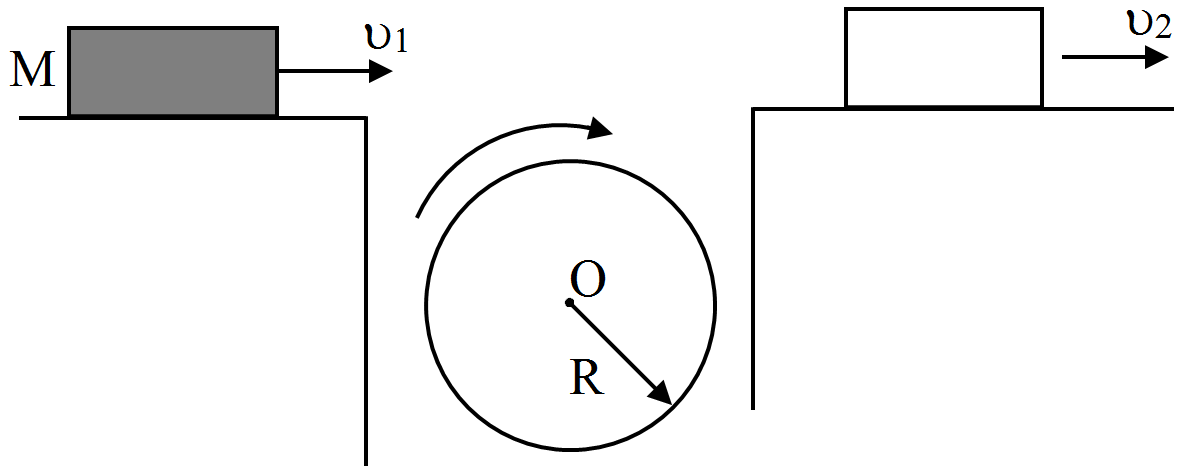
- 5A block of mass M is moving with a velocity $v_1$ on a frictionless surface as shown in fig. It passes over to a cylinder of radius R and moment of inertia I which has fixed axis and is initially at rest. When it first makes contact with the cylinder, it slips on the cylinder, but the friction is large enough so that slipping ceases before it losses contact with the cylinder. Finally it goes to the dotted position with velocity $v_2$ compute $v_2$ in terms of $v_1, M, I$ and $R$.View Solution
- 6Particles of masses $1g, 2g, 3g, ........, 100g$ are kept at the marks $1cm, 2cm, 3cm, ........, 100cm$ respectively on a metre scale. Find the moment of inertia of the system of particles about a perpendicular bisector of the metre scale.View Solution
- 7A car weighs $1800kg$. The distance between its front and back axles is $1.8m$. Its centre of gravity is $1.05m$ behind the front axle. Determine the force exerted by the level ground on each front wheel and each back wheel.View Solution
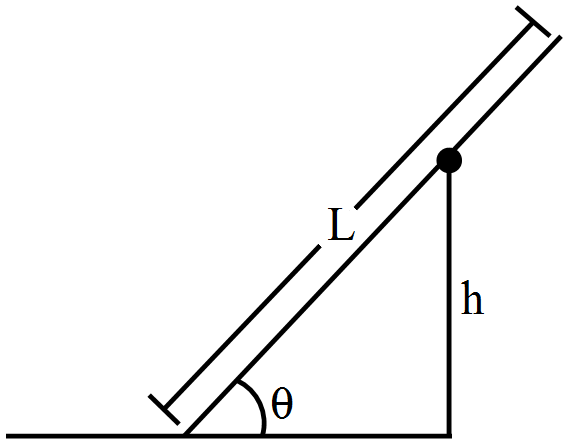
- 8A uniform rod of length L rests against a smooth roller as shown in figure. Find the friction coefficient between the ground and the lower end if the minimum angle that the rod can make with the horizontal is $\theta.$View Solution
- 9View Solution
- Define moment of inertia. Write the parallel and perpendicular axis theorem.
- Derive an expression for moment of inertia of a disc of radius r, mass m about an axis along its diameter.
- 10View SolutionWhat do you mean by the term "equilibrium"? What are equilibrium of rest and equilibrium of motion? State the conditions for complete equilibrium of a body.