Two discs of moments of inertia $I_1$ and $I_2$ about their respective axes (normal to the disc and passing through the centre), and rotating with angular speeds $\omega_1$ and $\omega_2$ are brought into contact face to face with their axes of rotation coincident.
- What is the angular speed of the two-disc system?
- Show that the kinetic energy of the combined system is less than the sum of the initial kinetic energies of the two discs. How do you account for this loss in energy? Take $\omega_1\neq\omega_2$
Download our app for free and get started
- Moment of inertia of dise $\text{I}=\text{I}_{1}$
Angular speed of disc $\text{II}=\text{I}_2$
Angular momentum of disc $\text{II}=\omega_1$
Angular momentum of disc $\text{I},\text{L}_1=\text{I}_1\omega_1$
Angular momentum of disc $\text{II},\text{L}_2=\text{I}_2\omega_2$
Total initial angular momentum, $\text{L}_{\text{i}}=\text{I}_1\omega_1+\text{I}_2+\omega_2$
When the two discs are joined together, their moments of inertia get added up.
Moment of inertia of the system of two discs $\text{I}=\text{I}_1+\text{I}_2$
Let $\omega$ be the angular speed of the system.
Total final angular momentum, $\text{L}_{\text{f}}=(\text{I}_1+\text{I}_2)\omega$
Using the law of conservation of angular momentum, we have,
$\text{L}_{\text{i}}=\text{L}_{\text{f}}$
$\text{I}_1\omega_1+\text{I}_2\omega_2=(\text{I}_1+\text{I}_2)\omega$
$\therefore\ \omega=\frac{\text{I}_1\omega_1+\text{I}_2\omega_2}{\text{I}_1+\text{I}_2}$
- Kinetic energy of disc I, $\text{E}_1=\frac{1}{2}\text{I}_1\omega^2_1$
Total initial kinetic energy, $\text{E}_{\text{i}}=\frac{1}{2}\big(\text{I}_1\omega^2_1+\text{I}_2\omega^2_2\big)$
When the discs are joined, their moments of inertia get added up.
Moment of inertia of the system, $\text{I}=\text{I}_1+\text{I}_2$
Angular speed of the system $=\omega$
Final kinetic energy $E_f$
$=\frac{1}{2}(\text{I}_1+\text{I}_2)\omega^2$
$=\frac{1}{2}(\text{I}_1+\text{I}_2)\Big(\frac{\text{I}_1\omega_1+\text{I}_2\omega_2}{\text{I}_1+\text{I}_2}\Big)^2=\frac{1}{2}\frac{(\text{I}_1\omega_1+\text{I}_2\omega_2)^2}{\text{I}_1+\text{I}_2}$
$\therefore\ \text{E}_{\text{i}}-\text{E}_{\text{f}}$
$=\frac{1}{2}\big(\text{I}_1\omega^2_1+\text{I}_2\omega^2_2\big)-\frac{(\text{I}_1\omega_1+\text{I}_2\omega_2)^2}{2(\text{I}_1+\text{I}_2)}$
$=\frac{1}{2}\text{I}_1\omega_1^2+\frac{1}{2}\text{I}_2\omega_2^2-\frac{1}{2}\frac{\text{I}^2_1\omega^2_1}{(\text{I}_1+\text{I}_2)}-\frac{1}{2}\frac{\text{I}^2_2\omega^2_2}{(\text{I}_1+\text{I}_2)}-\frac{1}{2}\frac{2\text{I}_1\text{I}_2\omega_1\omega_2}{(\text{I}_1+\text{I}_2)}$
$=\frac{1}{(\text{I}_1+\text{I}_2)}\Big[\frac{1}{2}\text{I}^2_1\omega^2_1+\frac{1}{2}\text{I}_1\text{I}_2\omega^2_1+\frac{1}{2}\text{I}_1\text{I}_2\omega^2_2+\frac{1}{2}\text{I}^2_2\omega^2-\frac{1}{2}\text{I}^2_1\omega^2_1-\frac{1}{2}\text{I}_2^2\omega^2_2-\text{I}_1\text{I}_2\omega_1\omega_2\Big]$
$=\frac{\text{I}_1\text{I}_2}{2(\text{I}_1+\text{I}_2)}\big[\omega^2_1+\omega^2_2-2\omega_1\omega_2\big]$
$=\frac{\text{I}_1\text{I}_2(\omega_1-\omega_2)^2}{2(\text{I}_1+\text{I}_2)}$
All the qauantities on RHS are positive.
$\therefore\ \text{E}_{\text{i}}-\text{E}_{\text{f}}>0$
$\text{E}_{\text{i}}>\text{E}_{\text{f}}$
The loss of KE can be attributed to the frictional force that comes into play when the two discs come in contact with each other.

Download our appand get started for free
Experience the future of education. Simply download our apps or reach out to us for more information. Let's shape the future of learning together!No signup needed.*
Similar Questions
- 1Locate the centre of mass of a system of particles of mass $m_1 = 1kg, m_2 = 2kg$ and $m_3 = 3kg$, situated at the corners of an equilateral triangle of side 1.0 metre.View Solution
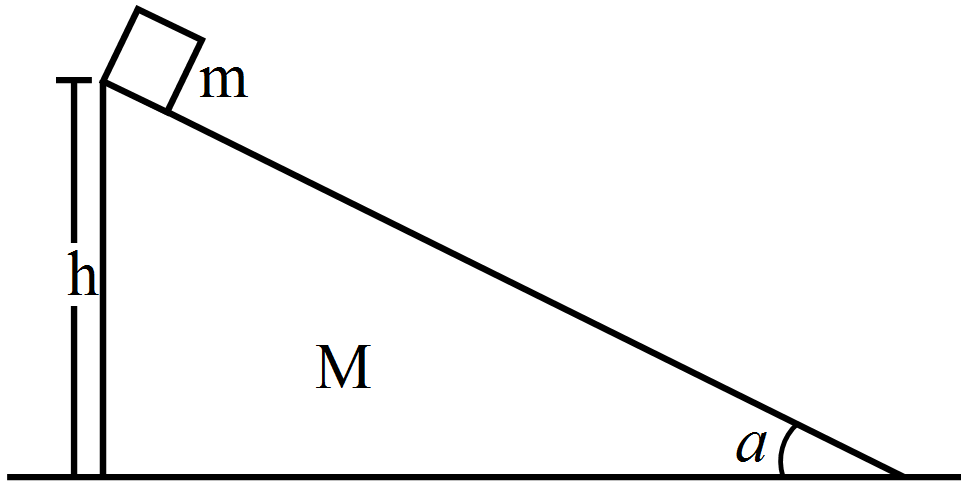
- 2View SolutionA block of mass m is placed on a triangular block of mass M, which in turn is placed on a horizontal surface as shown in figure. Assuming frictionless surfaces find the velocity of the triangular block when the smaller block reaches the bottom end.
- 3The oxygen molecule has a mass of $5.30 \times 10^{-26}kg$ and a moment of inertia of $1.94 \times 10^{-46}kgm^2$ about an axis through its centre perpendicular to the lines joining the two atoms. Suppose the mean speed of such a molecule in a gas is 500m/s and that its kinetic energy of rotation is two thirds of its kinetic energy of translation. Find the average angular velocity of the molecule.View Solution
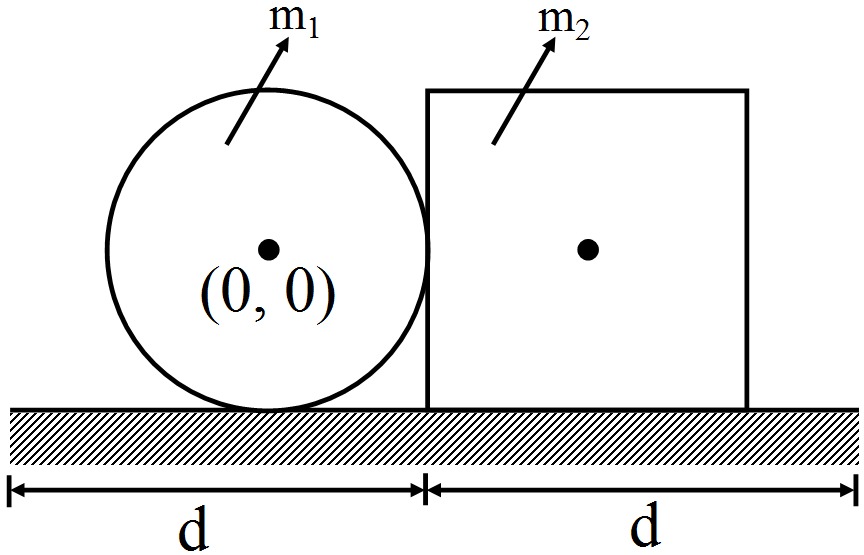
- 4View SolutionA square plate of edge d and a circular disc of diameter d are placed touching each other at the midpoint of an edge of the plate as shown in figure. Locate the centre of mass of the combination, assuming same mass per unit area for the two plates.
- 5Prove the result that the velocity v of translation of a rolling body (like a ring, disc, cylinder or sphere) at the bottom of an inclined plane of a height h is given by $\text{v}^2=\frac{2\text{gh}}{\Big(\frac{1+\text{k}^2}{\text{R}^2}\Big)}$ using dynamical consideration (i.e. by consideration of forces and torques).View Solution
Note: k is the radius of gyration of the body about its symmetry axis, and R is the radius of the body. The body starts from rest at the top of the plane. - 6View SolutionThree particles of masses 1.0kg, 2.0kg and 3.0kg are placed at the corners A, B and C respectively of an equilateral triangle ABC of edge 1m. Locate the centre of mass of the system.
- 7A car weighs $1800kg$. The distance between its front and back axles is $1.8m$. Its centre of gravity is $1.05m$ behind the front axle. Determine the force exerted by the level ground on each front wheel and each back wheel.View Solution
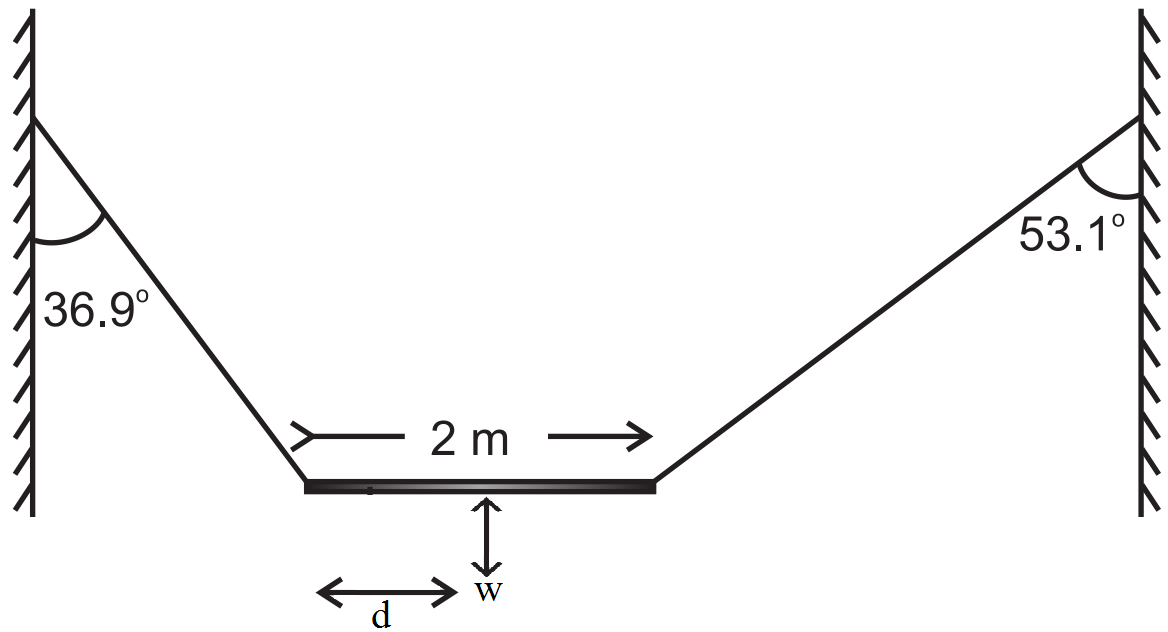
- 8A non-uniform bar of weight W is suspended at rest by two strings of negligible weight as shown in. The angles made by the strings with the vertical are $36.9°$ and $53.1°$ respectively. The bar is $2m$ long. Calculate the distance d of the centre of gravity of the bar from its left end.View Solution
- 93 A man stands on a rotating platform, with his arms stretched horizontally holding a 5kg weight in each hand. The angular speed of the platform is 30 revolutions per minute. The man then brings his arms close to his body with the distance of each weight from the axis changing from 90cm to 20cm. The moment of inertia of the man together with the platform may be taken to be constant and equal to $7.6kgm^2$.View Solution
- What is his new angular speed? (Neglect friction).
- Is kinetic energy conserved in the process? If not, from where does the change come about?
- 10A $2kg$ body and a $3kg$ body are moving along the x-axis. At a particular instant, the $2kg$ body is $1m$ from the origin and has a velocity of $3ms^{-1}$ and the $3kg$ body is $2m$ from the origin and has velocity of $-1 ms^{-1}$. Find the position and velocity of the centre of mass and also find the total momentum.View Solution