Question
$\Delta U + \Delta W = 0$ is valid for

Answer

(a) In adiabatic process $\Delta Q = 0 $ ==> $\Delta U + \Delta W = 0$

$(\because \,\Delta Q = \Delta U + \Delta W)$

Need a full question paper?

Generate a complete, print-ready paper with questions like this in minutes — across 16+ boards, with answer keys.
Start Generating Free

Similar questions

Density of substance at $0°C$ is $10\, gm/cc$ and at $100°C,$ its density is $9.7\, gm/cc$. The coefficient of linear expansion of the substance will be
A kettle with $2\, littre$ water at $27\,^oC$ is heated by operating coil heater of power $1\, kW$. The heat is lost to the atmosphere at constant rate $160\, J/sec$, when its lid is open. In how much time will water heated to $77\,^oC$. (specific heat of water $= 4.2\, kJ/kg$) with the lid open ?
Which of the following react with $NaHS{O_3}$
Oxygen boils at $-183°C.$ This temperature is approximately ....... $^oF$
Consider two solid spheres $\mathrm{P}$ and $\mathrm{Q}$ each of density $8 \mathrm{gm} \mathrm{cm}^{-3}$ and diameters $1 \mathrm{~cm}$ and $0.5 \mathrm{~cm}$, respectively. Sphere $\mathrm{P}$ is dropped into a liquid of density $0.8 \mathrm{gm} \mathrm{cm}^{-3}$ and viscosity $\eta=3$ poiseulles. Sphere $Q$ is dropped into a liquid of density $1.6 \mathrm{gm} \mathrm{cm}^{-3}$ and viscosity $\eta=2$ poiseulles. The ratio of the terminal velocities of $\mathrm{P}$ and $\mathrm{Q}$ is 
In the disintegration series the $_{92}^{238}U\xrightarrow{\alpha }X\xrightarrow{{\beta  - }}_Z^AY$ values of $Z$ and $A$ respectively will be
Suppose an electron is attracted towards the origin by a force $\frac{k}{r}$ where $'k'$ is a constant and $'r'$' is the distance of the electron from the origin. By applying Bohr model to this system, the radius of the $n^{th}$ orbital of the electron is found to be $r_n$ and the kinetic energy of the electron to be $'K_n'$ Then which of the following is true?
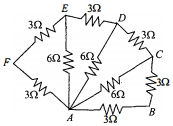
Six resistors of $3 \;\Omega$ each are connected along the sides of a hexagon and three resistors of $6\; \Omega$ each are connected along $A C, A D$ and $A E$ as shown in the figure. The equivalent resistance between $A$ and $B$ is equal to
A capacitor of capacitance $C$  is initially charged to a potential difference of $V$ $volt$. Now it is connected to a battery of $2V$ with opposite polarity. The ratio of heat generated to the final energy stored in the capacitor will be
If the refractive angles of two prisms made of crown glass are $10^o$ and $20^o$ respectively, then the ratio of their colour deviation powers will be