Find the maximum magnifying power of a compound Microscope having a 25 diopter lens as the objective, a 5 diopter lens as the eyepiece and the separation 30cm between the two lenses. The least distance for clear vision is 25cm.
Download our app for free and get started
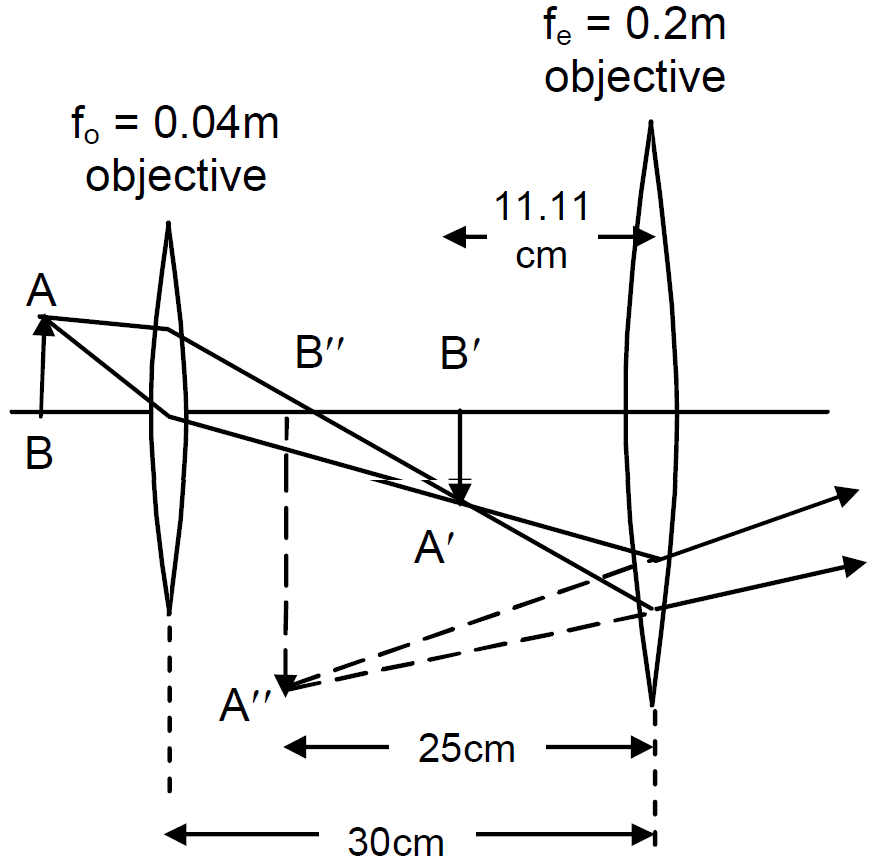
For the given compound microscope $\text{f}_0=\frac{1}{25\text{ diopter}}=0.04\text{m}=4\text{cm,}$ $\text{f}_\text{e}=\frac{1}{5\text{ diopter}}=0.2\text{m}=20\text{cm}$ D = 25cm,
separation between objective and eyepiece = 30cm
The magnifying power is maximuwm hen the image is formed by the eye piece at least distance of clear vision
i.e. D = 25cm for the eye piece, $v_e= -25cm, f_e = 20cm$
For lens formula, $\frac{1}{\text{v}_\text{e}}-\frac{1}{\text{u}_\text{e}}=\frac{1}{\text{f}_\text{e}}$
$\Rightarrow\frac{1}{\text{u}_\text{e}}=\frac{1}{\text{v}_\text{e}}-\frac{1}{\text{f}_\text{e}}$
$\Rightarrow\frac{1}{\text{u}_\text{e}}\frac{1}{-25}-\frac{1}{20} $
$\Rightarrow\text{u}_\text{e}=11.11\text{cm}$
So, for the objective lens, the image distance should be
$v_0 = 30 - (11.11) = 18.89$cm Now, for the objective lens,
$v_0 = +18.89$cm (because real image is produced) $f_0 = 4cm$
So, $\frac{1}{\text{u}_\text{o}}=\frac{1}{\text{v}_\text{o}}-\frac{1}{\text{f}_\text{o}}\Rightarrow \frac{1}{18.89}-\frac{1}{4}\\=0.053-0.25=-0.197$
$\Rightarrow\text{u}_\text{o}=-5.07\text{cm}$
So, the maximum magnificent power is given by
$\text{m}=-\frac{\text{v}_\text{o}}{\text{u}_\text{o}}\Big[1+\frac{\text{D}}{\text{f}_\text{e}}\Big]=\frac{18.89}{-5.07}\Big[1+\frac{25}{20}\Big]$$=3.7225\times2.25=8.376$
separation between objective and eyepiece = 30cm
The magnifying power is maximuwm hen the image is formed by the eye piece at least distance of clear vision
i.e. D = 25cm for the eye piece, $v_e= -25cm, f_e = 20cm$
For lens formula, $\frac{1}{\text{v}_\text{e}}-\frac{1}{\text{u}_\text{e}}=\frac{1}{\text{f}_\text{e}}$
$\Rightarrow\frac{1}{\text{u}_\text{e}}=\frac{1}{\text{v}_\text{e}}-\frac{1}{\text{f}_\text{e}}$
$\Rightarrow\frac{1}{\text{u}_\text{e}}\frac{1}{-25}-\frac{1}{20} $
$\Rightarrow\text{u}_\text{e}=11.11\text{cm}$
So, for the objective lens, the image distance should be
$v_0 = 30 - (11.11) = 18.89$cm Now, for the objective lens,
$v_0 = +18.89$cm (because real image is produced) $f_0 = 4cm$
So, $\frac{1}{\text{u}_\text{o}}=\frac{1}{\text{v}_\text{o}}-\frac{1}{\text{f}_\text{o}}\Rightarrow \frac{1}{18.89}-\frac{1}{4}\\=0.053-0.25=-0.197$
$\Rightarrow\text{u}_\text{o}=-5.07\text{cm}$
So, the maximum magnificent power is given by
$\text{m}=-\frac{\text{v}_\text{o}}{\text{u}_\text{o}}\Big[1+\frac{\text{D}}{\text{f}_\text{e}}\Big]=\frac{18.89}{-5.07}\Big[1+\frac{25}{20}\Big]$$=3.7225\times2.25=8.376$

Download our appand get started for free
Experience the future of education. Simply download our apps or reach out to us for more information. Let's shape the future of learning together!No signup needed.*
Similar Questions
- 1View Solution
- State Huygen’s principle. Using this principle draw a diagram to show how a plane wave front incident at the interface of the two media gets refracted when it propagates from a rarer to a denser medium. Hence verifiy Snell’s law of refraction.
- When monochromatic light travels from a rarer to a denser medium, explain the following, giving reasons:
- Is the frequency of reflected and refracted light same as the frequency of incident light?
- Does the decrease in speed imply a reduction in the energy carried by light wave?
- 2View Solution
- An object is placed in front of a concave mirror. It is observed that a virtual image is formed. Draw the ray diagram to show the image formation and hence derive the mirror equation $\frac{1}{\text{f}}=\frac{1}{\text{u}}+\frac{1}{\text{v}}.$
- An object is placed 30cm in front of a plano-convex lens with its spherical surface of radius of curvature 20cm. If the refractive index of the material of the lens is 1.5, find the position and nature of the image formed.
- 3With the help of a ray diagram, show the formation of image of a point object due to refraction of light at a spherical surface separating two media of refractive indices $n_1$ and $n_2 (n_2 > n_1)$ respectively. Using this diagram, derive the relation.View Solution
$\frac{\text{n}_2}{\text{v}}-\frac{\text{n}_1}{\text{u}}=\frac{\text{n}_1-\text{n}_2}{\text{R}}$
Write the sign conventions used. What happens to the focal length of convex lens when it is immersed in water? - 4View SolutionA convex lens has a focal length of 10cm. Find the location and nature of the image if a point object is placed on the principal axis at a distance of:
- 9.8cm
- 10.2cm from the lens.
- 5View SolutionA gun of mass M fires a bullet of mass m with a horizontal speed V. The gun is fitted with a concave mirror of focal length f facing tpwards the receding bullet. Find the speed of separation of the bullet and the image just after the gun was fired.
- 6View SolutionWill the focal length of a lens for red light be more, same or less than that for blue light?
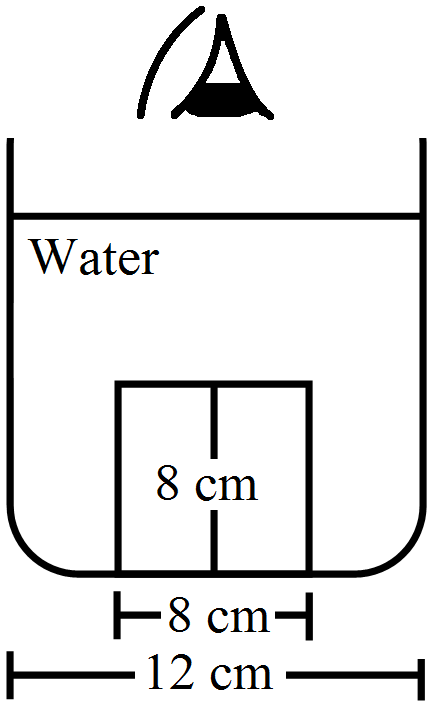
- 7A cylindrical vessel of diameter 12cm contains $800\pi\text{cm}^3$ of water. A cylindrical glass piece of diameter 8.0 cm and height 8.0cm is placed in the vessel. If the bottom of the vessel under the glass piece is seen by the paraxial rays, locate its image. The index of refraction of glass is 1.50 and that of water is 1.33.View Solution
- 8View SolutionA converging lens of focal length 15cm and a converging mirror of focal length 10cm are placed 50cm apart. If a pin of length 2.0cm is placed 30cm from the lens farther away from the mirror, where will the final image form and what will be the size of the final image?
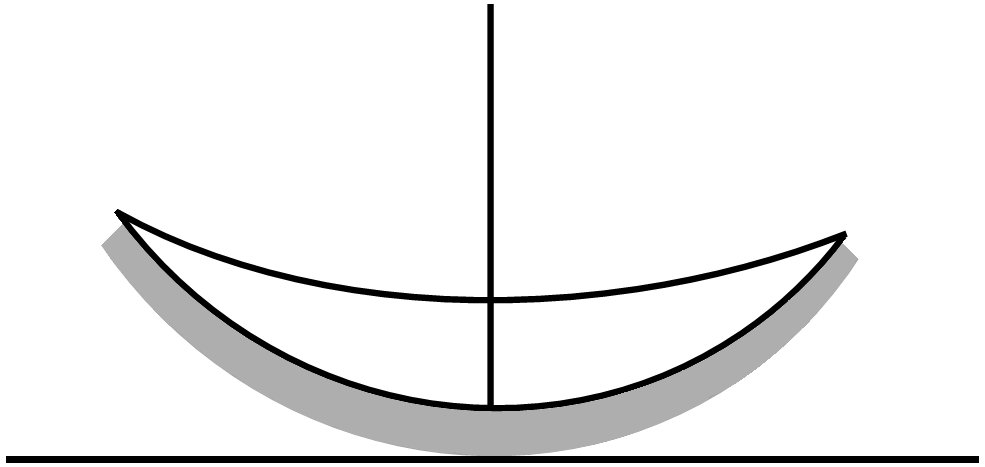
- 9The convex surface of a thin concavo-convex lens of glass of refractive index 1.5 has a radius of curvature 20cm. The concave surface has a radius of curvature 60cm. The convex side is silvered and placed on a horizontal surface as shown in figure.View Solution
- Where should a pin be placed on the axis so that its image is formed at the same place?
- If the concave part is filled with water $\Big(\mu=\frac{4}{3}\Big),$ find the distance through which the pin should be moved so that the image of the pin again coincides with the pin.
- 10View SolutionA particle executes a simple harmonic motion of amplitude 1.0cm along the principal axis of a convex lens of focal length 12cm. The mean position of oscillation is at 20cm from the lens. Find the amplitude of oscillation of the image of the particle.