Question
Describe the working of Carnot engine. Obtain an expression for its efficiency.

Answer

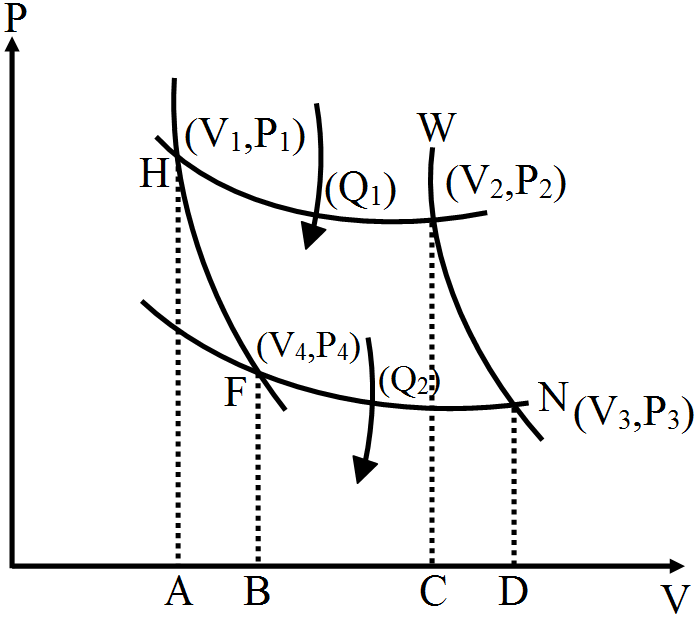
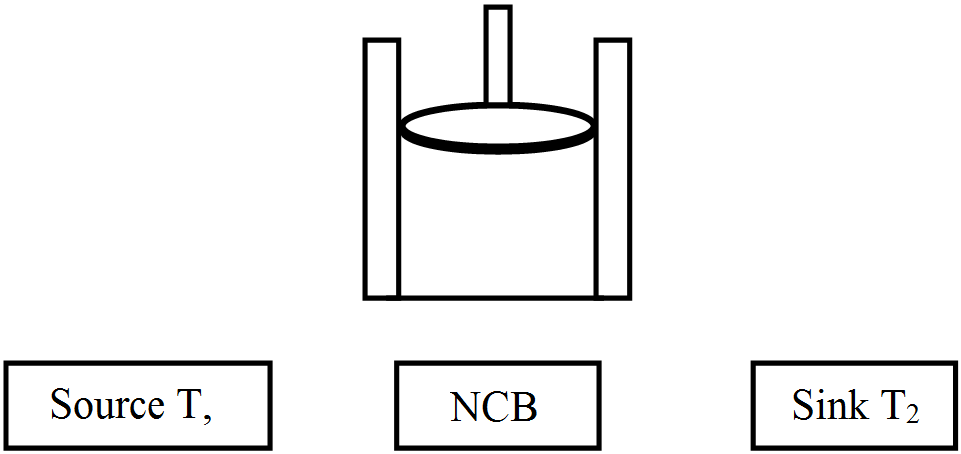
Carnot used a set of four devices—a source at a high temperature (say $T_1$), a sink at a low temperature (say $T_2$), a non-conducting base and a cylinder with a working substance, frictionless piston made of conducting base and non-conducting walls and piston. He carried the system through a step of four processes to complete a cycle as shown here. Process I-HW is an isothermal expansion. $Q_1$ energy flows in and temperature is maintained at $T_1$ by placing the cylinder over the source.

Process II-WN is an adiabatic processes at a temperature flow from $T_1$ to $T_2$ conducted with cylinder over (NCB = Non conducting base). Process III-NF is an isothermal process at $T_2$ which gives out an energy $Q_2$ with cylinder over sink Process IV-FH is an adiabatic process which changes the temperature from $T_2$ to $T_1$ conducted with the cylinder placed over (NCB = Non conducting base).

 In the process, a net work equalling the area HWNFH is done with the net heat intake, $Q_1 - Q_2$ So, Efficiency $=\frac{\text{Work done}}{\text{heat supplied}}$ $=\frac{\text{Q}_1-\text{Q}_2}{\text{Q}_1}=1-\frac{\text{Q}_2}{\text{Q}_1}=1-\frac{\text{T}_2}{\text{T}_1}$

Need a full question paper?

Generate a complete, print-ready paper with questions like this in minutes — across 16+ boards, with answer keys.
Start Generating Free

Similar questions

Do permeability and relative permeability have the same dimensions?
  1. What is beat phenomenon?
  2.  


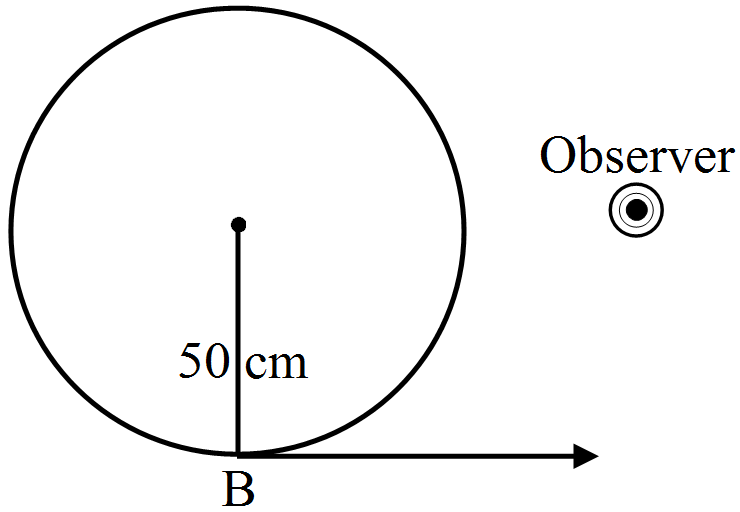
A whistle revolve in a circle with angular velocity of o =$20 rad s^{-1}$. If the frequency of the sound is $385Hz$ and speed is $340ms^{-1}$, than find the frequency heard by the observer when the whistle is at B.
Define velocity and acceleration. Draw a velocity time graph for uniformly accelerated motion and prove that the area between the curve of this graph and the time axis is equal to the displacement of the moving object
For the harmonic travelling wave $\text{y}=2\cos2\pi(10\text{t}-0.0080\text{x}+3.5)$ where x and y are in cm and t is second. What is the phase difference between the oscillatory motion at two points separated by a distance of:
What is the phase difference between the oscillation of a particle located at x = 100cm at t = T and t = 5s?
A body is projected at an angle o upward with the horizontal:
  1. Obtain the condition for maximum horizontal range.
  2. Prove that horizontal range of projectile is same when fired at an angle $\theta$ and $(90^\circ-\theta)$ with the horizontal.
  3. Obtain an expression for velocity of projectile at any instant t.
In a Young's double slit interference experiment the fringe pattern is observed on a screen placed at a distance D from the slits. The slits are separated by a distance d and are illuminated by monochromatic light of wavelength $\lambda$. Find the distance from the central point where the intensity falls to,
  1. Half the maximum.
  2. One fourth of the maximum.
A slightly tapering wire of length I and end radii a and b on both sides is subjected to the stretching forces F on both sides as shown in figure. If Y is the Young's modulus of the wire, calculate the extension produced in the wire.
A satellite orbits the earth at a height of 400 km above the surface. How much energy must be expended to rocket the satellite out of the earth's gravitational influence? Mass of the satellite $=200 \mathrm{~kg}$; mass of the earth $=6.0 \times$ $10^{24} \mathrm{~kg}$; radius of the earth $=6.4 \times 10^6 \mathrm{~m} ; \mathrm{G}=6.67 \times 10^{-11} \mathrm{~N} \mathrm{~m}^2 \mathrm{~kg}^{-2}$.
Consider a non-conducting plate of radius r and mass m that has a charge q distributed uniformly over it. The plate is rotated about its axis with an angular speed $\omega.$ Show that the magnetic moment $\mu$ and the angular momentum of the plate are related as $\mu=\frac{\text{q}}{2\text{m}}\text{l}.$
The electric field associated with a light wave is given by $\text{E}=\text{E}_0\sin[(1.57\times10^7\text{m}^{-1})(\text{x}-{\text{ct}})].$ Find the stopping potential when this light is used in an experiment on photoelectric effect with the emitter having work function 1.9eV.